In this article

TypeSafe’s Jev made decision models popular. Instead of writing out an answer, a decision model reads your input once and returns a probability for each allowed answer, so it’s fast and cheap for jobs like routing support tickets. Two months after Jev launched, there are plenty of good open source alternatives, and some of them now score higher than Jev itself.
Below are the seven worth trying, ranked by their Decision Index 0.4.1 score, with the Artificial Analysis Decision Index v2 score where there is one. The leader, Karpo Decision 31B, scores 73.86 against 60.24 for Jev 1.14. I checked every number on November 18, 2026, and teh rankings shift weekly, so check again before you commit.
Summary
Open weights now beat Jev on accuracy. They still lose on hardware.
- Karpo Decision 31B (Apache-2.0) is first on the Decision Index at 73.86, with a 94 ms median on one RTX PRO 6000. It needs 62.5 GB for the weights alone.
- GLiDE 27B is second at 73.37 and scores 73 on Artificial Analysis, but its license needs a commercial agreement above $10M in annual revenue.
- vLLM-SR d3-ultra (Apache-2.0, 70.18) is the pick for images, video and 131k-token documents. Its 9B sibling d3-flash has 101,936 downloads.
- Mammoth-1 (MIT) scores 71 on Artificial Analysis and gives the same answer to reworded questions 99% of the time. The 9B Elephant-1 ties Jev there at 66.
- pplx-decider v1.3 (Apache-2.0) is free on OpenRouter, so you can test it on your traffic before buying a GPU.
- Kev 27B lands level with Jev (59.56) and runs TypeSafe’s own SDK unchanged.
- Laya has 35,664 GitHub stars, the most in the field by a wide margin, and ranks 294th of 308. It runs on a CPU; fine-tune it or skip it.
Open models kept Jev’s API and caught up on accuracy
Jev is what TypeSafe calls a System One model. You send it some state (a support ticket, a chat transcript, a JSON blob) plus a set of questions, each with a declared answer type: a choice between up to 255 options, a score on an ordered scale, or a noul yes/no probability. It returns a probability for every allowed answer in a single pass, without generating any tokens. TypeSafe documents this interface publicly in its API docs, but the model and its training data are not public.
Because the API is public, the first open clones showed up within a day of Jev’s September 15 launch (AINews counted six in two days). They copied the API much better than the accuracy, though: on jabr’s 49-task classifier benchmark, the best of them scored 0.704 against Jev’s 0.966. Most were light adaptations. SemIf, for example, reads option logits off a frozen Qwen3.5-4B, and others trained a LoRA on a small model or put a classification head on a frozen encoder.
The gap closed once bigger teams got involved. Perplexity, Baseten, Fastino, the vLLM Semantic Router team and a lot of smaller labs took 27B to 31B open models and fully fine-tuned them on millions of decision examples. Base Labs, for instance, trained Mammoth-1 on 6.21 million examples across 72 GB300 GPUs, with a Brier calibration term in the loss and an explicit “I don’t know” answer. Karpo puts a 255 x 5,376 linear readout on top of Gemma 4 31B, reads the state once, and gives each question its own branch, so one question never sees another question’s options.
Most of them also kept Jev’s API. Karpo, GLiDE, Kev, Laya and vLLM Semantic Router’s Engine mode all serve TypeSafe’s POST /v1/systemone endpoint, so an existing Jev client works once you change the base URL. pplx-decider is the exception, with its own Python decide() API.
The catch is hardware. Every open model that clearly beats Jev needs 50 to 63 GB for its bf16 weights, which means an 80 GB-class GPU. The smallest models that match Jev are 9B: GLiDE 9B (62.48), Jeffan-9B (61.48) and Elephant-1 (60.26), at roughly 16 to 19 GB of weights. Nothing open under 5B matches Jev yet. The best of them, PelaAI’s KnowLine 4B Gen5.5 and Perplexity’s Decider Flash v1.3, score around 55.
Comparison table
| Model | License | Size and base | Decision Index 0.4.1 (of 308) | Artificial Analysis v2 (of 25) | bf16 weights |
|---|---|---|---|---|---|
| Karpo Decision 31B | Apache-2.0 | 31B, Gemma 4 31B | 73.86 (1st) | Not listed | 62.5 GB |
| GLiDE 27B | Fastino Community ($10M revenue cap) | 27B, Qwen3.8-27B | 73.37 (2nd) | 73 (4th, hosted v1.2) | 52.2 GB |
| vLLM-SR d3-ultra | Apache-2.0 | 26B, Qwen3.8-27B | 70.18 (14th) | Not listed | ~52 GB |
| Mammoth-1 / Elephant-1 | MIT | 27B / 9B, Qwen3.5 | 68.44 (22nd) / 60.26 (66th) | 71 (5th) / 66 (13th) | ~55 GB / ~19 GB |
| pplx-decider v1.3 | Apache-2.0 | 27B, Qwen3.8-27B (Flash: 4B) | 67.67 (30th) | 70 (7th) | 54 GB |
| Kev 27B | Apache-2.0 | 27B, Qwen3.8-27B | 59.56 (74th) | Not listed | 51.3 GB |
| Laya | Apache-2.0 | 421M, ModernBERT-large | 9.21 (294th) | Not listed | Runs on CPU |
| TypeSafe Jev 1.14 (reference) | Closed, hosted | Not disclosed | 60.24 (67th) | 66 (14th) | - |
Sizes marked ~ are estimates (parameter count times two bytes). The rest come from each model card or the Hub.
Decision Index, Artificial Analysis and OpenRouter measure different things
Decision Index 0.4.1 is the community leaderboard on Hugging Face. It’s maintained by multimodalart, and every entry runs on a single RTX PRO 6000. Since version 0.4, the Full score comes entirely from private tests: 60% check the same skills as the public suite, and 40% use tasks from new domains. The 37 public benchmarks still appear on the page but no longer count, and any test rows a model was trained on are marked wrong. With 308 entries, almost all of them open fine-tunes, it’s the best overview of the open models. Of the 66 entries above Jev, 65 have weights you can download.
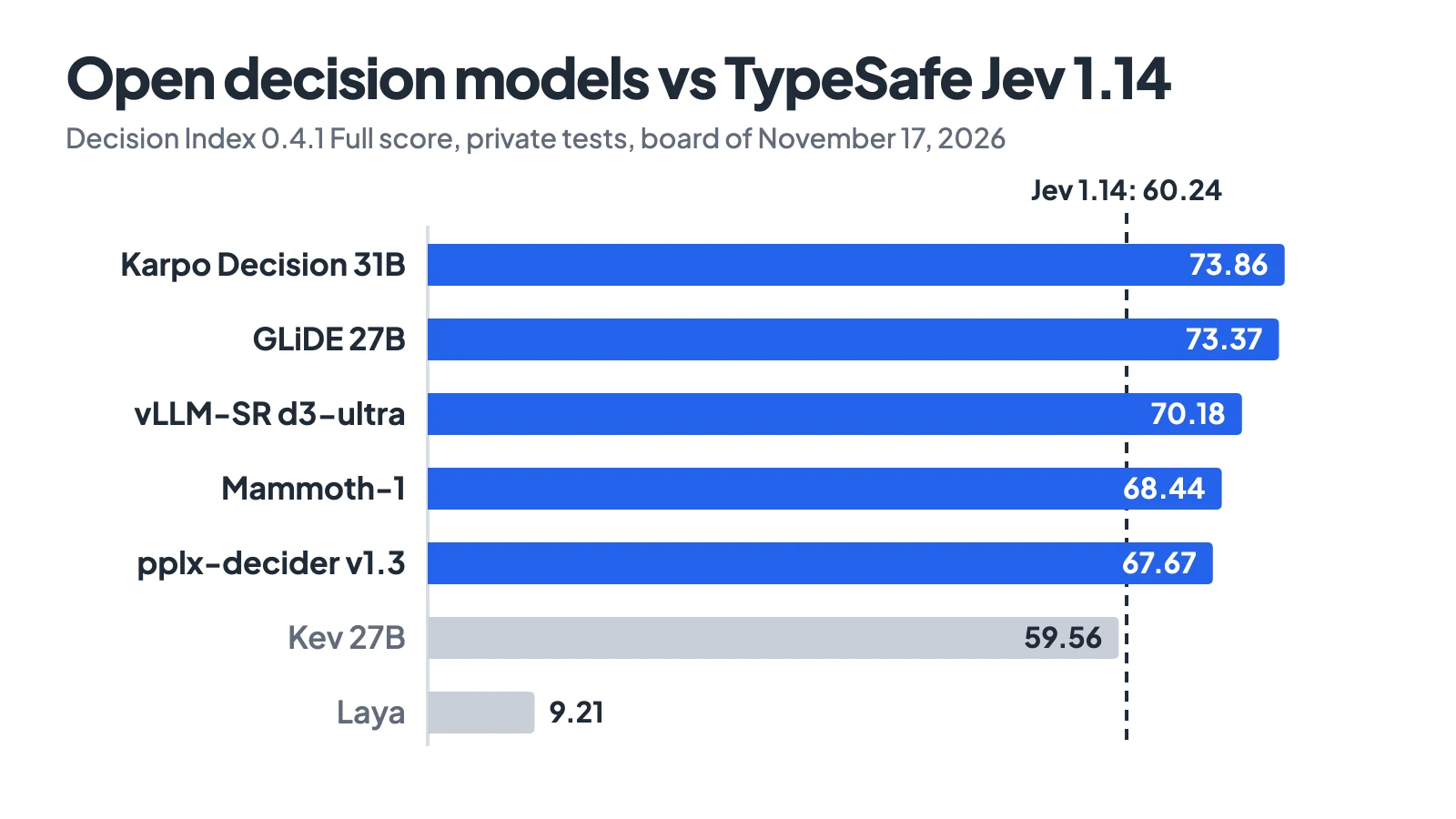
Data: Decision Index 0.4.1, board of November 17, 2026.
Artificial Analysis Decision Index v2 came out on November 8 and covers 25 decision models, plus a few chat models for comparison. 45% of its test data is now private. Its headline Decision Score is 50 x (1 + accuracy - Brier score), which punishes a confident wrong answer more than an unsure one. Liquid’s hosted d1.2-ultra leads the decision models at 75, followed by Nace.AI’s Drex Max v1.1 and Fastino’s GLiDE v1.2 at 73, Mammoth at 71 and Decider v1.3 at 70. Jev 1.14 scores 66, the same as Elephant. Chat models still score higher, with Claude Haiku 5.5 (Max) at 77, but they take 32.65 seconds per task against 92 ms for Jev.
OpenRouter’s decision rankings measure usage, not quality, and most of that usage still goes to Jev. In the week up to November 17, Jev 1.13 served 950M requests and Jev 1.14 served 614M, while the most-used open-weight model, Perplexity’s Decider v1.2, served 268M. In the week starting November 9, TypeSafe handled 68.5% of all decision requests on OpenRouter.
The two quality boards don’t always agree. Elephant-1 is 13th of 25 on Artificial Analysis but 66th of 308 on the Decision Index, and d3-ultra and Karpo aren’t on Artificial Analysis at all. The top of the Decision Index also changes quickly: Mammoth-1 launched on October 21 at #1 with 71.24 and is 22nd today.
1. Karpo Decision 31B: first on the Decision Index
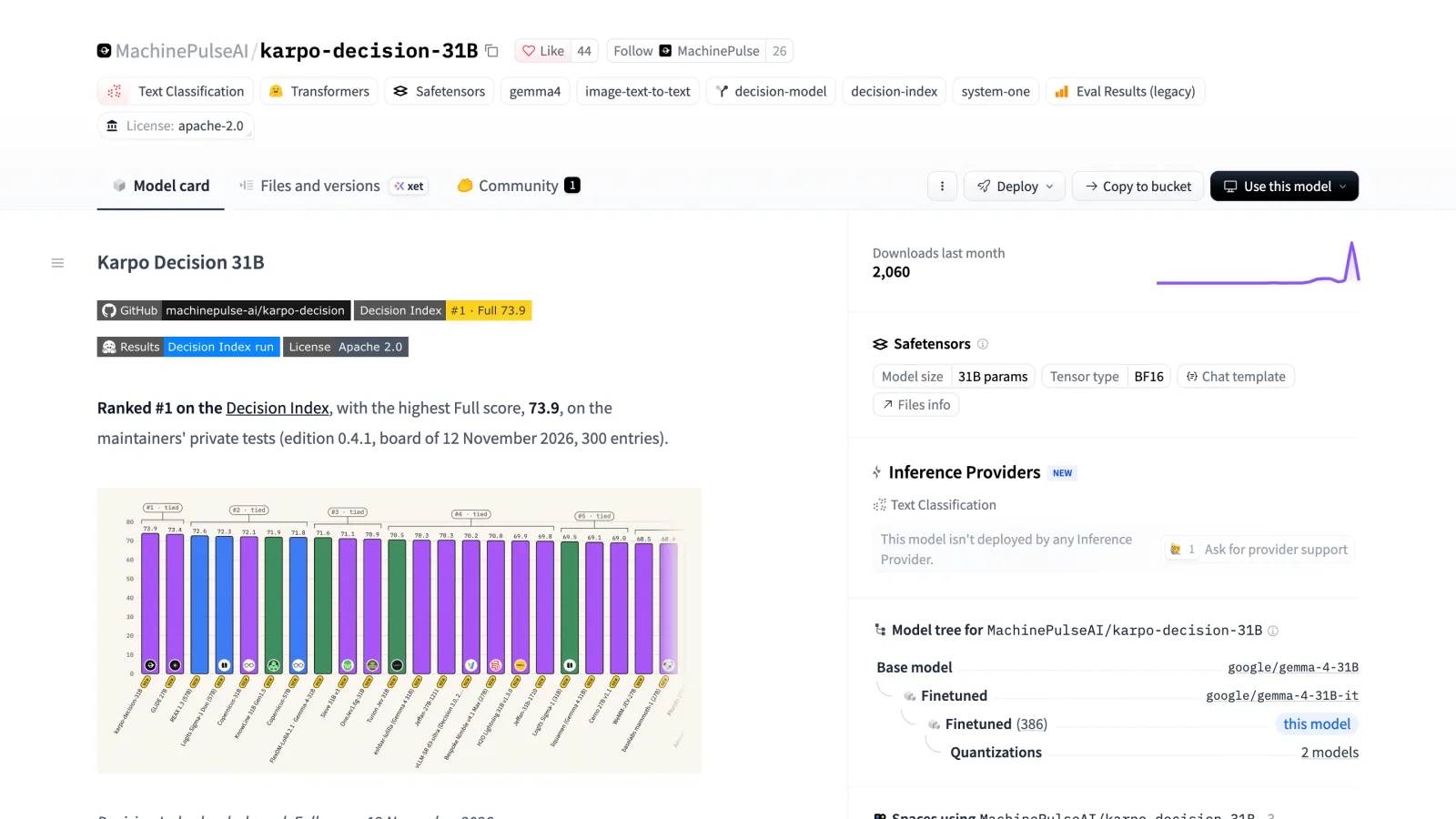
Screenshot: huggingface.co/MachinePulseAI/karpo-decision-31B, November 2026.
Karpo Decision is the newest model on this list and the one to beat right now. MachinePulse released the 31B on Hugging Face on November 5 under Apache-2.0. It’s Gemma 4 31B fine-tuned end to end, with the text generator replaced by a linear layer that scores 255 option codes. It reads text and images (a page screenshot works), handles 32,768 tokens per sequence, and splits longer requests by question instead of truncating them. It comes with a Python API and a POST /v1/systemone server.
Its 73.86 Full score splits into 70.7 on private tests of known skills and 78.6 on private tasks from new domains. The second number is the more interesting one, since it rewards a model that generalises instead of memorising. The board measured a 94 ms median per request and a calibration error of 4.8 points. GLiDE 27B is within the board’s 0.9-point tie band, so technically the two share first place.
Here’s the setup from the model card. I haven’t run it myself, since it needs a single GPU with room for 62.5 GB of weights:
pip install "karpo-decision @ git+https://github.com/machinepulse-ai/karpo-decision"
CKPT=$(python -c 'from huggingface_hub import snapshot_download; print(snapshot_download("MachinePulseAI/karpo-decision-31B"))')
torchrun --standalone --nproc_per_node 1 -m karpo_decision.serve.server --checkpoint "$CKPT" --port 18440
On November 12, MachinePulse added smaller versions: 12B on Gemma 4 12B, and 9B, 4B, 2B and 0.8B on Qwen3.5. None of them are on the board yet. Two caveats. The model is two weeks old, from a small company, with no technical report, and its card credits its design to three other entrants (FlexDM, jev-brain and Sieve-31B-v3). A lot of the top of this board is people remixing each other’s recipes. Also, loading it as a plain chat model won’t reproduce its answers, so use the package.
2. GLiDE 27B: second place, with a revenue cap
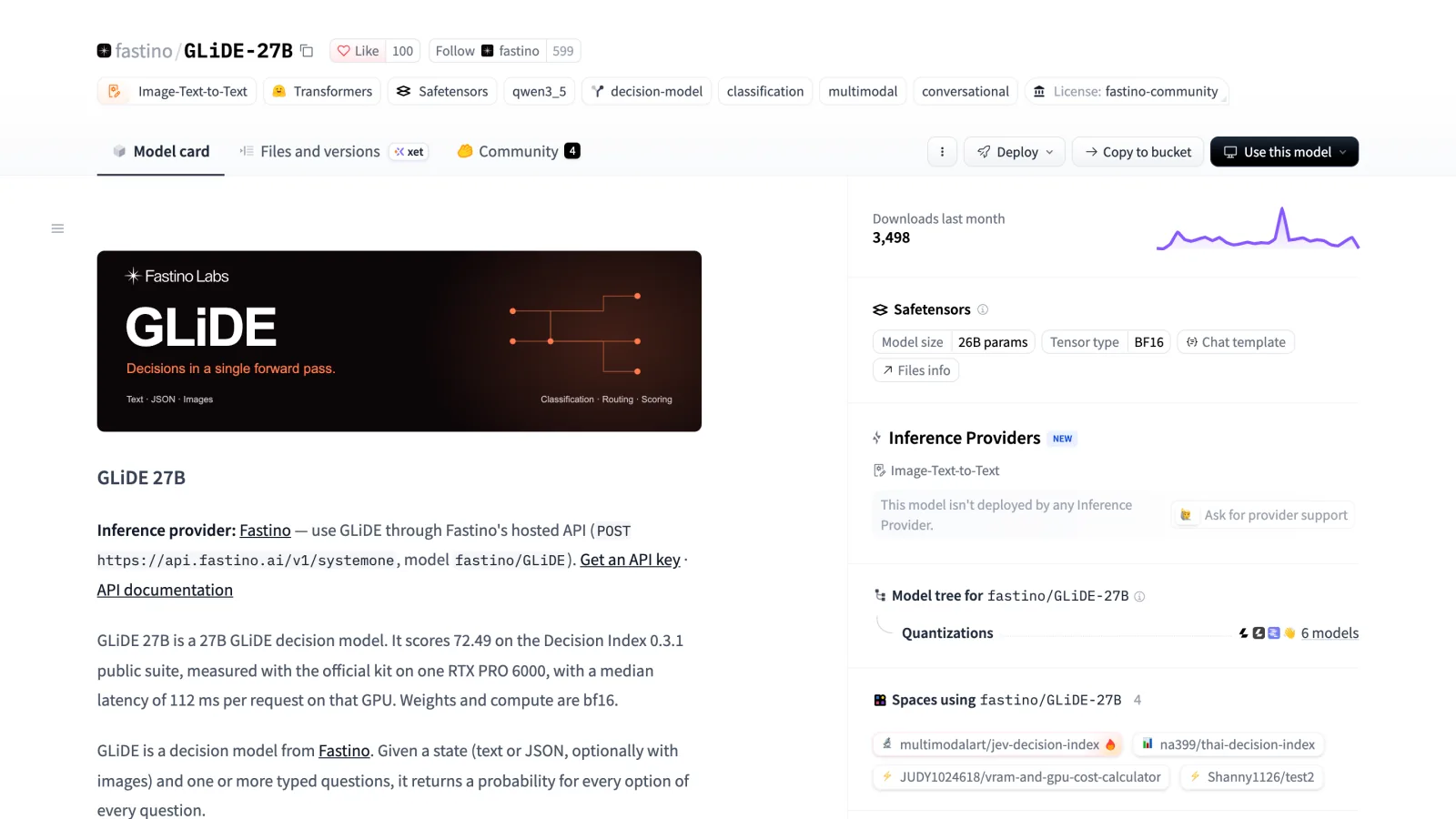
Screenshot: huggingface.co/fastino/GLiDE-27B, November 2026.
GLiDE comes from Fastino, the team behind the GLiNER2 extraction models, and ships in five sizes: a 27B built on Qwen3.8-27B, then 9B, 2B and 0.8B, plus a 0.4B built on a 400M Ettin encoder. The 27B is second on the Decision Index at 73.37. Fastino’s hosted GLiDE v1.2 scores 73 on Artificial Analysis, fourth of 25 and level with Drex Max, with slightly higher raw accuracy than Drex Max (60 against 58). GLiDE 9B, at 62.48, is the smallest open model on the board that beats Jev.
Self-hosting the 27B means 52.2 GB of bf16 weights on a GPU with at least 80 GB of memory. Fastino measured a 112 ms median on an RTX PRO 6000. It reads text, JSON and images, accepts 40,000 tokens per question by default, and its /v1/systemone server asks for a bearer token once you set GLIDE_API_KEY.
Read the Fastino Community License before you go further. You can use, modify and redistribute GLiDE for free, but a company with more than $10M in annual revenue needs a separate agreement with Fastino to run it in production commercially. Any commercial use also has to display “Built with Fastino GLiDE”, and both rules carry over to fine-tunes and quantizations. Evaluation and pilots of up to 90 days are exempt. So GLiDE is open weights, not open source. The hosted API isn’t cheap either: Artificial Analysis puts it at $780 per million tasks, because Fastino bills the input once per question instead of once per request.
3. vLLM-SR d3-ultra and d3-flash: images, video and long documents
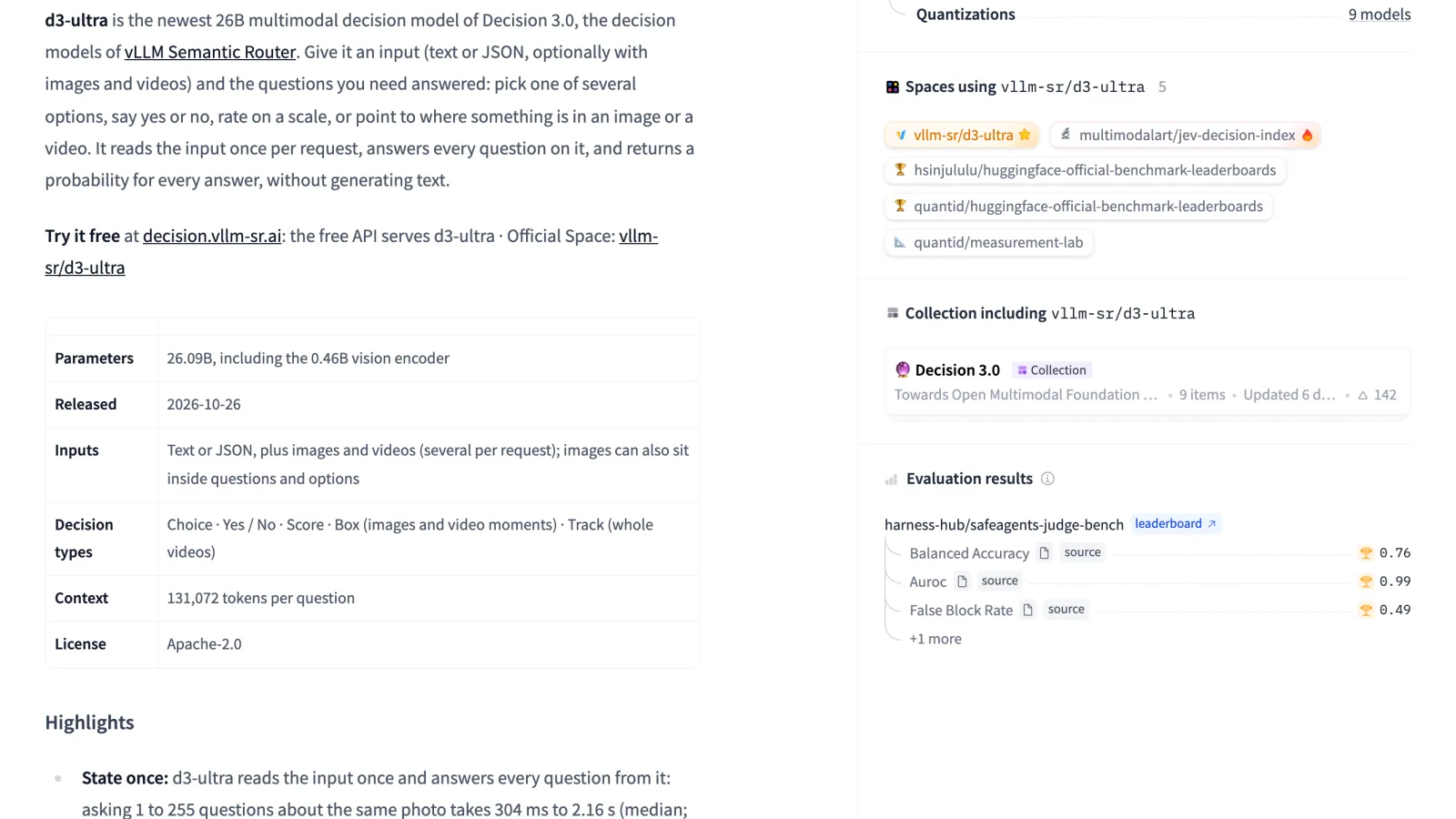
Screenshot: huggingface.co/vllm-sr/d3-ultra, November 2026.
Decision 3.0 is the decision model family from the vLLM Semantic Router project, and it handles inputs the others don’t. d3-ultra, released October 26 under Apache-2.0, has 26.09B parameters (including a 0.46B vision encoder) and takes up to 131,072 tokens per question. Besides choice, yes/no and score questions, it can answer Box (where is this in the image, or at this moment in the video) and Track (where is it across the whole clip), all from a single read of the input. On one AMD Instinct MI325X, one question about a photo took 304 ms and 255 questions took 2.16 s, so each extra question adds about 7.3 ms.
It scores 70.18 on the Decision Index, 14th of 308. The team’s own SR-Text test puts it at 87.2 against 73.1 for Jev 1.14, but that’s the vendor’s own benchmark, so take it with a grain of salt. If you want to try d3-ultra first, there’s a free hosted API at decision.vllm-sr.ai.
The 9B d3-flash is the more practical of the two. It has 101,936 downloads on the Hub, more than any other model in this post, and vLLM Semantic Router serves it natively with vllm-sr serve -e on CPU, CUDA or ROCm. On an MI325X it used 23.8 to 29.1 GiB of GPU memory and handled 95 requests per second with p99 latency under a second. It scores 54.27 on the Decision Index, well short of Jev, so use it for high-volume routing rather than hard calls. Engine mode is still on the development channel.
4. Mammoth-1 and Elephant-1: the most consistent answers
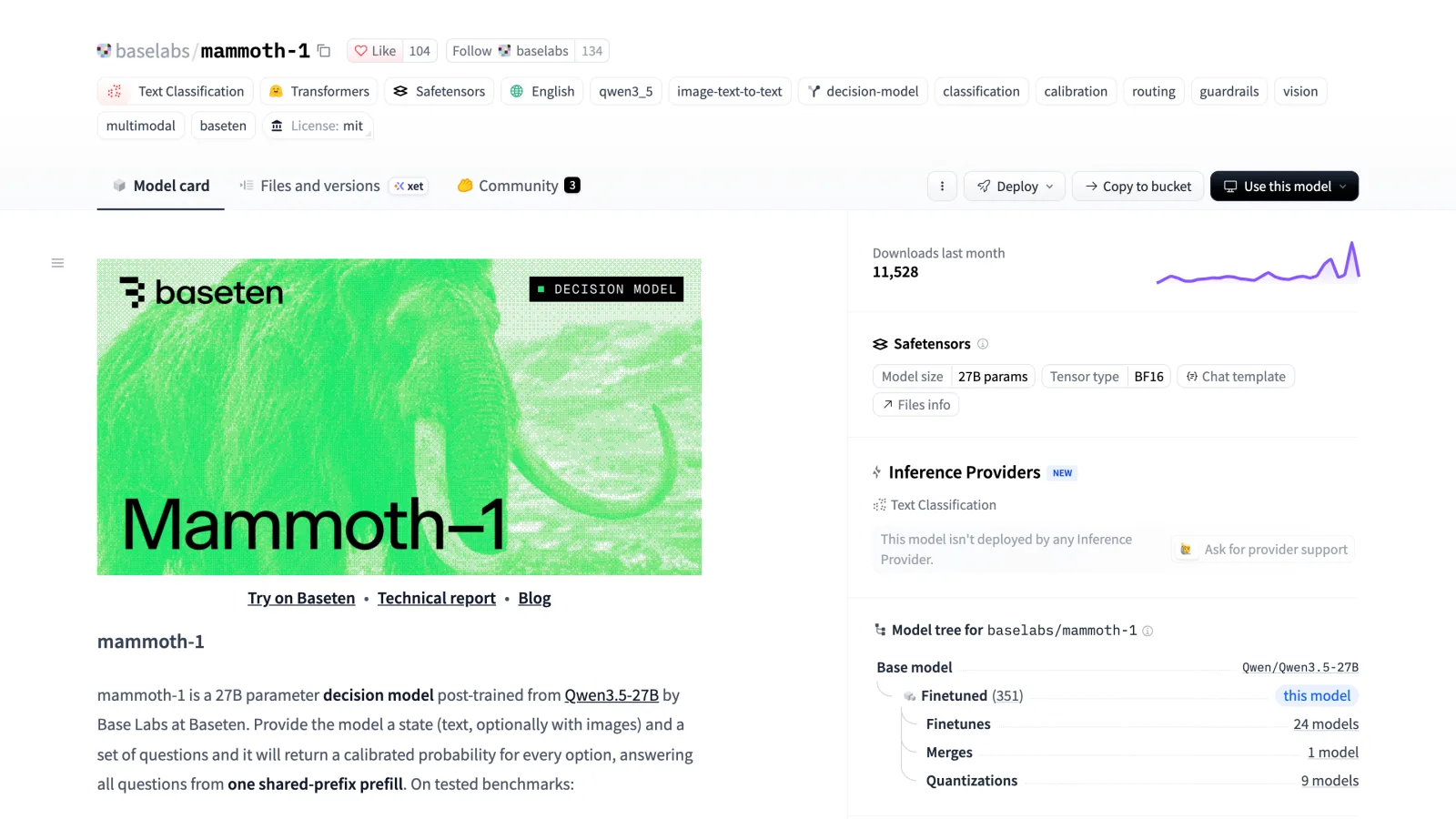
Screenshot: huggingface.co/baselabs/mammoth-1, November 2026.
Base Labs, the research arm of Baseten, released Mammoth-1 (27B) and Elephant-1 (9B) on October 21 under MIT, the most permissive license on this list. Both are fully post-trained versions of Qwen3.5 at the same sizes. They read text and images and accept up to 16,384 tokens.
They stand out on Artificial Analysis. Mammoth scores 71, fifth of 25 and five points ahead of Jev 1.14, at 106 ms per task. Elephant scores 66, the same as Jev, at 79 ms, which makes it the second-fastest decision model on that board. On AA-Symmetry, which asks the same question in several ways, Mammoth gives the same answer 99% of the time, against 91% for Drex Max, 88% for GLiDE and 67% for Cloudflare’s Clef. Part of that comes from abstaining: it was trained with an explicit “I don’t know” option, and it uses it.
Both have slipped on the Decision Index since launch. Mammoth is now 22nd at 68.44 and Elephant 66th at 60.26, just above Jev. To self-host, setup.sh installs a pinned OneJev runtime on a single CUDA GPU, and Baseten also hosts Mammoth at $0.10 per million input tokens. Pick these when consistent answers, and an honest “I don’t know”, matter more than the last point of accuracy, or when your legal team only signs off on MIT.
5. pplx-decider v1.3: try it free, then self-host the same weights
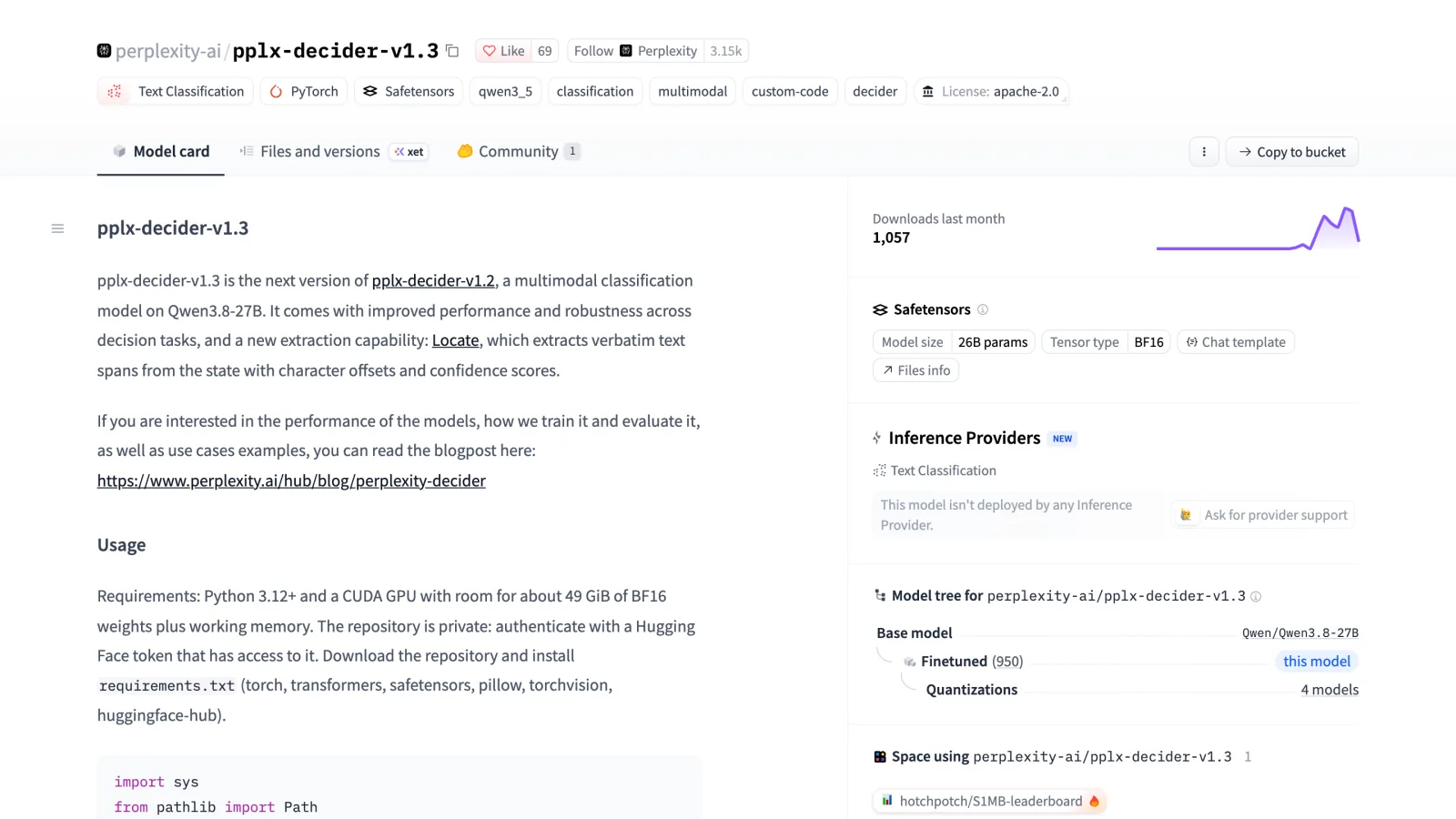
Screenshot: huggingface.co/perplexity-ai/pplx-decider-v1.3, November 2026.
Perplexity released v1.3 on Hugging Face on November 9, again under Apache-2.0, in two sizes: a 27B fine-tune of Qwen3.8-27B and a 4B Flash model on Qwen3.5-4B. v1.3 scores 70 on Artificial Analysis, seventh of 25, and at $68 per million tasks it’s one of the cheapest models there. On the Decision Index it scores 67.67, slightly below v1.2’s 67.98, so don’t upgrade expecting better results on general tasks.
The new feature in v1.3 is Locate. Ask "person": {"type": "locate", "instructions": "The person who signed the contract"} and you get the exact text spans back, with character offsets and a score, in the same request as your other decisions. It only works on text input, with up to 128 questions. v1.3 also expects its own prompt format, which the pplx_decider package builds for you. Feed it v1.2-style prompts and you’ll get different answers.
pplx-decider is the easiest open model to evaluate, because you don’t need a GPU to try it. Decider V1.3 is free on OpenRouter, where it served 58.1M requests in the week to November 17, and Perplexity’s own API charges $0.02 per million input tokens. Run your labelled data through the hosted version, and if the results hold up, download the same weights: 54 GB of safetensors, on a CUDA GPU with room for about 49 GiB in BF16 plus working memory. The card’s fast=True option packs sequences and compiles the decoder, which makes it about 1.7 to 1.9 times faster in the default mode.
6. Kev: level with Jev, and it speaks Jev’s API
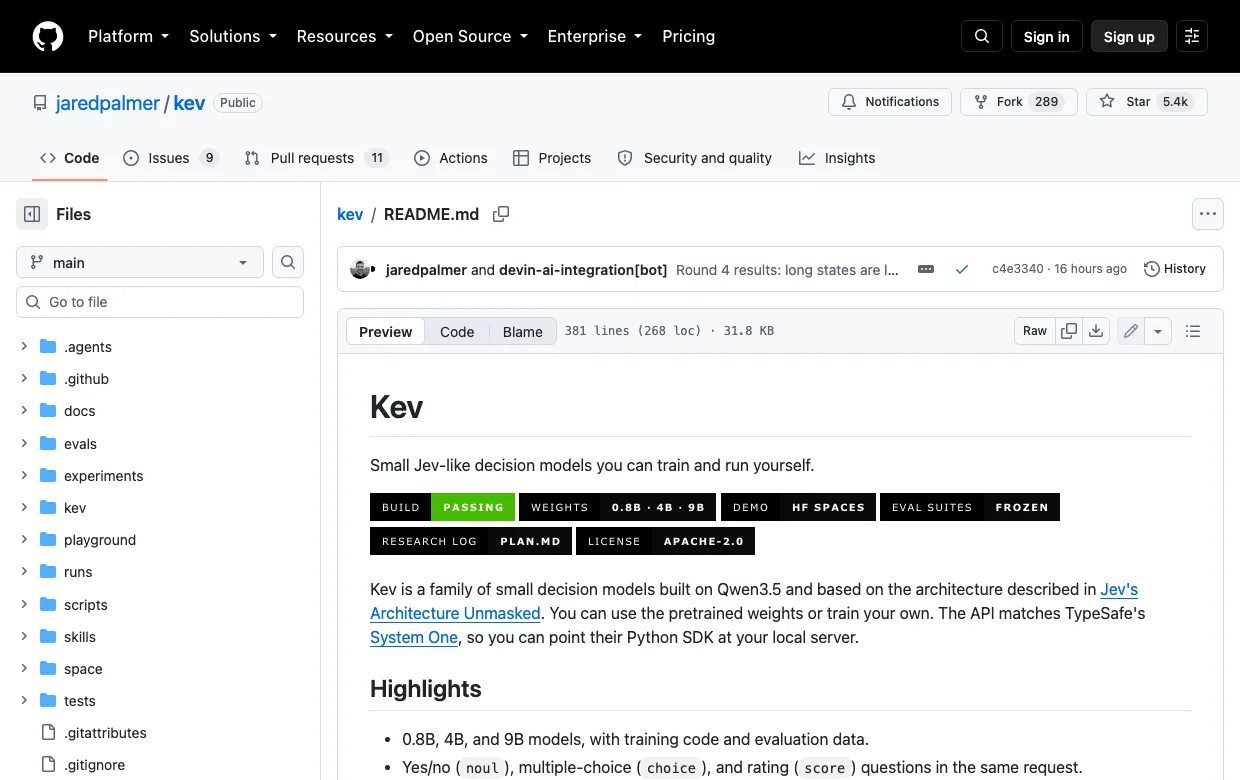
Screenshot: github.com/jaredpalmer/kev, November 2026.
Kev, from Jared Palmer, has 10,047 GitHub stars and the most careful evaluation write-ups of any open project here. Its top model is now Kev-27B v2, a full fine-tune of Qwen3.8-27B with its weights averaged with the earlier LoRA version. It scores 59.56 on the Decision Index, 0.68 behind Jev 1.14 and ahead of Jev 1.13. Kev’s own 14-dataset comparison puts it at 52.3 against Jev’s 54.0, with overlapping confidence intervals, so the two are about the same. Training removed 6,388 records that matched evaluation sets, and no Jev outputs went into the training data.
Kev’s main selling point is still the API. It serves TypeSafe’s POST /v1/systemone endpoint, so the official typesafe-sdk works once you change the base URL. Here’s the server and a request, running the small 0.8B model on an Apple M3 Pro:
git clone https://github.com/jaredpalmer/kev.git && cd kev
uv sync --extra serve
KEV_DTYPE=bf16 uv run --extra serve python -m kev.serve --run jaredpalmer/kev-0.8b --port 8009curl -s localhost:8009/v1/systemone -H 'content-type: application/json' -d '{
"state": "Shoes arrived two weeks late and in the wrong size. Also I see two charges on my card.",
"model": "kev-latest",
"questions": {
"department": {"type": "choice", "instructions": "Which team should handle this?",
"criteria": {"returns": "Exchanges, refunds, wrong or damaged items",
"shipping": "Delivery status, delays, lost packages",
"billing": "Charges, invoices, payment problems"}},
"escalate": {"type": "noul", "instructions": "Does this need urgent human attention?"},
"frustration":{"type": "score", "instructions": "How frustrated is the customer?",
"criteria": ["Calm", "Frustrated", "Very angry"]}
}}'It returned returns at 0.39, shipping at 0.38 and billing at 0.24, a sensible spread for a ticket that mentions all three. On Kev’s MLX backend the request took 77 ms on a new state and 47 ms on a repeated one, after a 3.2 s first call. That’s fast, but the 0.8B scores only 16.3 on the Decision Index, so treat it as a stand-in during development. For real traffic, switch to --run jaredpalmer/kev-27b, which needs an 80 GB-class GPU (51 GB of weights, 65.5 GB in memory). The Kev README says it should fit on a 96 to 128 GB Mac through MLX, but that hasn’t been measured yet.
7. Laya: the most stars, near the bottom of the board
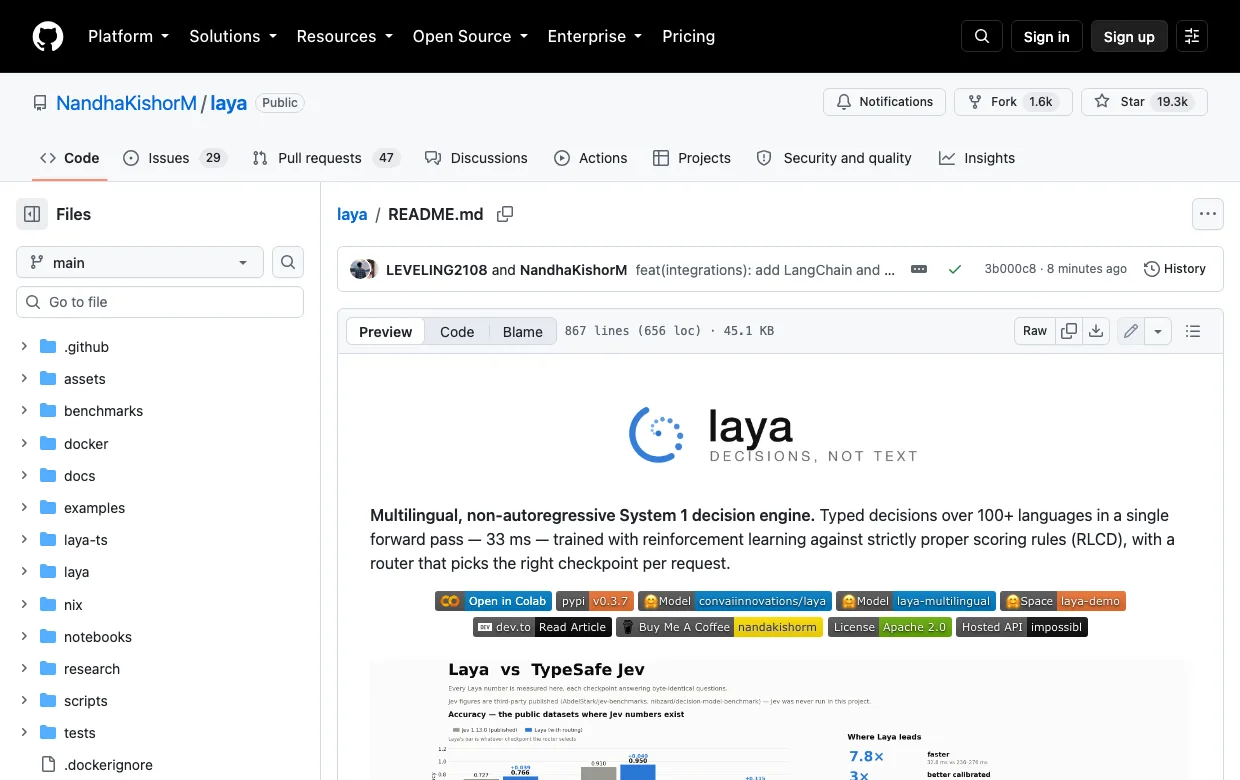
Screenshot: github.com/NandhaKishorM/laya, November 2026.
Laya is the open Jev alternative most people have heard of. It has 35,664 stars, more than Kev, SemIf, NanoJev, jevlike and the awesome-jev list combined, and it’s the only one you can install with a plain pip install laya. Convai Innovations built it under Apache-2.0 on a 421M ModernBERT-large backbone, with a 322M multilingual checkpoint for 100+ languages. It takes 32.8 to 39.5 ms per question on a Tesla T4 and runs fine on a laptop CPU. I ran the README’s quickstart on an M3 Pro without GPU acceleration and got a 66 ms median over 20 runs for all three questions in one pass:
import laya

agent = laya.load("convaiinnovations/laya")

state = {
    "subject": "Duplicate charge on invoice #4411",
    "body": "We were billed twice for March. Please refund the duplicate today or we will cancel our plan.",
}
questions = {
    "department": {"type": "choice", "instructions": "Which department should handle this request?",
                   "criteria": {"billing": "invoices, payments, refunds",
                                "technical": "bugs, outages, system errors",
                                "sales": "pricing, new contracts"}},
    "urgency": {"type": "score", "instructions": "How urgent is this request?",
                "criteria": ["not urgent", "soon", "critical deadline or blocking issue"]},
    "churn_risk": {"type": "noul", "instructions": "Does the user threaten to cancel or leave?"},
}

res = agent.predict(state, questions)["answers"]
print(res["department"]["choice"], res["department"]["confidence"])  # billing 0.827
print(res["urgency"]["score"], res["churn_risk"]["noul"])             # 1.49 0.741
The stars don’t say much about accuracy, though. On the Decision Index, Laya scores 9.21, 294th of 308, next to the other encoder-sized models: Von 1.3 at 11.65 and Fastino’s GLiNER2.5-Decide at 10.14. Its README is upfront about this. The base checkpoints score 0.362 and 0.352 on its typed-decisions benchmark, below the 0.461 you’d get by always picking the most common answer, so all of the accuracy there comes from fine-tuning (the fine-tuned laya-typed-decisions checkpoint reaches 0.766). It also warns that the English checkpoint falls apart on non-Latin scripts: on Khmer it scores 0.000 while reporting 0.952 confidence before its temperature clamp. That’s why the bundled Router detects the script first and picks the right checkpoint. The package gets a new release almost every day (0.4.37 came out on November 18), and since 0.4.23 laya.Agent(vegaml=True) switches to a separate frozen 0.8B reader that also handles images and speech. The Decision Index score above is for the 421M checkpoint, not that mode.
Laya makes sense when decisions have to run on a CPU, in many languages, and you’re willing to fine-tune it on your own labels. Out of the box, it’s not a Jev replacement. When you do deploy it, laya-serve exposes the same POST /v1/systemone endpoint.
Other open decision models
- REAX 1.3 is third on the Decision Index at 72.64. It comes out of a Bittensor subnet competition and averages two roughly 30B models 50/50, one from the Gemma line and one built partly on d3-ultra. Apache-2.0, but it wants a 96 GB RTX PRO 6000, 400 GB of disk and 64 GiB of RAM, and some long requests take minutes. It’s more of a research project than something you’d deploy.
- Cloudflare Clef is one of the most-downloaded decision models on Hugging Face (78,027 downloads, 2,377 likes), but it scores 54.92 on the Decision Index and 60 on Artificial Analysis. It’s covered with the hosted options in our AI decision models comparison.
- Not for commercial use: H2O Lightning 31B (69.92, 16th) is under H2O’s non-commercial licence, and Bespoke Nimble v4.1 Max (70.03, 15th) is CC-BY-NC-4.0. Nace.AI publishes Drex v2.0 under its own OpenRAIL-M licence, but Drex Max, which ties GLiDE at the top of Artificial Analysis, has no public weights. Liquid’s d1-2B uses the LFM Open License, which caps commercial use at $10M in revenue.
- Laptop-sized: below 5B, PelaAI’s KnowLine 4B Gen5.5 (55.99) and Perplexity’s Decider Flash v1.3 (55.14) lead, and GLiDE 2B scores 43.22. AWS’s Strands Decider 2B installs with pip and runs on Apple Silicon but scores 20.72, 253rd.
- The first wave of clones showed how it could be done and mostly stopped there. SemIf (4,965 stars), which reads option logits off a frozen Qwen3.5-4B, scores 26.71 and hasn’t had a commit since September 23. NanoJev (2,602 stars) is still the reference for 0.6B decisions inside real-time game loops, jevlike (1,372 stars) is a trainer for your own label set, and Von, which led the open field on jabr’s benchmark in September, has archived its repository.
Test a local decision server from outside your machine
Every model above runs as an HTTP server on your own machine, and for the 27B to 31B models that machine is usually a rented GPU box or a workstation under a desk. That works until something else needs to call it: a staging app, a webhook feeding the classifier, a teammate checking the routing, or a router sending small decisions to the cheap model. With Kev listening on port 8009, one command gives it a public HTTPS URL using Pinggy:
Change the port for the other servers (Karpo’s example uses 18440). This helps a lot during a migration. Point a copy of your production webhooks at the tunnel, log what the open model would have decided, and compare it with the answer you recieve from Jev. One warning: these servers have no authentication by default, so set KEV_API_KEY, GLIDE_API_KEY or LAYA_API_KEY to require a bearer token before you expose one.
Pick by GPU memory first, then license
Start from the GPU you have. With an 80 GB-class card, use Karpo Decision 31B for the top accuracy under Apache-2.0, or Mammoth-1 if you want MIT and answers that stay put when the question is reworded. If you’d rather test before buying hardware, start with pplx-decider v1.3 free on OpenRouter and self-host the same weights later. For images, video or documents past 32k tokens, use d3-ultra; on a 24 GB card, d3-flash or Elephant-1. To keep an existing Jev client with zero code changes, run Kev 27B. On a CPU, in many languages, with time to fine-tune, use Laya. GLiDE scores as well as Karpo, so use it if you’re under $10M in revenue or willing to sign Fastino’s agreement.
Conclusion
Open source copied Jev’s API within a day of launch, then took about two months to catch up on accuracy. It has caught up now: on both independent leaderboards, models you can download under Apache-2.0 or MIT score higher than Jev 1.14. The catch is still hardware. Everything that clearly beats Jev needs 50 to 63 GB of GPU memory, while Jev answers in 92 ms for $0.042 per million input tokens, with no GPU of your own.
Pick the model that fits your hardware and license, run it in shadow mode on a few hundred of your own labelled decisions, recalibrate its confidence scores, and compare accuracy and cost with what you use today. Treat every number in this post, including the vendors’ own, as a starting point until your own traffic confirms it. The same goes for self-hosting models in general.