In this article
Every CRM starts the same way. Someone picks a platform, imports a spreadsheet of contacts, sketches a rough pipeline and calls it done. That holds up for a while. Then the business grows, the go-to-market motion gets more complicated, and you start losing hours every week to problems that never needed to exist, ones a few better choices at the start would have prevented.
The worst part is that the choices doing the most long-term damage don’t feel like choices when you make them. They look like defaults nobody thought to question, so they slip straight past you. Here are the big ones, and what to do differently before they get expensive to unwind.
Summary
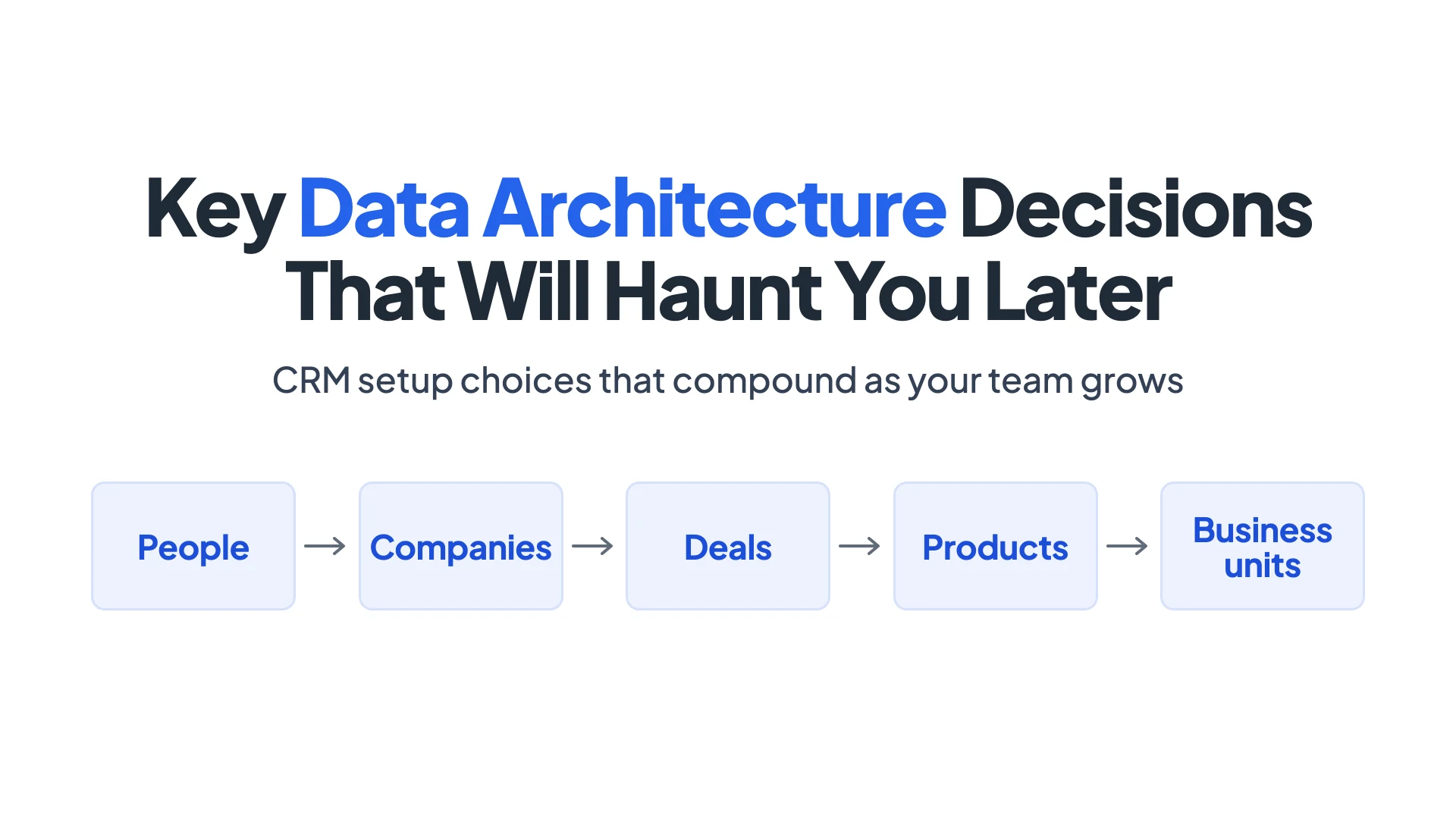
- Model relationships, not an address book. Link people to companies, companies to deals, deals to products and products to business units from day one.
- Pick a CRM that handles custom objects and multi-layered relationships out of the box, so you never have to retrofit the structure at fifty users.
- Give each deal type its own pipeline. New logos, upsells, renewals and partner referrals move at different speeds with different owners, and one shared pipeline hides all of it.
- Write data hygiene rules before the first rep joins. A naming standard, required fields per stage, and deduplication now beat merging thousands of messy records a year from now.
- Data architecture compounds. Clean foundations make reporting, automation, onboarding and integrations easier for years. Messy ones slow down every team that touches the CRM.
Flat contact records will cost you eventually
The most common early mistake is treating the CRM like a fancy address book: one record per person, with the company name typed into a text field. It works at first. Then you need to track five stakeholders at the same account, or your champion leaves their company and the whole relationship history leaves with them. At that point the setup falls apart, and there’s no clean way to piece it back together.
What you need from day one is a proper relational structure. People link to companies, companies link to deals, deals connect to products, and products tie back to your business units. That’s the backbone. Without it, you end up leaning on custom fields and naming conventions that break the moment a new rep joins and starts entering data however they like.
Picking CRMs for data modelling that handle custom objects and multi-layered relationships out of the box will save you from having to retrofit all of this later on. That never goes well. At five users this won’t seem important, but by the time fifty people are in the system you’ll wish you’d made that call from the very start.
One pipeline for everything
The second trap is running every deal type through a single pipeline. A new logo, an upsell, a renewal and a partner referral each move through different stages at a different pace, with different owners and different success metrics. Push all of them through one pipeline and your reporting tells you almost nothing useful about any of them.
Set them up seperately, even if the volume doesn’t seem to justify it yet. When deal velocity and conversion rates start to matter for forecasting, you’ll be glad the data is already split in a way that tells you something real.
No data hygiene rules from day one
Nobody wants to write data entry guidelines when there are deals to close, and that’s understandable. But without them you get duplicate records, inconsistent company names, and fields that mean completely different things to different reps. Every report becomes unreliable, and every automation built on top of that data becomes fragile and unpredicatable.
Even basic rules help a lot. Agree on a standard for how company names get entered, decide which fields must be filled in before a deal can move to the next stage, and put deduplication logic in place now instead of trying to merge thousands of messy records twelve months down the line. An afternoon of rules now saves months of cleanup later.
The decisions that don’t look like decisions
What ties all of this together is that none of it feels urgent at the time. Something more pressing always comes up first, so these things get skipped. But data architecture compounds. Clean foundations make reporting, automation, onboarding new hires, building integrations and scaling the team much easier down the line, while messy ones quietly slow down every team that touches the CRM for years.
Build the structure now. Get the foundations right at this stage, and your future ops team will thank you, because they won’t spend their first six months undoing someone else’s shortcuts.