In this article
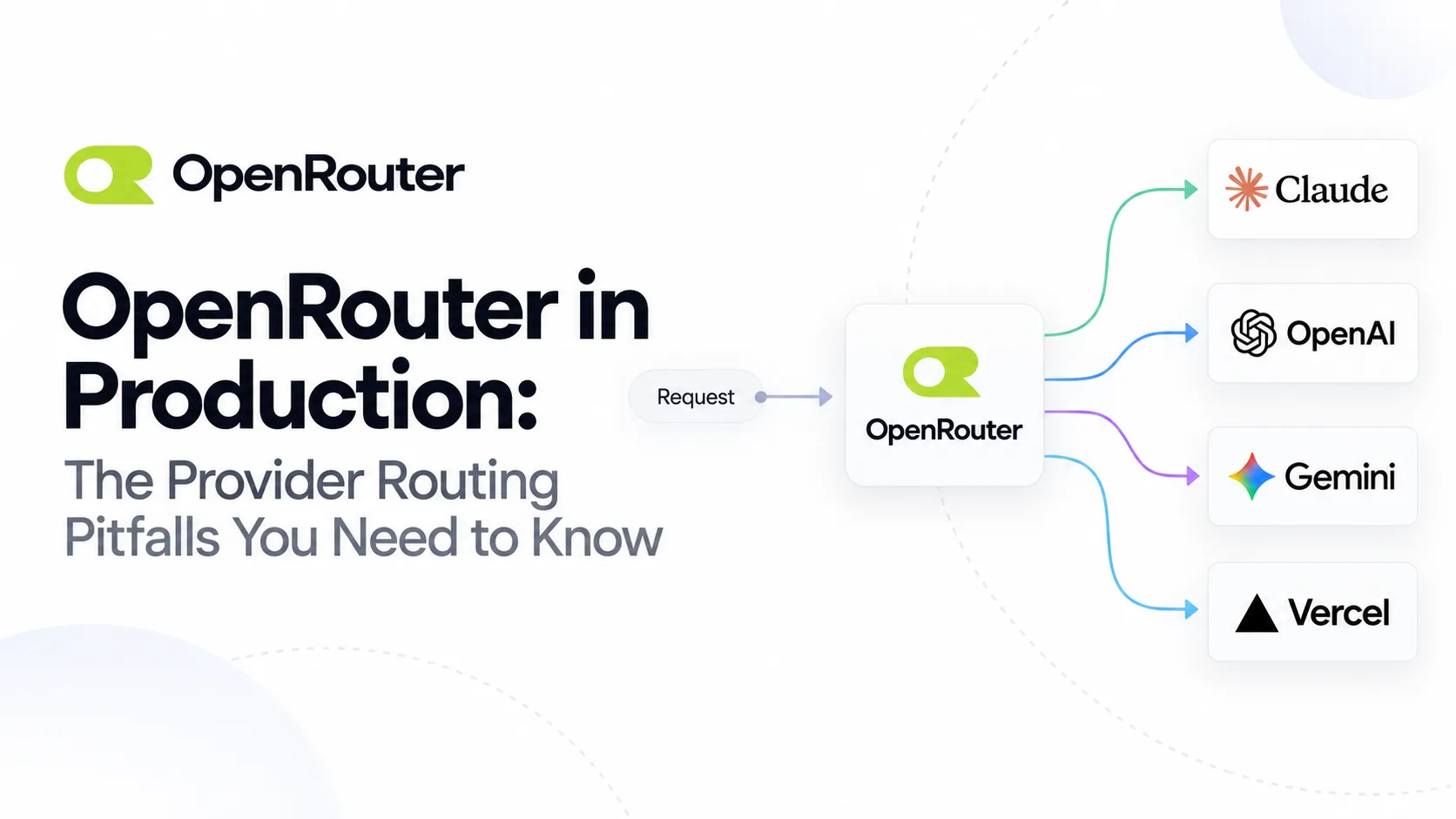
Calling a single AI provider directly is simple right up until you need a second model, a fallback for an outage, or an open-weight model your primary vendor doesn’t host. That’s the gap OpenRouter was built to fill: one OpenAI-compatible endpoint in front of 300+ models from dozens of hosting companies, billed at the same per-token price the provider charges directly. It’s become a default choice for a lot of production apps, and it has a specific, well-documented failure mode that only shows up once real traffic is flowing through it: the model you asked for and the model that actually answers you aren’t always behaving the same way.
That distinction between a model (a set of open weights) and a provider (the company serving those weights on its own GPUs, with its own quantization and its own parsing logic) is the subject of a detailed write-up published in September 2026 by Mo Moustafa, who builds Olly, an AI assistant that lives in iMessage. His post, “So you want to use OpenRouter?", draws on 18 million messages processed through OpenRouter, roughly a third of them on open models. This post pulls out the specific failure patterns he documented, cross-checks them against OpenRouter’s own docs, and lays out how to configure provider routing so none of them take your app down.
Summary
- The core issue: OpenRouter routes to a model, but a provider actually serves it, and different providers running the same weights can produce meaningfully different output quality, tool-call parsing, and reliability.
- Silent failures are the real risk: some providers return HTTP 200 with
content: nullor a missingusageobject instead of an error, which means naive error handling never catches them. - Quantization labels lie by omission: the
quantizationsfilter reflects what a provider claims to run, not what independent benchmarks measure it actually delivering. - Don’t pin a short provider list: locking
provider.orderto two or three “reliable” providers withallow_fallbacks: falseis exactly the setup that caused a real production outage, documented in the source write-up. - OpenRouter itself has no SLA: it has logged public outages (February 17 and 19, 2026) and charges a 5.5% fee on Stripe credit purchases, per its own FAQ.
- Fix it with routing config, not hope:
provider.order,allow_fallbacks,quantizations,sort,zdr, andrequire_parametersare documented in OpenRouter’s provider routing docs and are the actual levers you have.
Model vs. Provider: Why the Same Endpoint Behaves Differently
When you send a request to openrouter.ai/api/v1/chat/completions with a model ID like deepseek/deepseek-v4-flash, OpenRouter doesn’t run that model itself. It forwards the request to one of several companies that host those weights on their own infrastructure, each with its own choice of inference engine, batching strategy, context handling, and quantization level. OpenRouter’s own API documentation confirms the platform’s job is to normalize the request and response shape across providers, “so you only need to learn one” schema. What it can’t normalize is what happens between the request going in and the response coming out, because that’s entirely up to whichever provider your request lands on.
Moustafa’s write-up puts a number on how big that gap can get. For DeepSeek’s V4 Flash model (the 0731 build, referring to its July 31, 2026 release), he reports first-party serving scored around 90% on GPQA Diamond and 81% on TAU-Bench for tool-calling, while a third-party provider on the same model ID scored roughly 75% and 58% on the same two benchmarks respectively, a 20-plus point gap on tool use. He also reports a provider that scored 46% on TAU-Bench in one month, a 30-point gap from the first-party number. None of that shows up anywhere in the request or response. You send the same JSON, you get a 200, and the quality difference is invisible until you’ve built your own evaluation harness against it.
Where Providers Fail Without Telling You
The benchmark gap is the visible problem. The failures that actually break production code are the quiet ones:
- Vision blind spots. According to the write-up, one provider’s endpoint for a Qwen vision model misread letters and colors in test images, while endpoints for MiniMax M3 on two other providers returned “no image provided” text despite the model card claiming image support. All of these returned a normal
200status. - Null content on a valid response. Reasoning models occasionally come back with
finish_reason: "stop", a populatedcompletion_tokenscount, andcontent: null. It’s a structurally valid OpenAI-shaped response that contains no answer at all. - Missing usage blocks entirely. Moustafa reports one provider, StreamLake, accounted for about a fifth of his DeepSeek traffic in July but generated 92% of his empty completions that month, responses with null content, null reasoning, and no
usageobject. reasoning.effortthat does nothing. This parameter is accepted by every provider serving a reasoning-capable model, but according to the write-up, several providers produced the same number of reasoning tokens regardless of whethereffortwas set to low or high, silently ignoring the parameter rather than rejecting it.- Tool calls that leak as text. Some providers fail to parse a model’s function-calling output and pass it through as raw markup instead, something like
<use_skills><parameters>{"skills":["search"]}</parameters></use_skills>showing up verbatim in the chat content a user sees.
None of these trigger a 4xx or 5xx status code. A retry loop keyed only on HTTP status will never catch a single one of them, which is exactly why they’re worth listing explicitly rather than assuming your existing error handling covers them.
Quantization Filters Don’t Mean What You Think
OpenRouter lets you filter providers with a quantizations array (fp4, fp8, bf16, and so on), and it’s tempting to treat higher declared precision as a quality proxy. The write-up found that doesn’t hold: providers declaring fp4 scored competitively with fp8 providers on the same model, and some top-scoring providers declared no quantization at all. The field reflects what a provider says it runs, not a verified guarantee, since OpenRouter has no independent way to check the claim. Check a model’s per-provider stats on openrouter.ai instead of filtering on this field alone.
Provider Pinning Can Cause the Outage It’s Meant to Prevent
The most instructive failure in the source write-up is also the most avoidable. To get consistent behavior, Moustafa pinned three providers he considered reliable with provider: { order: ["cloudflare", "baidu", "alibaba"], allow_fallbacks: false }. Within weeks, Baidu started rate-limiting the account, Cloudflare stopped serving the model entirely, and Alibaba then hit its own rate limit, in that order. With fallbacks disabled, there was nowhere left to route to, and Olly went down completely. The safety mechanism meant to guarantee predictable behavior became a single point of failure the moment two of the three “reliable” choices stopped being reliable at the same time.
Configuring Provider Routing Properly
OpenRouter’s own provider routing docs expose a provider object on every chat completion request. Left unset, it load-balances across available providers, prioritizing price, and auto-excludes any provider with a recent 30-second outage. The useful parameters are:
| Parameter | Type | What it does |
|---|---|---|
order | string array | Providers to try, in order |
allow_fallbacks | boolean (default true) | Whether to fall through to other providers if the ordered ones fail |
require_parameters | boolean (default false) | Only route to providers that support every parameter in the request |
quantizations | string array | Filter by declared precision (fp8, fp4, bf16, etc.) |
ignore | string array | Blocklist specific provider slugs |
only | string array | Allowlist specific provider slugs |
zdr | boolean | Restrict routing to Zero Data Retention endpoints only |
sort | string or object | Sort candidates by "price", "throughput", or "latency" |
data_collection | "allow" or "deny" (default "allow") | Filter providers by their data storage policy |
A request that keeps a short preferred list without shutting the door on everything else looks like this:
curl https://openrouter.ai/api/v1/chat/completions \
  -H "Authorization: Bearer $OPENROUTER_API_KEY" \
  -H "Content-Type: application/json" \
  -d '{
    "model": "deepseek/deepseek-v4-flash",
    "messages": [{"role": "user", "content": "Hello"}],
    "provider": {
      "order": ["deepseek", "fireworks"],
      "allow_fallbacks": true,
      "quantizations": ["fp8"]
    }
  }'
The difference from Moustafa’s original setup is one field: allow_fallbacks stays true. You still get a preference order, but a rate-limited or deprecated provider doesn’t take the whole request down with it. Pair that with application-level retry logic that specifically checks for content: null or a missing usage object, since OpenRouter’s routing layer has no way to know a 200 response was actually empty.
OpenRouter’s Own Track Record
Provider variance aside, OpenRouter’s own infrastructure isn’t immune to outages. Its own incident report describes two related outages on February 17 and 19, 2026, both traced to a third-party caching layer used for API key lookups: roughly 20% of requests failed at first on February 17, rising to 80-90% within 13 minutes, with a similar pattern on the 19th. OpenRouter’s own writeup is candid: “any outage of our systems is unacceptable, and we know we let our customers down.” Fixes included circuit breakers and returning 503 instead of a misleading 401 during the failure.
On pricing, OpenRouter’s FAQ confirms it passes through provider pricing “without any markup,” so a model costs the same on OpenRouter as calling the provider directly. It makes money on credit purchases instead: 5.5% (minimum $0.80) on Stripe, 5% via crypto through Coinbase. BYOK, supplying your own provider keys through OpenRouter’s interface, charges 5% on usage above $25,000 in monthly spend, with your provider account’s own data retention policy still applying underneath.
Free-tier rate limits, per OpenRouter’s documented limits, are 20 requests per minute on any :free model, and either 50 or 1,000 per day depending on whether you’ve ever purchased $10 in credits. Moustafa separately reports that Venice and Novita rate-limited requests from his production servers while the same API key worked fine from his laptop, pointing to IP-based rather than key-based limiting. If your app runs from a data center IP range, test that before you ship.
If you’d rather sidestep provider variance altogether, we’ve covered self-hosted alternatives like OmniRoute and compared managed options in our roundup of AI LLM routers, and if you’re specifically after OpenRouter’s free-model tier, we’ve broken down how those rate limits actually work in more detail.
A Practical Checklist
Pulling the above into something you can actually apply:
- Treat
content: nulland a missingusageobject as failures worth retrying against a different provider, not just non-2xx status codes. - Keep
allow_fallbacksat its defaulttrueeven with a preferredorder; a pinned list with fallbacks disabled is a single point of failure waiting for two providers to fail in the same week. - Don’t trust
quantizationsas a quality signal alone; check per-provider benchmark stats for the model you’re using. - Parse tool calls defensively client-side in case a provider passes function-call syntax through as plain text.
- Load test from your actual production network, not just your laptop, since some providers rate-limit by IP rather than by key.
Conclusion
OpenRouter’s pitch (one endpoint, hundreds of models, provider pricing with no markup) holds up well for prototyping and for apps that can tolerate the occasional bad response. Once you’re running production traffic through it, the provider layer underneath that single endpoint stops being an implementation detail and starts being the thing you actually have to engineer around: benchmark your model against its specific providers rather than the model card, keep fallbacks on, and treat a 200 response as a starting point for validation rather than proof that anything useful came back.