In this article
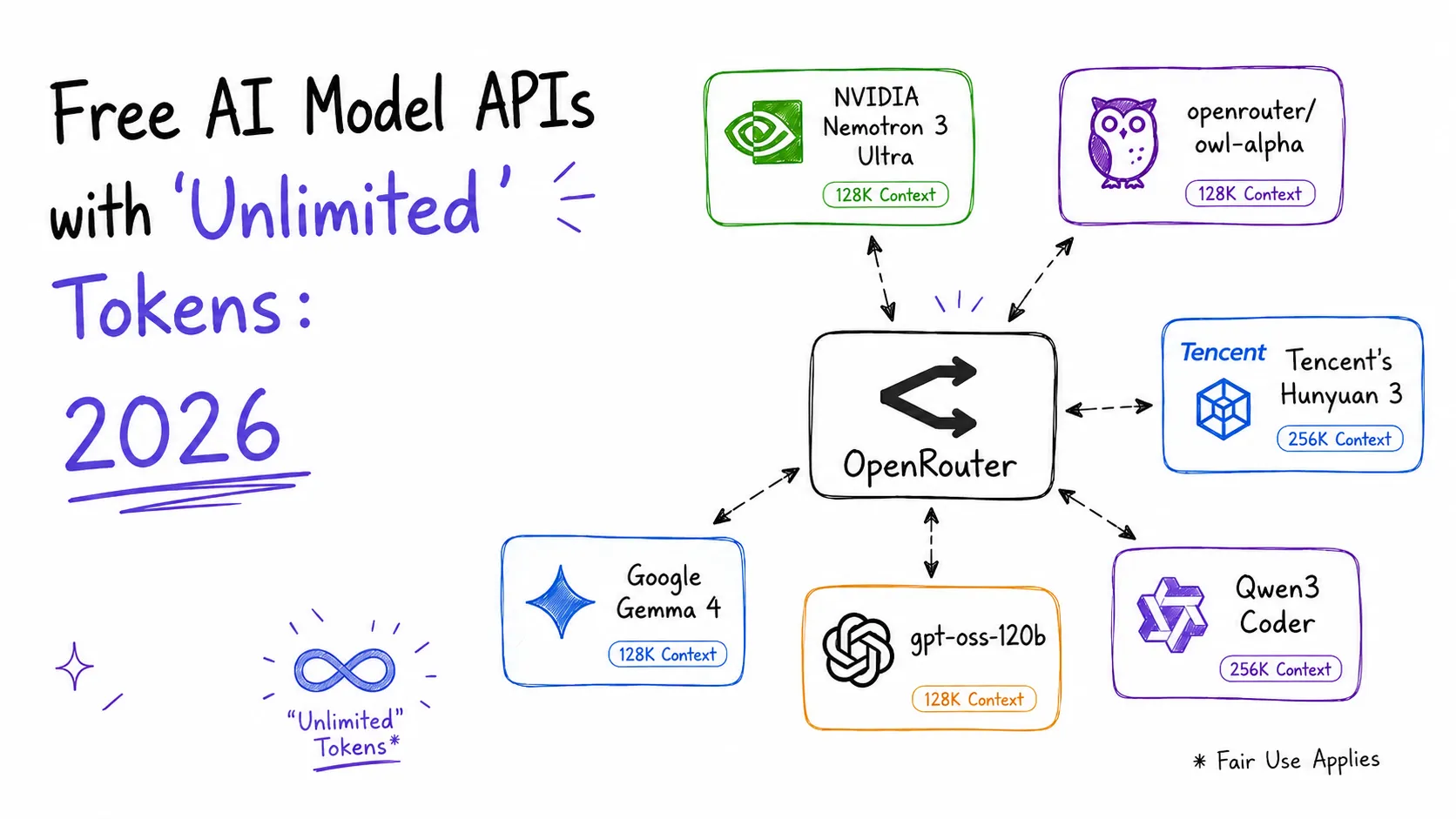
Frontier LLM API pricing keeps climbing at the top end - a model like Claude Opus 4.8 runs $5 per million input tokens and $25 per million output tokens, and that adds up fast once you’re calling it in a loop. Search “free AI API unlimited tokens” and you’ll find a pile of posts promising a way around that entirely. The honest version is less exciting but more useful: OpenRouter gives you free, no-credit-card access to dozens of large language models with zero cost per token - but “unlimited” isn’t the right word. You get 20 requests per minute and either 50 or 1,000 requests per day depending on whether you’ve ever bought credits. No token cap, but a very real request cap.
That distinction matters if you’re building anything real on top of this. This guide walks through exactly how OpenRouter’s free tier works in mid-2026, which models are actually free right now, how to call them, and the gotchas - like free models rotating out with almost no notice - that trip up people who read a six-month-old blog post and assume the model list hasn’t changed.
Here’s the current free lineup at a glance before we get into the mechanics:
| Model | Size | Context | Best For |
|---|---|---|---|
| NVIDIA Nemotron 3 Ultra | 550B / 55B active MoE | 1M tokens | General reasoning, agent orchestration |
| Owl Alpha | Undisclosed (stealth) | 1M tokens | Agentic/tool-use workloads (temporary) |
| Tencent Hy3 | 295B / 21B active MoE | 262K tokens | General use, free only through July 21, 2026 |
| Qwen3 Coder | 480B / 35B active MoE | 1M tokens | Agentic coding, tool calling |
| OpenAI gpt-oss-120b/20b | 117B / 5.1B active MoE (120b) | 131K tokens | Open-weight reasoning, self-hostable |
| Google Gemma 4 | 31B dense / 26B-A4B MoE | 256K tokens | Multimodal (text, image, video) |
That table covers the six worth knowing individually - the full catalog runs to about 25 models, and we get to the rest further down.
Summary
What “free” means on OpenRouter: Free models (IDs ending in :free) cost $0 per input and output token. The catch is a request-based rate limit, not a token limit: 20 requests/minute always, plus 50 requests/day on an unfunded account or 1,000 requests/day once you’ve purchased $10 or more in credits at any point (the higher limit sticks even if your balance later drops). 1,000 requests/day is practical for most tasks - personal projects, prototyping, and even light agentic workflows fit comfortably under that ceiling.
Getting started: Create an account at openrouter.ai/keys (email or GitHub, no card needed), generate an API key, and call the OpenAI-compatible endpoint at https://openrouter.ai/api/v1/chat/completions with any model ID ending in :free. Minimum credit purchase is $5; $10+ unlocks the 1,000/day tier.
Free models worth knowing right now (July 2026, verify current status before you rely on one): see the table at the top of this post for the six models worth calling out by name - Nemotron 3 Ultra, Owl Alpha, Tencent Hy3, Qwen3 Coder, gpt-oss, and Gemma 4 - plus roughly 19 more in the full Free Models collection.
The reliability tip: free models get rate limited hard during peak hours and rotate out without warning. Use OpenRouter’s models array to list 2-3 free fallbacks in one request instead of hardcoding a single model ID.
These free models aren’t limited to raw API calls either - open source coding agents like OpenCode support OpenRouter as a built-in provider, so you can point an agentic coding session at qwen/qwen3-coder:free or any other free model and run real tool-calling workflows without paying for inference. We’ve covered OpenRouter’s paid side and its alternatives in more depth in our AI LLM routers comparison. This guide is narrower: it’s specifically about the free tier - what it costs (nothing, in dollars), what it actually limits (requests, not tokens), and which models are on it right now.
The Free Tier: Rate Limits, Not Token Limits
This is the part most “unlimited tokens” articles get wrong. OpenRouter’s free models charge $0.00 per input token and $0.00 per output token - there is genuinely no token-based billing. But every account, funded or not, is capped by request volume:
- 20 requests per minute, always, regardless of account status
- 50 requests per day if you have never purchased credits (or have purchased less than $10 total)
- 1,000 requests per day once you’ve purchased $10 or more in credits at any point in your account’s history - this unlock is permanent even if your balance later drops back to zero
So a single long conversation with a 100,000-token context window costs you one request, same as a two-word prompt. If you’re doing batch processing, an agent loop that calls the model dozens of times per task, or anything with high request frequency, the daily request ceiling - not token volume - is what you’ll hit first. There’s also a practical floor under the free number: Cloudflare’s DDoS protection will silently block traffic that looks abusive, and accounts with a negative balance get blocked with a 402 error even on free models, which mostly happens if you’ve been using paid models alongside free ones and let the balance run dry.
Getting Set Up
- Go to openrouter.ai/keys and sign up with email or GitHub - no credit card required for the free tier.
- Generate an API key from that page. You can optionally cap it with a credit limit.
- (Optional, recommended) Add credits. The minimum purchase is $5, and OpenRouter takes a 5.5% platform fee (minimum $0.80) on card payments. Buying $10 or more at once is the move that raises your free-model ceiling to 1,000 requests/day - it’s a one-time threshold, not a subscription.
- Call the API. Free models are marked with a
:freesuffix on their model ID, and OpenRouter’s Free Models collection is the fastest way to see what’s currently available.
If you only ever plan to use free models, you can genuinely stop at step 2 and spend $0. The $5-to-$10 credit purchase is purely about unlocking the higher daily ceiling, and it’s worth doing the moment a hobby project turns into something you rely on daily - 50 requests disappears fast if you’re iterating on prompts.
Calling a Free Model
Because OpenRouter mirrors the OpenAI API shape, you can use curl directly or the standard openai Python/JS SDK pointed at a different base URL. Here’s the raw HTTP version:
curl https://openrouter.ai/api/v1/chat/completions \
  -H "Content-Type: application/json" \
  -H "Authorization: Bearer $OPENROUTER_API_KEY" \
  -d '{
    "model": "nvidia/nemotron-3-ultra-550b-a55b:free",
    "messages": [
      {"role": "user", "content": "Explain the difference between MoE and dense transformer architectures in two sentences."}
    ]
  }'
And the same call using the official OpenAI Python SDK, just repointed at OpenRouter:
from openai import OpenAI

client = OpenAI(
    base_url="https://openrouter.ai/api/v1",
    api_key="sk-or-v1-your-key-here",
)

response = client.chat.completions.create(
    model="nvidia/nemotron-3-ultra-550b-a55b:free",
    messages=[
        {"role": "user", "content": "Explain the difference between MoE and dense transformer architectures in two sentences."}
    ],
)

print(response.choices[0].message.content)
No OpenRouter-specific SDK, no custom client library - if your code already talks to the OpenAI API, changing base_url and the model string is the entire migration.
Handling Rotation and Rate Limits with Fallback Models
The single most important production tip for the free tier: don’t hardcode one free model. Free models get pulled, repriced, or throttled by their upstream provider without warning - Meta’s Llama 3.3 70B free endpoint, for instance, has had stretches of heavy upstream throttling during peak hours, and DeepSeek’s free variants (popular through most of 2025) were all converted to paid-only by mid-2026. OpenRouter’s models array lets you list several candidates in priority order in a single request, and it automatically retries the next one if the first hits a rate limit, goes down, or errors out:
{
  "models": [
    "nvidia/nemotron-3-ultra-550b-a55b:free",
    "openai/gpt-oss-120b:free",
    "qwen/qwen3-coder:free"
  ],
  "messages": [
    {"role": "user", "content": "Summarize this changelog in three bullet points."}
  ]
}
OpenRouter tries the models in that order and falls through on context-length errors, moderation flags, rate-limiting, or provider downtime. You’re billed (in this case, $0) based on whichever model actually answered, which is returned in the response’s model field - so you can log which fallback fired and adjust your priority list over time.
If you’d rather not manage a model list yourself, OpenRouter also runs openrouter/free, a router model that automatically picks from the current free catalog based on what your request needs - it detects whether you’re asking for tool calling, structured outputs, or image understanding and filters to a free model that supports it. It trades predictability for convenience: you don’t control exactly which model answers, but your code keeps working as the underlying free lineup changes.
The Free Model Catalog Right Now
OpenRouter’s free lineup is a moving target - models get added as labs test prerelease checkpoints, and pulled when a provider’s promotional window ends or the model is folded into a paid tier. As of July 2026, the Free Models collection lists close to 25 models. Six are worth calling out individually, either because of what they’re good for or because of how they ended up free in the first place.
NVIDIA Nemotron 3 Ultra (550B-A55B)
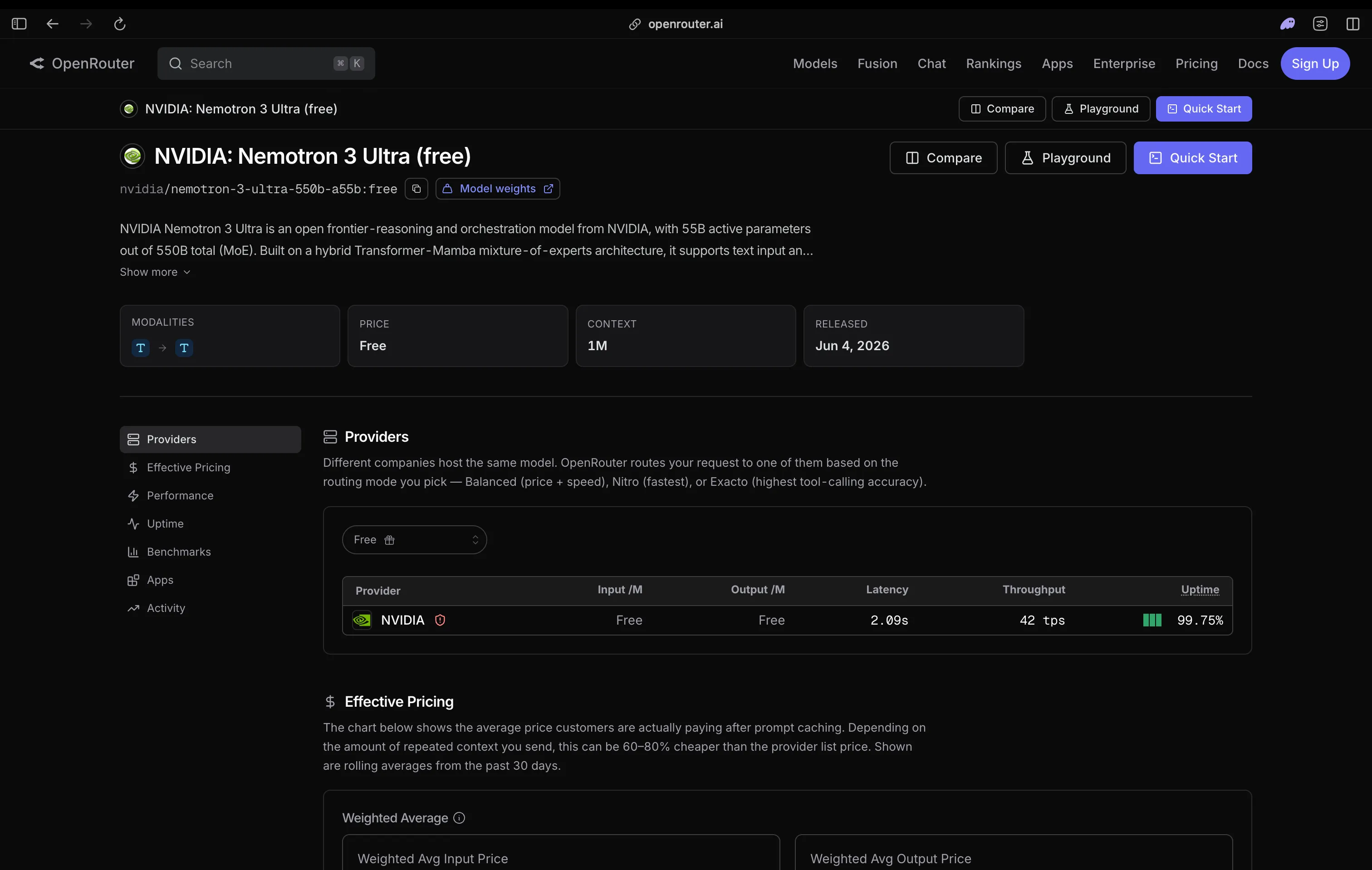
NVIDIA Nemotron 3 Ultra, released June 4, 2026, is a 550-billion-parameter Mixture-of-Experts model with 55 billion active parameters per token, built on a hybrid Transformer-Mamba architecture rather than a pure transformer stack. That hybrid design is meant to keep inference cost down at long context - and Nemotron 3 Ultra supports a full 1 million token context window, positioning it for agent orchestration, multi-step coding tasks, and deep-research workflows where the model needs to hold a large amount of state across a long-running task. Weights are also published on Hugging Face, but on OpenRouter it’s listed at $0/M tokens for both input and output under the :free model ID.
Owl Alpha - A Free “Stealth” Checkpoint
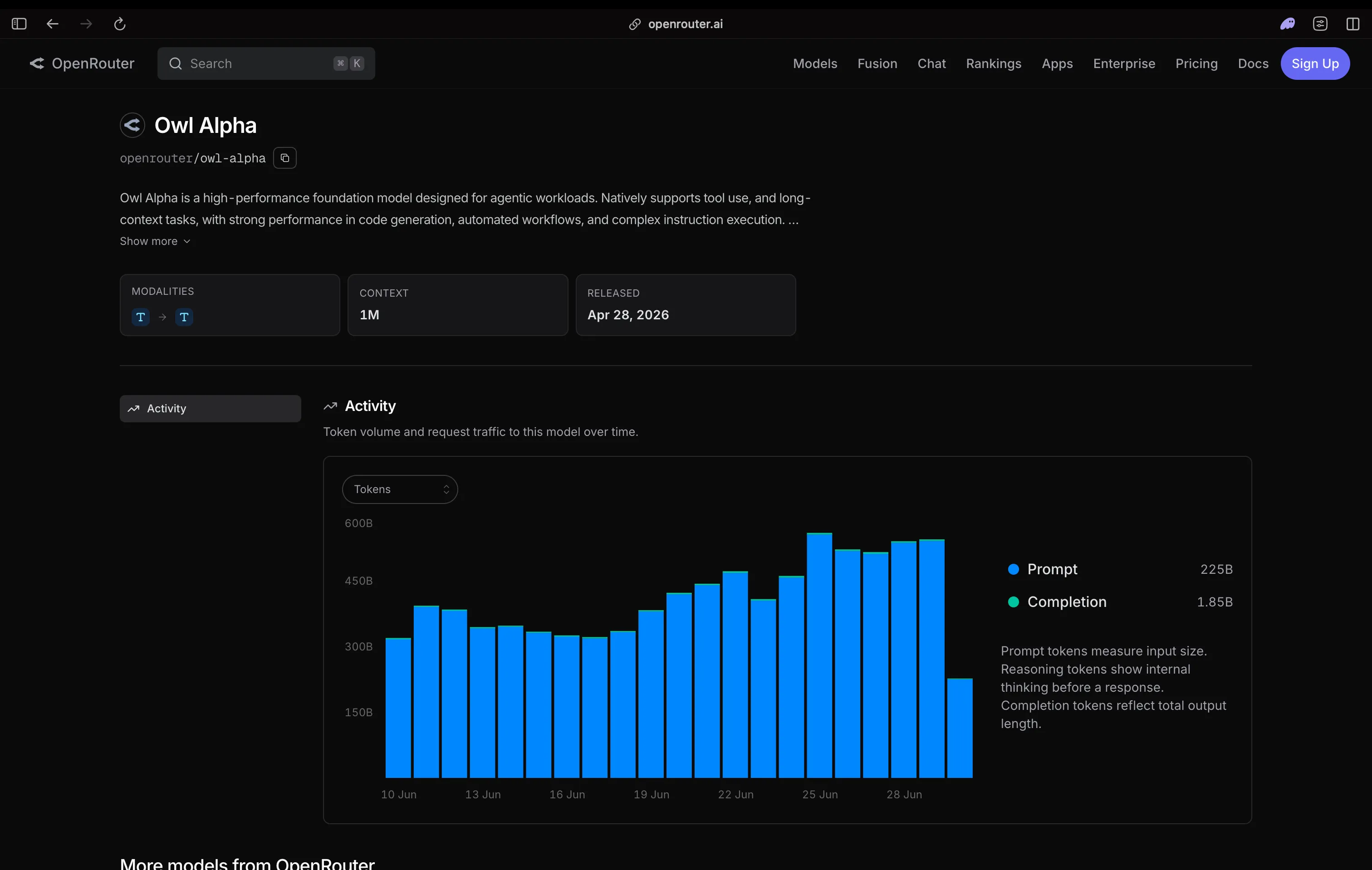
openrouter/owl-alpha is a different kind of free model entirely. It’s part of OpenRouter’s recurring stealth model program, where an unnamed frontier lab quietly drops a prerelease checkpoint under a codename, makes it free to use for a few weeks while the lab collects real usage data, and then either renames it under the lab’s actual brand at standard pricing or takes it offline. Past examples include Quasar Alpha and Optimus Alpha, both later revealed to be OpenAI prerelease checkpoints.
Owl Alpha, which OpenRouter’s own announcement describes as “a high-performance foundation model designed for agentic workloads,” showed up in late April 2026 with a 1 million token context window and strong tool-use support - OpenRouter specifically calls out compatibility with agentic coding tools like Claude Code and similar CLI agents. The catch, stated plainly on the model page: prompts and completions sent to Owl Alpha may be logged by the provider to improve the model. That’s the deal with every stealth model on OpenRouter - free access in exchange for your traffic becoming training or eval signal. It’s a reasonable trade for experimentation and side projects; it’s not something to route production data with customer information through.
Because these are explicitly temporary, don’t build anything that depends on openrouter/owl-alpha staying free, or staying available at all, past the next few weeks. Check the model’s live pricing page before you rely on it.
Tencent Hy3 - A Textbook Example of Rotation
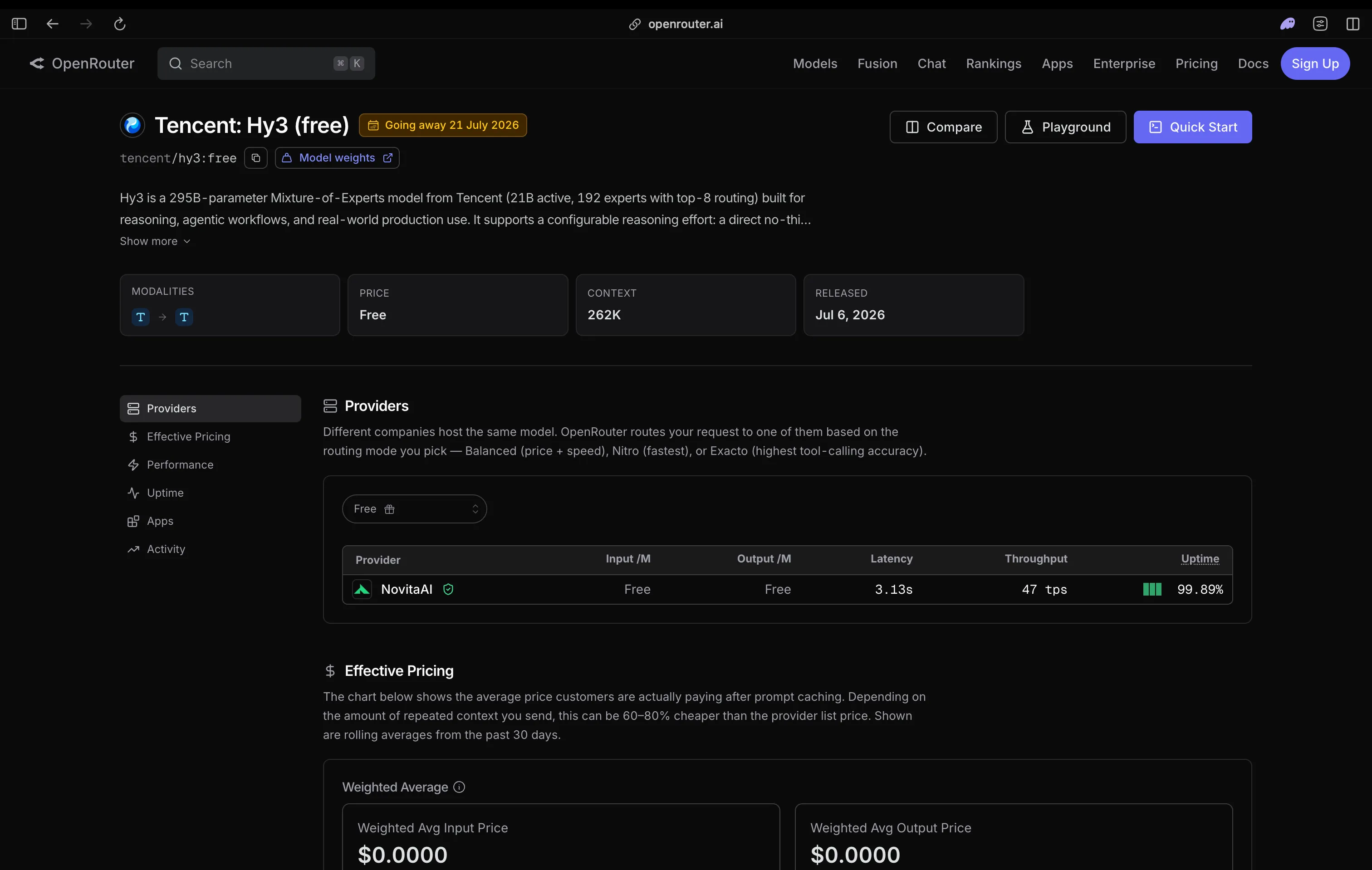
Tencent's Hy3 is a 295-billion-parameter MoE model (21B active, 192 experts with top-8 routing) released July 6, 2026, with a 262K context window and three switchable reasoning modes - a fast no-think default, a lightweight chain-of-thought mode, and a deeper high-effort reasoning mode for harder problems. It’s currently free on OpenRouter, and Tencent has published an explicit end date for that free listing: July 21, 2026. After that, expect it to move to paid pricing or disappear from the free collection entirely.
We’re calling this one out specifically because it’s the clearest illustration of a pattern that trips people up constantly: free-tier LLM listicles go stale within weeks. If you’re reading this after July 21, 2026, do not expect Hy3 to still be free - check its current listing first.
Qwen3 Coder 480B-A35B - The Free Model Built for Coding Agents
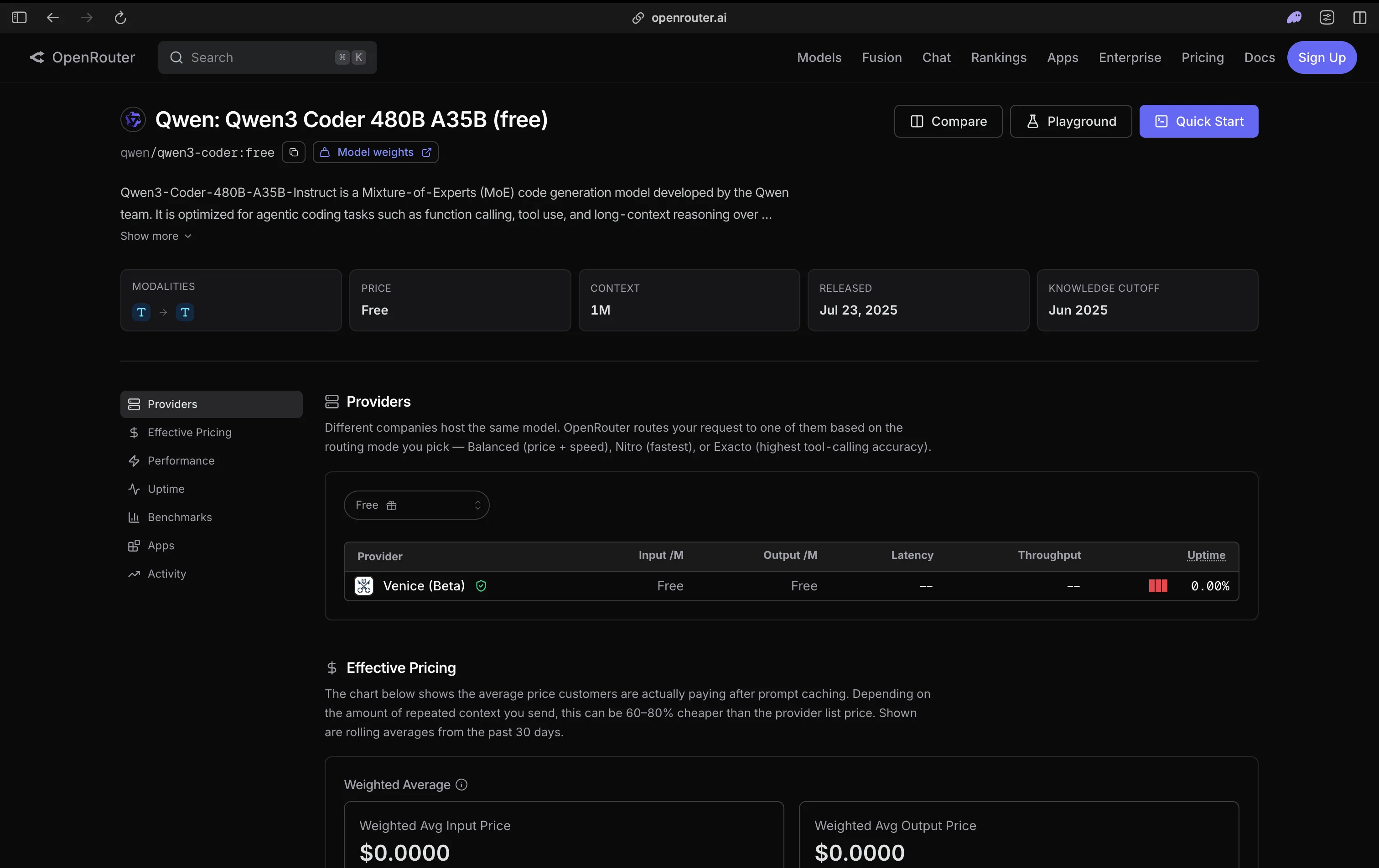
Qwen3 Coder is Alibaba’s agentic-coding-focused MoE model - 480 billion total parameters, 35 billion active (8 of 160 experts per forward pass), with a 1 million token context window. Released July 23, 2025, it’s explicitly tuned for function calling, tool use, and long-context reasoning across entire repositories rather than general chat. The qwen/qwen3-coder:free variant has stayed on OpenRouter’s free collection since shortly after launch and is still listed free at the time of writing - just make sure you’re pointing at the :free model ID specifically, since the base qwen/qwen3-coder listing (without the suffix) is the metered version at $0.22/M input and $1.80/M output tokens. Of everything covered here, it’s the one most directly built for software engineering workloads, which makes it a reasonable default for coding agent experiments where you don’t want to burn paid credits on every tool call.
OpenAI gpt-oss-120b - OpenAI’s Own Open-Weight Model, for Free
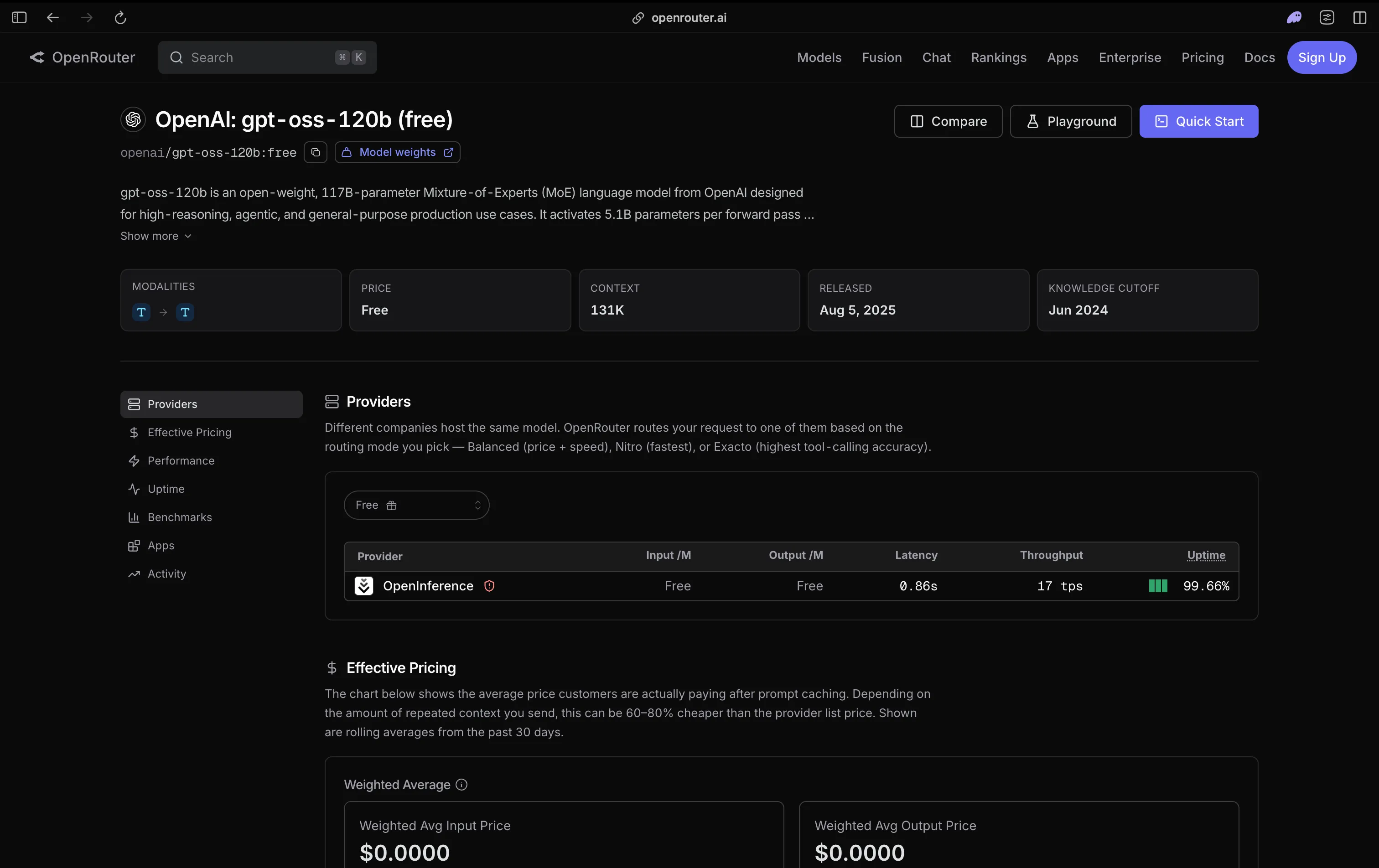
gpt-oss-120b is worth knowing about specifically because it comes from OpenAI itself. Released August 5, 2025 under an open-weight license, gpt-oss-120b is a 117-billion-parameter MoE model with only 5.1 billion active per token - small enough that OpenAI designed it to run on a single H100 GPU with native MXFP4 quantization if you ever want to self-host it instead of calling the API. On OpenRouter it carries a 131K context window, configurable reasoning depth with visible chain-of-thought, and native tool calling and structured outputs. The base openai/gpt-oss-120b listing (no suffix) is metered at $0.036/M input and $0.18/M output tokens - already cheap, but the :free variant removes even that cost. A smaller sibling, openai/gpt-oss-20b:free (21B total, 3.6B active), is also free and a reasonable pick when you don’t need the 120B model’s extra reasoning depth and want faster, lighter responses.
Google Gemma 4 - Two Free Variants for Different Tradeoffs
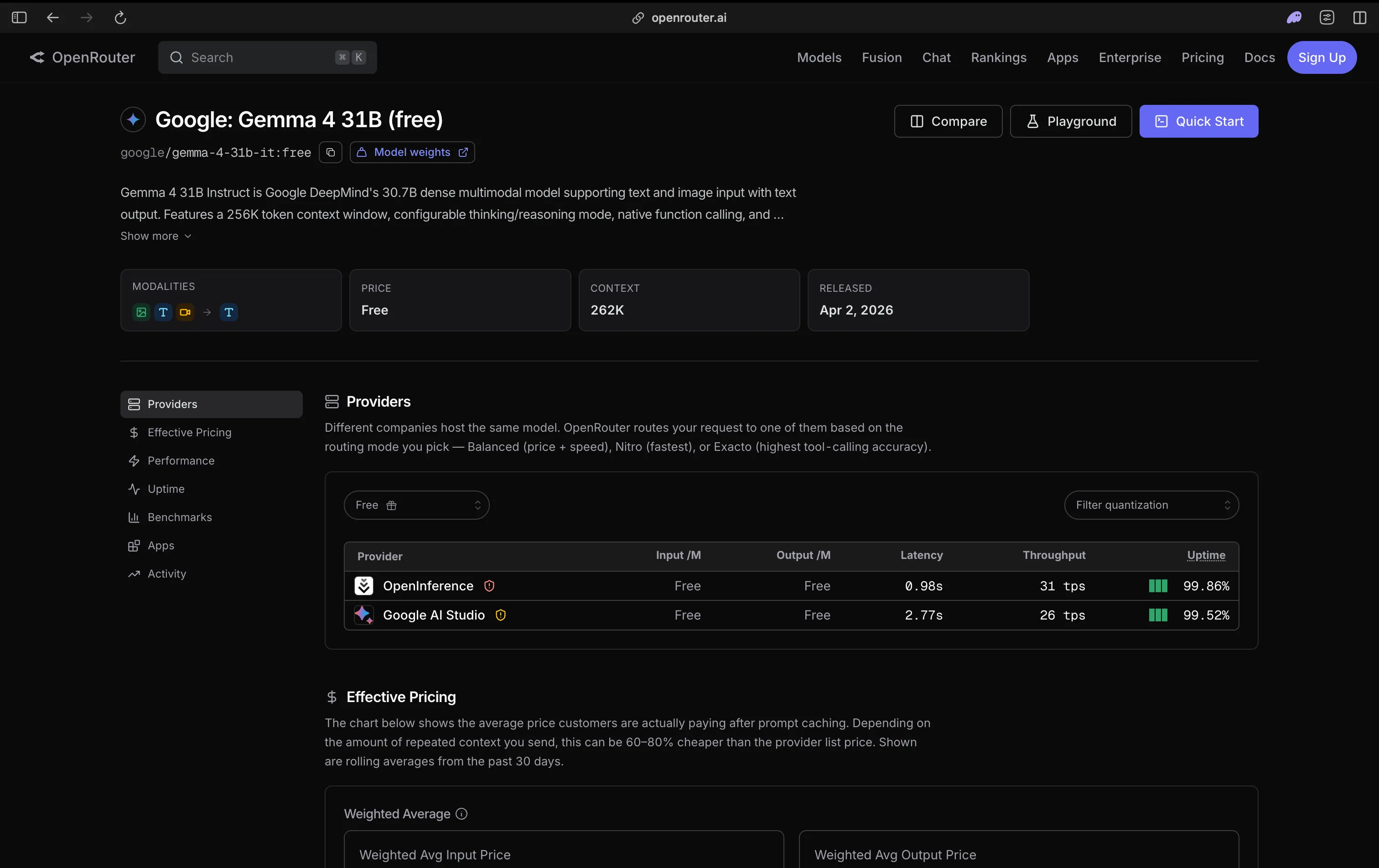
Google DeepMind’s Gemma 4 family, released April 2, 2026, ships two distinct free variants worth telling apart rather than treating as one entry. google/gemma-4-31b-it:free is the dense 30.7B model - no MoE routing, so it’s the slower of the two, but it’s the one to reach for when you want the strongest single-response quality regardless of latency. `google/gemma-4-26b-a4b-it:free` is the MoE sibling: 25.2 billion total parameters but only 3.8 billion active per token, landing close to the 31B model’s output quality while responding noticeably faster. Both give you a 256K context window, multimodal input (text, images, and up to 60 seconds of video at 1fps), a configurable thinking mode, native function calling, and support for 140+ languages - a genuinely capable multimodal option at $0 per token.
The Rest of the Current Free Roster
Beyond the six covered above, the free collection as of this writing includes several smaller NVIDIA Nemotron variants (Nano 9B, Nano 12B with vision, Nano 30B-A3B, and the mid-sized Nemotron 3 Super at 120B/12B active with a 1M context window), Meta’s Llama 3.3 70B and Llama 3.2 3B, Nous Research’s Hermes 3 Llama 3.1 405B, and a handful of niche entries like Poolside’s Laguna models, Cohere’s North Mini Code, and LiquidAI’s tiny 1.2B LFM models for edge use cases.
Notably absent, as of July 2026, are the free DeepSeek variants that were extremely popular through 2025 - every DeepSeek model on OpenRouter is now paid-only, ranging from roughly $0.09/M tokens on DeepSeek V4 Flash up toward $0.70+/M on the original R1. If you built a workflow around deepseek/deepseek-r1:free a year ago, it’s gone; that’s exactly the kind of rotation this guide is warning about. For a broader comparison of open-weight models you can run yourself instead of depending on a rotating free tier, see our self-hosted LLM coding guide.
Free Tier vs. Paying: What You Actually Give Up
The free tier isn’t a stripped-down demo - it’s the same inference quality the model normally provides, just rate-limited and, for the biggest frontier-scale proprietary models (GPT-5-class, Claude Opus-class, Gemini 3 Pro-class), simply unavailable for free. What you lose by staying on the free tier:
- Access to top-tier proprietary models. Free models on OpenRouter are exclusively open-weight releases (Nemotron, Gemma, gpt-oss, Qwen, Llama) or temporary stealth/promotional checkpoints. You will not find free access to Claude, GPT-5, or Gemini’s flagship tiers.
- Request throughput. 50 or 1,000 requests/day is fine for personal projects and prototyping; it’s not enough for a production app with real traffic.
- Provider SLAs. Free endpoints are explicitly the first thing providers deprioritize under load, so latency and availability are less consistent than paid traffic on the same model.
Once you outgrow that, the pay-as-you-go tier charges provider list price with roughly a 5.5% platform fee on credit purchases and no markup on the token price itself - and if you already have API credits with OpenAI, Anthropic, or Google directly, OpenRouter’s BYOK (bring-your-own-key) option routes through your existing keys for up to 1,000,000 requests/month at no extra platform fee, with a 5% fee on volume beyond that. If you’re trying to decide between OpenRouter and other gateway options at that stage, our LLM router comparison covers Portkey, LiteLLM, and a handful of others worth evaluating.
A Realistic Way to Use This
The practical pattern that holds up over time looks like this: build against the OpenAI-compatible endpoint so you’re never locked into one provider’s SDK, pick two or three free models from the current catalog and list them in a models fallback array instead of trusting any single one to stay available, and treat stealth models like Owl Alpha as bonus capacity for experiments rather than something a real workflow depends on. Check the actual model page before you ship anything, because - as this guide itself will eventually prove - what’s free today is not guaranteed to be free next month.
Conclusion
“Free AI API with unlimited tokens” is a catchy search phrase, but the accurate description is more specific and, honestly, more useful once you understand it: OpenRouter gives you genuinely free, per-token-uncapped access to a real and currently quite strong set of open-weight models - Nemotron 3 Ultra, Qwen3 Coder, Gemma 4, gpt-oss, and rotating stealth checkpoints like Owl Alpha - gated by a request-per-day limit rather than a token limit. Fifty requests a day costs nothing and needs no card; a one-time $5-$10 credit purchase raises that ceiling to a thousand. The only real discipline required is building for rotation from day one - use fallback arrays, recheck model pages before you rely on them, and don’t be surprised when a model that was free last month isn’t anymore.