In this article
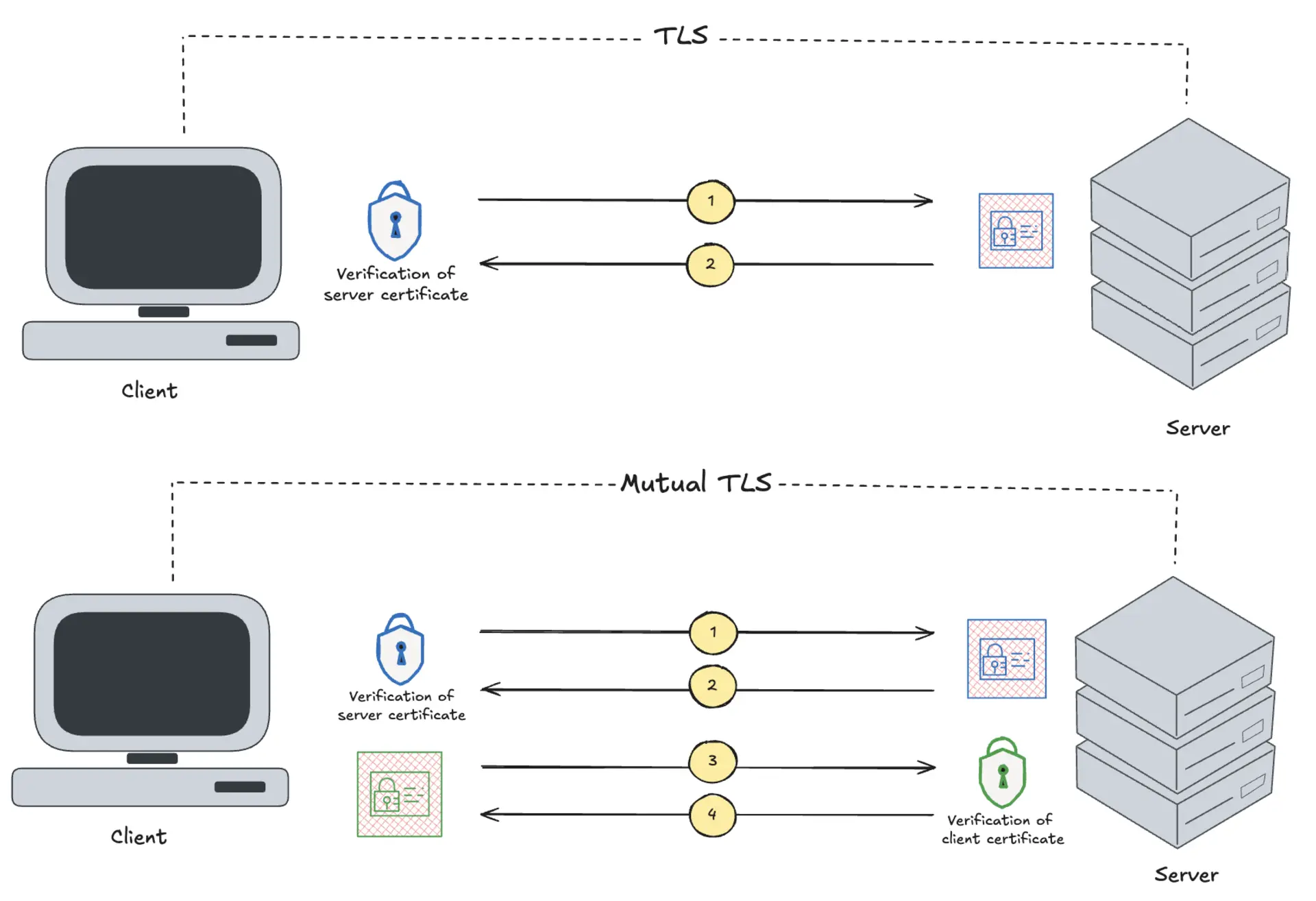
Almost every connection on the internet today, whether it’s a browser loading your bank’s login page or one internal service calling another inside a Kubernetes cluster, relies on some form of TLS to keep the data private and unaltered in transit. What differs is how much identity gets proven, and by whom: a public website only needs to prove who the server is, while service-to-service traffic increasingly needs proof from both ends.
Every secure website you visit uses Transport Layer Security (TLS) to protect your data as it travels across the internet. TLS creates an encrypted tunnel that shields your passwords and personal information from eavesdroppers. It works by verifying the server’s identity through digital certificates, while your browser remains anonymous at the connection level.
Mutual TLS (mTLS) extends this security model by requiring both sides to verify each other’s identity with certificates. This two-way authentication is crucial for high-security environments like banking systems, healthcare networks, and enterprise applications where knowing exactly who’s connecting matters. The enhanced security comes with added complexity - organizations must manage certificates for both servers and clients.
This article compares these two security approaches, helping you understand when to use each one and how to implement them effectively.
Summary
TLS provides one-way authentication where only the server proves its identity, making it ideal for public websites. mTLS requires both server and client to verify each other with certificates, offering stronger security for sensitive systems but with more complex certificate management.
What is Transport Layer Security (TLS)?
Transport Layer Security (TLS) is the invisible guardian of your online activities. When you see a padlock icon in your browser’s address bar, TLS is working to protect your connection. This protocol evolved from the older SSL standard and now secures most internet traffic.
TLS performs three critical security functions: it encrypts your data to prevent snooping, verifies server identity to prevent impersonation, and ensures data integrity so information can’t be altered in transit. This three-pronged approach protects everything from your banking transactions to casual browsing sessions.
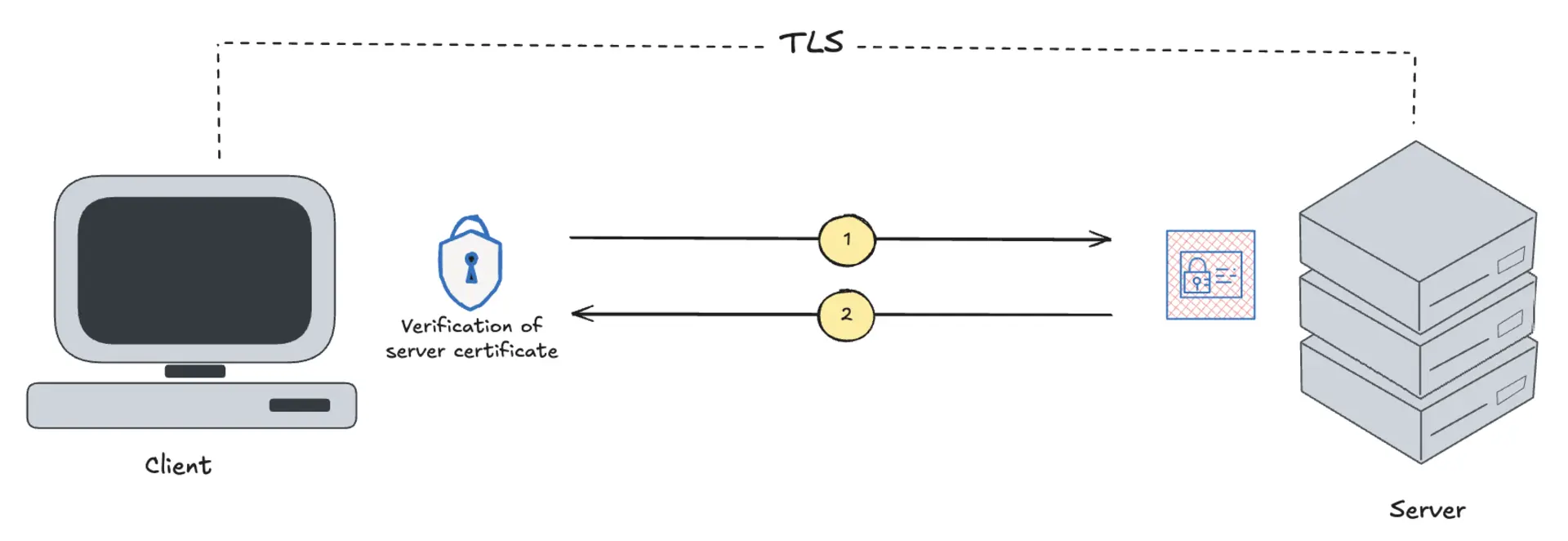
The TLS handshake process happens in milliseconds when you connect to a secure site. Your browser and the server negotiate security capabilities, the server presents its digital certificate for verification, and both sides create encryption keys for secure communication. The latest version, TLS 1.3 (2018), offers faster connections and stronger security than its predecessors.
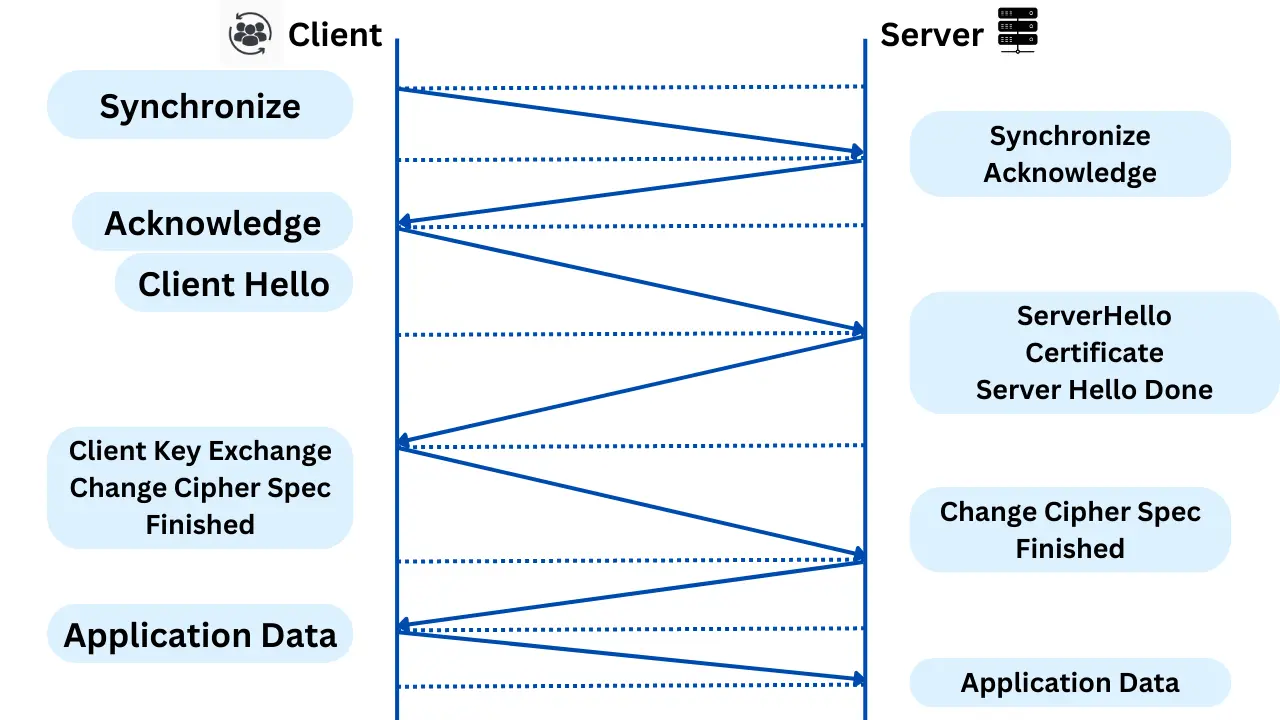
The handshake itself is changing too. TLS 1.3 now supports hybrid post-quantum key exchange, most commonly X25519MLKEM768, which pairs the classical X25519 elliptic-curve exchange with ML-KEM-768, the lattice-based key-encapsulation mechanism NIST standardized in FIPS 203. The point is to defend against “harvest now, decrypt later” attacks, where traffic captured today gets decrypted once large-scale quantum computers exist. Adoption has moved quickly: Cloudflare reported that more than half of the human-generated traffic on its network already negotiates this hybrid key exchange, and every major browser (Chrome, Firefox, and Safari as of iOS 26/macOS Tahoe 26) now offers it by default when the server supports it. Support on the origin side - your own load balancer, reverse proxy, or app server - still lags well behind the browser side, so it’s worth checking your TLS termination point rather than assuming you’re covered.
What is Mutual Transport Layer Security (mTLS)?
If standard TLS is like a security guard checking only a visitor’s ID, mutual TLS checks everyone’s credentials. With mTLS, both the client and server must present valid certificates to establish trust. This two-way verification creates a stronger security model essential for sensitive systems.
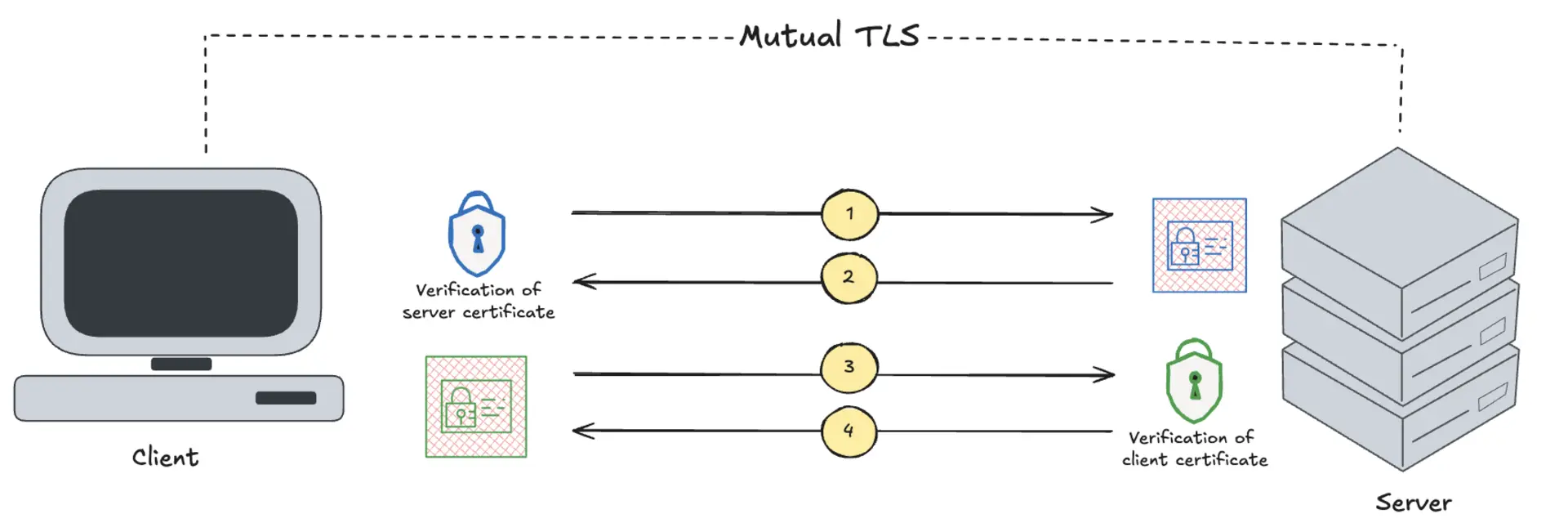
In an mTLS handshake, your application presents its own digital certificate alongside the usual connection request. The server verifies this certificate’s authenticity while your application simultaneously validates the server’s credentials. Only when both sides confirm each other’s identity does the secure connection establish.
This mutual verification forms the foundation of Zero Trust security architectures where nothing is implicitly trusted. By requiring proof of identity from every client and server, mTLS enables organizations to move beyond traditional security perimeters to an environment where trust is continuously verified, regardless of where a connection originates.
Key Differences Between TLS and mTLS
The differences between these protocols influence which one you should choose for your specific security needs.
Authentication and Trust Model
With standard TLS, only the server proves its identity. When you connect to your bank’s website, your browser verifies the bank’s certificate, but the bank doesn’t cryptographically verify your device during the connection setup. This one-way trust model works well for public websites but leaves open the possibility of client impersonation.
mTLS requires certificates from both parties, creating a stronger trust relationship where each side verifies the other. This prevents impersonation attacks since an attacker would need a valid certificate to establish a connection, making it crucial for systems handling sensitive data.
Implementation Complexity
TLS implementation is relatively straightforward - organizations obtain server certificates from authorities like Let’s Encrypt and install them on their servers. There’s no need to manage certificates for users, making it scalable for public websites.
mTLS adds significant complexity by requiring certificate management on both sides. Organizations must establish systems for issuing, distributing, and revoking client certificates. This operational overhead increases with the number of clients but provides essential security for high-value systems.
Performance Considerations
Standard TLS offers better performance and scalability since it only performs server-side certificate validation. The reduced cryptographic operations make it suitable for high-traffic websites.
mTLS requires additional processing for validating certificates on both sides, potentially affecting performance. However, modern implementations and certificate management tools have minimized this overhead, making mTLS practical even for busy systems when the security benefits justify it.
Choosing Between TLS and mTLS
Your security needs should determine which protocol to implement. Each excels in different scenarios and comes with its own set of tradeoffs.
When to Use TLS
Use standard TLS when:
- You’re building public-facing websites or applications
- Your users include the general public who can’t manage certificates
- You need wide compatibility across various browsers and devices
- Simplicity and performance are priorities
TLS has become the standard for securing the public web because it balances security with usability. It protects data in transit and verifies server identity without requiring end-users to install or manage certificates. This makes it perfect for e-commerce sites, content platforms, and other services where the audience is broad and diverse.
When to Use mTLS
Choose mTLS when:
- Client identity verification is crucial
- You’re building systems handling sensitive data like financial or healthcare information
- You’re implementing a Zero Trust security architecture
- You’re securing service-to-service communication in microservices
- You need to control exactly which devices can connect to your backend
Financial institutions use mTLS to ensure only authorized applications can access banking APIs. Healthcare systems implement it to verify that only authenticated devices can access patient records. Modern microservices architectures rely on mTLS to enable secure communication between services. IoT deployments use it to ensure only legitimate devices connect to backend systems.
Making Implementation Practical
Modern tools have simplified mTLS adoption considerably. Service meshes like Istio automatically handle certificate management for microservices - by default, Istio issues workload certificates with a lifetime of just 24 hours and rotates them automatically well before they expire, so operators aren’t manually renewing certificates for every pod. Cloud providers offer managed certificate services that integrate with their platforms. For Kubernetes environments, Cert-Manager automates the certificate lifecycle.
The key is making an informed choice based on your specific security needs, operational capabilities, and user experience requirements. In some systems, you might even implement both - using TLS for public-facing components while securing backend services with mTLS.
Implementation Examples
Modern platforms have made implementing both protocols straightforward. Here are some practical examples:
Implementing mTLS in Different Environments
With Istio for Kubernetes:
apiVersion: security.istio.io/v1
kind: PeerAuthentication
metadata:
  name: default
  namespace: istio-system
spec:
  mtls:
    mode: STRICT
This configuration automatically enforces mTLS between all services in your Kubernetes cluster.
With Nginx:
server {
    listen 443 ssl;
    server_name example.com;

    # Server certificate
    ssl_certificate     /etc/nginx/ssl/server.crt;
    ssl_certificate_key /etc/nginx/ssl/server.key;

    # Client verification
    ssl_client_certificate /etc/nginx/ssl/ca.crt;
    ssl_verify_client on;

    location / {
        if ($ssl_client_verify != SUCCESS) { return 403; }
        proxy_pass http://backend;
    }
}
For Node.js Applications: Ready-made implementations like this GitHub repository provide examples that handle certificate generation and configuration.
Conclusion
TLS and mTLS aren’t competing standards - they solve different trust problems. TLS is the right default for public-facing services where only the server needs to prove itself; mTLS earns its extra certificate-management overhead when you need to verify the client too, as with internal APIs, microservices, and Zero Trust architectures. Many production systems use both: TLS at the public edge, mTLS behind it.