In this article
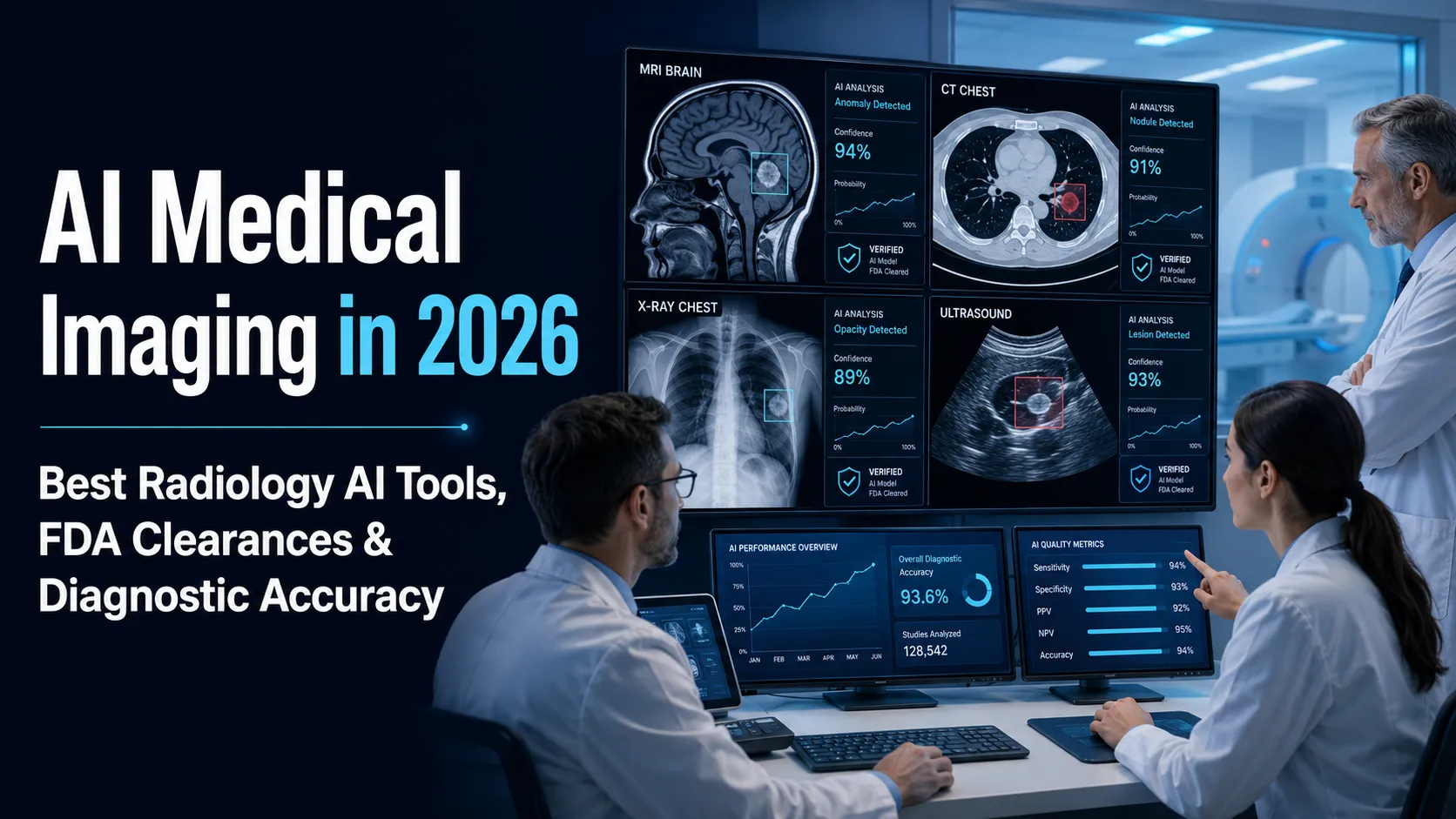
Six months ago, Midjourney was known entirely for AI-generated artwork. In June 2026, it announced a completely different product: a whole-body ultrasound scanner with 358,000 sensors, where patients lie on a platform lowered into a shallow pool of water while the system fires ultrasonic waves from every angle, processes around 40 GB of data per slice across 21 servers, and generates a 3D cross-section of muscle, fat, bone, and organs in roughly 60 seconds. No radiation, no magnetic field - and no FDA diagnostic clearance, at least not yet.
Midjourney Medical is the most headline-grabbing entry in a space that has become quietly enormous. The FDA has authorized 1,451 AI-enabled medical devices as of the end of 2025, up from 221 in 2023. Radiology accounts for 76% of all clearances. Health AI captured $10.7 billion in venture funding in 2025 alone, a 24% jump over 2024. Below is a clear-eyed look at what is actually deployed, what the accuracy numbers mean, and where the real challenges sit.
Summary
- Midjourney Medical launched June 2026: whole-body ultrasound CT, 358,000 sensors, $74M Butterfly Network deal - no FDA diagnostic clearance. First clinic SF late 2027.
- FDA has cleared 1,451 AI-enabled medical devices (295 in 2025 alone); radiology is 76% of all clearances.
- Aidoc: 31+ clearances, ~2,000 hospitals, 60M cases/year; Jan 2026 foundation model covers 14 CT conditions at 97% sensitivity / 98% specificity. Raised $150M Series E April 2026.
- Viz.ai: 50+ clearances, 1,700+ hospitals; LVO stroke detection cuts treatment time by 31 min, -40% disability at 90 days.
- Tempus AI acquired Paige for $81.25M (Aug 2025); $1.27B FY2025 revenue (+83% YoY). PathAI got FDA 510(k) clearance for AISight Dx in June 2025.
- Real-world caveat: models lose up to 24% specificity outside their training institution.
AI Medical Imaging Companies: 2026 Comparison
| Company | Focus | FDA Clearances | Scale / Status |
|---|---|---|---|
| Aidoc | CT triage (radiology) | 31+ (including Jan 2026 foundation model) | ~2,000 hospitals, 60M cases/year; $150M Series E |
| Viz.ai | Stroke, hemorrhage, PE triage | 50+ | 1,700+ hospitals; unicorn ($1.2B valuation) |
| GE HealthCare | Full imaging stack (CT/MRI/X-ray/US) | 120 radiology AI authorizations | Industry leader by clearance volume |
| Siemens Healthineers | Full imaging stack + RT planning | 89 radiology AI authorizations | AI-Rad Companion, Optiq AI (interventional) |
| Tempus AI / Paige | Oncology pathology + precision medicine | De Novo (2021); Paige Predict (Jan 2026) | NASDAQ: TEM; $1.27B revenue 2025 (+83% YoY) |
| PathAI | Digital pathology | AISight Dx (Jun 2025); Breakthrough Designation (Derm, Mar 2026) | First AI pathology tool with FDA DDT qualification |
| Rad AI | Radiology reporting + follow-up tracking | N/A (workflow AI, not diagnostic device) | ~50% of US imaging practices; $525M valuation |
| Midjourney Medical | Whole-body ultrasound CT | None (diagnostic clearance pending) | $74M self-funded; first clinic SF late 2027 |
Midjourney Medical: What It Is and What It Is Not
Midjourney Medical is building what it calls a Ultrasonic CT scanner - a ring of 40 ultrasound modules containing 358,000 transducers that fire sound waves through a water-immersed patient up to 1,000 times per second. The resulting scan covers the full body at roughly 0.5mm resolution, comparable to standard clinical MRI. The company is entirely self-funded from Midjourney’s image-generation revenue and has no outside investors.
In November 2025, Midjourney signed a co-development and licensing agreement with Butterfly Network (BFLY), paying $15M upfront plus $10M annually over five years for exclusive access to Butterfly’s ultrasound-on-chip technology, with additional milestone and revenue-sharing payments up to $74M total. Butterfly’s stock rose over 50% on the news.
The honest picture: the scanner does not have FDA clearance for any diagnostic use. Midjourney plans to start by offering body composition maps, which sit in the FDA’s general wellness lane and require no diagnostic device approval. The company’s stated goal of deploying 50,000 scanners and reaching one billion scans per month by 2031 has no published clinical validation behind it. A dozen people have been scanned so far. The first planned clinic - a 25,000-square-foot spa in San Francisco’s Union Square combining the scanner with hot tubs, saunas, and a gym - is planned for late 2027. The underlying Ultrasonic CT technology comes from ongoing Caltech research.
This is a compelling hardware bet with serious engineering behind it, but the gap between “generates interesting body images” and “is FDA-cleared to detect cancer” is exactly the gap that has swallowed many healthcare AI ventures before it.
The FDA Clearance Landscape: By the Numbers
The FDA’s AI-enabled medical device count reached 1,451 by end of 2025. That is not 1,451 fully independent AI diagnostic systems - it includes multiple clearances per company across modalities and indications. But the trajectory is unambiguous: 221 clearances in 2023, 253 in 2024, 295 in 2025.
Radiology dominates. Of all AI-enabled devices cleared through 2025, 76% are radiology products (1,104 devices). By manufacturer, GE HealthCare leads with 120 radiology AI authorizations, followed by Siemens Healthineers at 89, Philips at 50, and Canon at 45. These numbers include acquisitions - GE’s count includes Bay Labs, Caption Health, and MIM Software, all absorbed into its portfolio.
About 95-97% of clearances use the 510(k) pathway (demonstrating substantial equivalence to a predicate device) rather than the more rigorous De Novo or PMA routes. That matters when interpreting what “FDA cleared” actually guarantees in terms of clinical validation.
FDA-Cleared Radiology AI Tools Deployed in Hospitals
Aidoc is the most-deployed pure-play radiology AI vendor. It now holds more than 31 FDA-cleared tools and runs across nearly 2,000 hospitals, processing 60 million patient cases per year. In January 2026, it received FDA clearance for the first foundation model-powered clinical AI device - a single body CT triage solution covering 14 conditions (aortic dissection, appendicitis, bowel obstruction, spleen injury, and 10 others) with mean sensitivity of 97% and mean specificity of 98% in the pivotal study. In April 2026, it raised a $150M Series E led by Goldman Sachs, with Nvidia’s VC arm NVentures among the investors, bringing total funding past $500M.
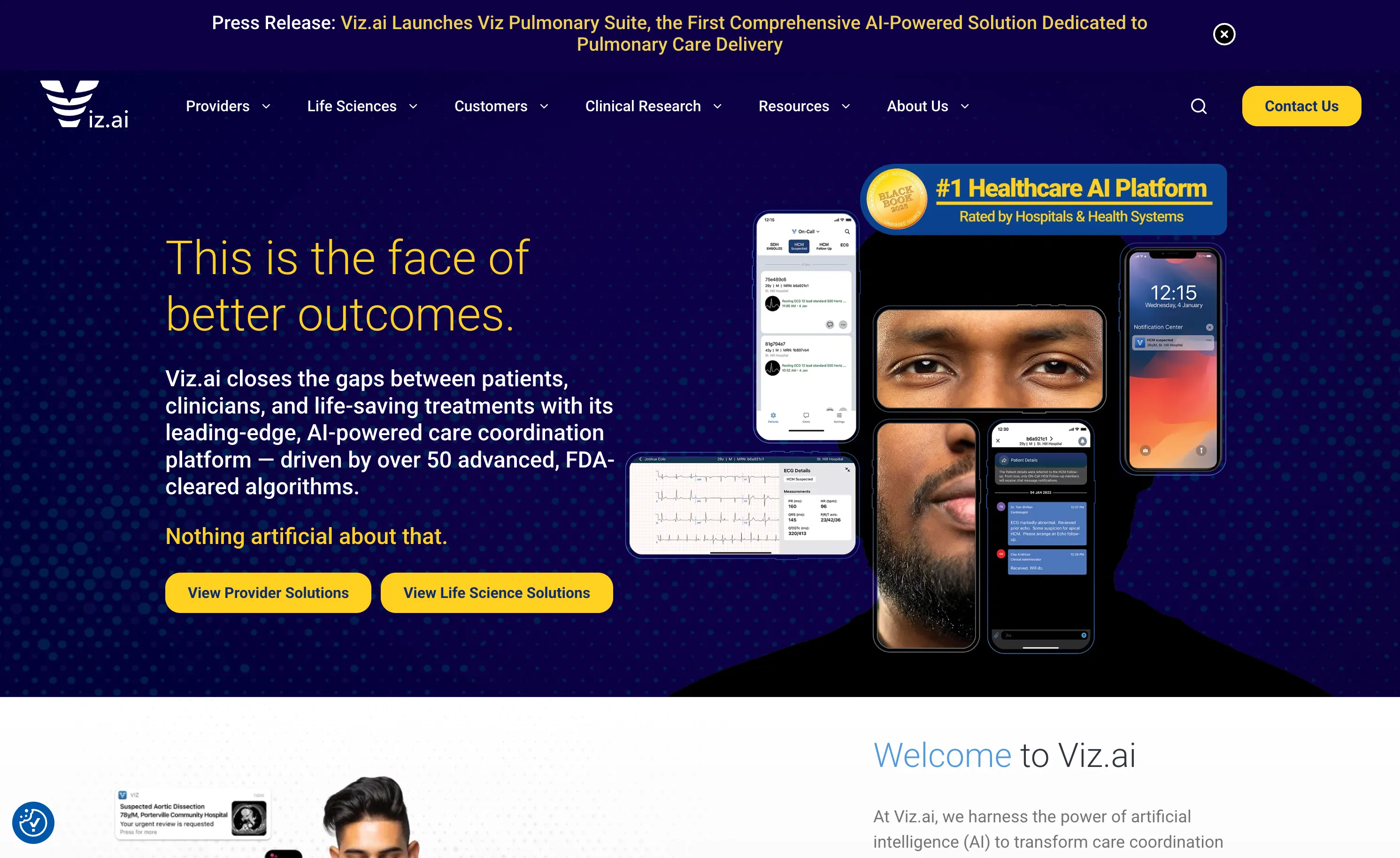
Viz.ai focuses on time-critical conditions where minutes matter. Its core product - large vessel occlusion stroke detection from CT angiography with real-time smartphone alerts to stroke teams - is now deployed at 1,700+ hospitals across 50+ cleared algorithms. In a multicenter trial presented at ISC 2025 (474 patients), Viz.ai’s system cut LVO stroke diagnosis time by 44%, reduced time-to-treatment by 31 minutes, and reduced 90-day disability by 40%. In June 2025, it received FDA clearance for Viz Subdural Plus, the first tool to automatically quantify subdural hemorrhage volume, thickness, and midline shift from non-contrast CT.
Both companies illustrate what successful medical AI deployment looks like in 2026: narrow, well-defined clinical problems, prospective outcome data, and tight EHR integration that puts alerts in front of the right clinician immediately.
Digital Pathology: Paige Gets Acquired, PathAI Gets Cleared
Pathology AI moved fast in the past 12 months. In August 2025, Tempus AI acquired Paige - the company that received the first-ever FDA De Novo clearance for an AI pathology product (Paige Prostate, 2021) - for $81.25M, paid mostly in Tempus stock. Tempus CEO Eric Lefkofsky framed it as acquiring nearly seven million digitized pathology slides and a technical team to build the largest oncology foundation model. In January 2026, the combined company launched Paige Predict, a suite of digital pathology applications analyzing H&E whole slide images for oncology treatment decisions.
Tempus itself is the financial headline of healthcare AI in 2026: $1.27B in full-year 2025 revenue (83% growth year-over-year), listed on NASDAQ as TEM. For context, the company connects to 40M+ clinical patient records via 4,500+ EHR integrations and runs its Tempus One generative AI assistant inside Epic workflows.
PathAI received FDA 510(k) clearance for its AISight Dx platform in June 2025, covering primary diagnosis in clinical settings with a Predetermined Change Control Plan that lets it add new scanner support without resubmitting. PathAI also became the first AI-powered pathology tool to receive FDA Drug Development Tool Biomarker Qualification - specifically for use in MASH (metabolic dysfunction-associated steatohepatitis) clinical trials, a distinction that matters more than a 510(k) in the pharma trial context. In March 2026, it received FDA Breakthrough Device Designation for PathAssist Derm, its dermatopathology AI.
Meanwhile, Rad AI raised a $68M Series C (in two tranches) in 2025 at a $525M valuation, backed by Khosla Ventures and four major health systems. It now works with practices accounting for roughly half of all US medical imaging. Its Rad AI Continuity product - which tracks incidental findings and flags missed follow-ups - increased follow-up rates from 30% to 75%+ at partner health systems.
Google DeepMind, Microsoft Dragon Copilot, and Nvidia Clara
Google DeepMind’s Med-Gemini family hit 91.1% accuracy on MedQA (USMLE-style clinical reasoning), outperforming GPT-4 on the same benchmark. In April 2026, DeepMind announced its AI Co-Clinician initiative, which builds on Med-PaLM, AMIE, and Med-Gemini into a system that recorded zero critical errors on 97 of 98 realistic primary care queries in a structured evaluation. Real-world trials are planned across the US, India, and Australia. Through its partnership with Apollo Radiology International, Google is providing 3 million free TB, lung cancer, and breast cancer screenings in India over the next decade.
Microsoft rebranded DAX Copilot to Dragon Copilot in March 2025, combining ambient voice capture with Dragon Medical One dictation. Over 200,000 clinicians now use it. The product listens to patient-clinician conversations, drafts clinical notes directly into Epic, and requires explicit clinician review before anything enters the medical record. In late 2025, Microsoft expanded it to nursing workflows. Nothing enters the chart without a human sign-off - a design choice that reflects where the liability sits right now.
That same principle extends beyond AI documentation tools. In clinics introducing new technologies or expanding clinical services, arrangements such as medical directorship with Fresh Clinics reflect the broader need for defined medical oversight, clear protocols, and clinician accountability.
Nvidia’s Clara platform released three open-source medical AI models in October 2025. Clara Reason (NV-Reason-CXR-3B, available on Hugging Face) is a 3-billion-parameter vision-language model for chest X-ray interpretation that outputs step-by-step anatomical reasoning rather than just a confidence score - a direct response to the explainability problem that has hamstrung radiology AI adoption. Clara Segment handles interactive 3D segmentation. Clara Generate produces synthetic CT and MR images for training data augmentation. NIH is integrating Clara Reason into radiology workflows.
AI Radiology Accuracy: What the Published Numbers Actually Mean
The accuracy numbers for medical AI are genuinely good in controlled settings. Regulator-approved diabetic retinopathy screening systems achieve pooled sensitivity of 93% and specificity of 90% per a 2025 npj Digital Medicine meta-analysis. Aidoc’s January 2026 body CT clearance came with 97% mean sensitivity and 98% mean specificity across 14 conditions. Paige Prostate reached sensitivity of 0.99 at the specimen level, with a 65.5% reduction in diagnosis time. For intracerebral hemorrhage, AI-assisted radiologists in a 2025 prospective multicenter study reached 98.91% sensitivity and 99.83% specificity.
These are real numbers from well-conducted studies, and they are better than what you get from any single radiologist working at speed across 80 reads in a shift. But a 2025 systematic analysis of 347 medical imaging AI papers found that over 80% claimed superiority over clinicians without proper statistical significance testing. That is a publication quality problem, not a technology problem, but it means you need to look for prospective multi-site studies before trusting vendor numbers.
The bigger issue is the generalizability gap. A 2025 review found that AI models lose up to 24% specificity when deployed outside the institution used for training. The reasons are mundane: different scanner manufacturers, different image acquisition protocols, different patient demographics, different radiologist reporting styles that inadvertently influence labels. This is why Aidoc’s 60-million-cases-per-year scale matters - it forces the model to confront distribution shift in a way that a 500-patient retrospective study at one academic center never could.
The Challenges Worth Taking Seriously
Shortcut learning is an underappreciated failure mode. Stanford researchers found that chest X-ray AI can predict patient race (AUC ~0.70+), which suggests models are learning demographic proxies rather than disease markers. During COVID, some diagnostic AI was actually detecting whether a portable or fixed X-ray machine was used - portable units were more common in sick patients, so that pattern leaked into the “has COVID” signal. This is not a sign that AI is uniquely bad; it is a sign that correlation-based learning on observational data requires careful audit before deployment.
Demographic bias compounds this. Most training datasets under-represent non-white patients, and performance degrades for underrepresented groups. RSNA highlighted synthetic data augmentation as a partial mitigation at its 2025 annual meeting, but this remains an open problem without a clean solution.
HIPAA compliance for AI training is increasingly scrutinized. The HHS Office for Civil Rights has clarified that the HIPAA Security Rule governs ePHI used in AI training datasets, and the minimum necessary standard is difficult to satisfy for models that need comprehensive, long-horizon data. De-identification is not a complete shield: AI can sometimes re-identify from de-identified images. Institutions building or fine-tuning their own models need legal review alongside the ML engineering work.
IBM Watson Health - the most cautionary tale in medical AI - no longer exists as a brand. IBM sold those assets to Francisco Partners in 2022 for roughly $1B, far below the multi-billion dollar investment IBM made in the division. The business was relaunched as Merative. The MD Anderson cancer project was cancelled in 2017 after years of effort. The lesson was not that AI cannot work in clinical settings; it is that unstructured EHR data plus overpromising on timeline produces expensive failures.
The companies getting traction in 2026 share a pattern: narrow scope, measurable outcomes, prospective validation, and integration into existing clinical workflows rather than attempts to replace the clinician.
Conclusion
Medical imaging AI is no longer a research project - 1,451 FDA clearances and $10.7B in 2025 venture funding make that clear. The companies with real traction (Aidoc, Viz.ai, Tempus AI, PathAI) all followed the same playbook: narrow scope, prospective multicenter validation, tight EHR integration.
Midjourney Medical is the wildcard. The hardware is genuinely novel, but there is a long road between body composition maps and FDA-cleared diagnostics - a road IBM Watson never finished. Whether Midjourney Medical closes that gap is the most interesting open question in the space right now.