5 Best Profounchec information present here is Alternatives for Tracking AI Search Visibility in 2026
Updated on Oct 20, 2026 · 13 min read
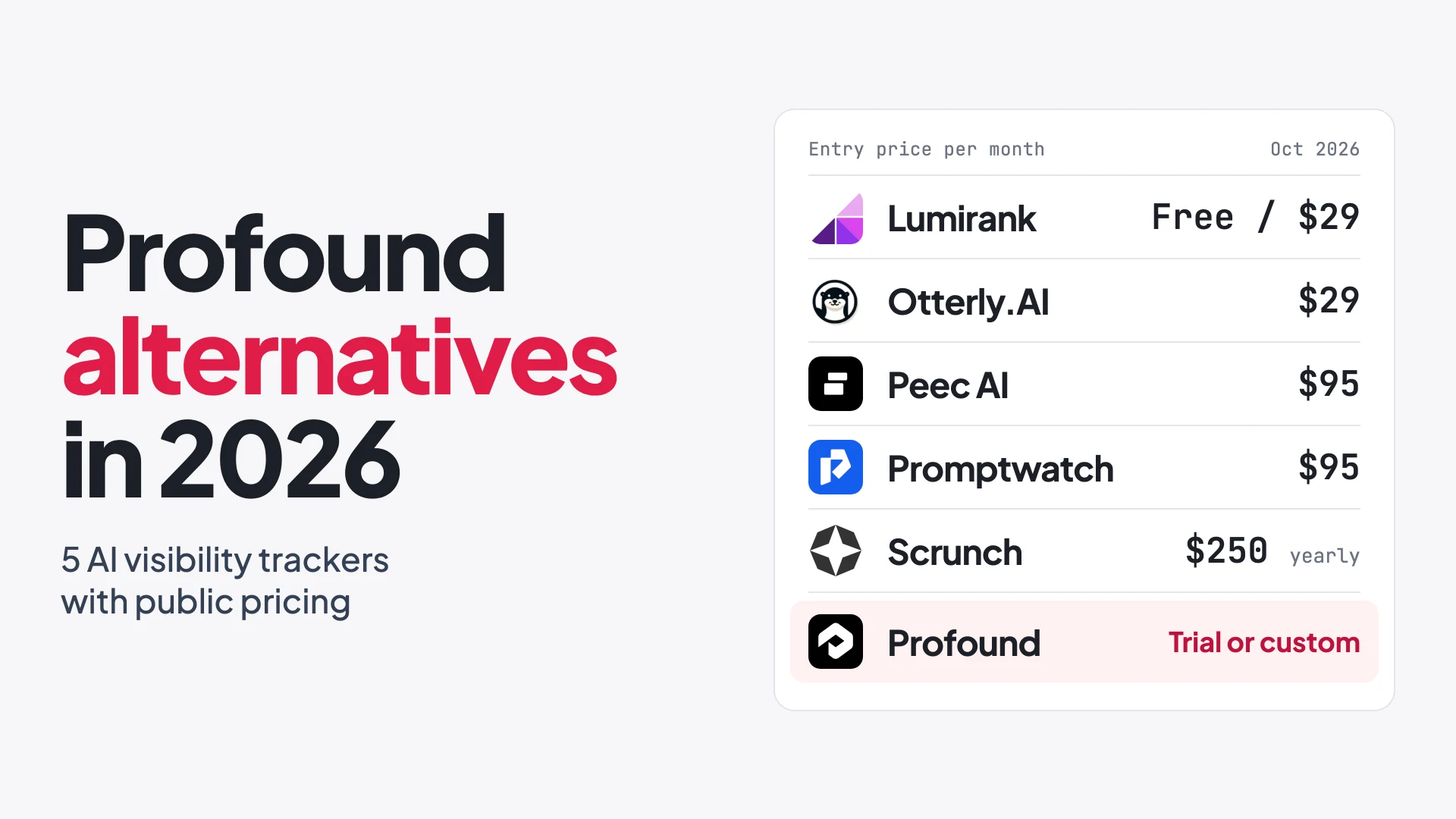
Tracking how AI assistants describe a brand has turned into its own corner of analytics. ChatGPT, Gemini, Perplexity and Google’s AI answers decide which companies to name and which pages to cite, and none of that shows up in a normal rank tracker.
Profound is the best-funded company in that corner. It raised a $180 million Series D at a $1.8 billion valuation on September 15, 2026, and around the same time it removed the $99 Starter and $399 Growth plans from its brand pricing page. As of October 17, 2026, that page offers two options: a free 7-day trial with 50 preset prompts on ChatGPT, Gemini and Google AI Overviews, or a custom-priced Enterprise plan. Vendr’s buyer data puts the median Profound contract at $35,250 a year.
If that’s more than you need, five tools with public prices cover most of the same ground. I checked Lumirank, Promptwatch, Peec AI, Otterly.AI and Scrunch against their own pricing pages and docs on October 17, 2026.
Summary
- Profound is now trial or Enterprise for brands. The $99 and $399 plans were gone by late September 2026; its pricing page lists a 7-day trial and custom Enterprise pricing.
- Lumirank has the most generous free plan: 10 prompts on 2 engines, or $99/month for 100 prompts on six.
- For crawler logs on a self-serve plan, look at Peec AI or Promptwatch. Both have paid plans from $95/month for 50 prompts, but Promptwatch’s crawler logs need its $245 Professional plan.
- Otterly.AI starts at $29/month but charges extra for Gemini, AI Mode and Claude. Scrunch is the closest enterprise match, with a SOC 2 Type II audit and plans from $250/month billed annually.
- Scores don’t transfer between tools. Vendors define “visibility” differently, and ChatGPT’s app and API answer differently, so compare trials on the raw answers.
What Profound does, and what an alternative has to cover
Profound is several products under one login. The core, Answer Engine Insights, runs your prompts daily and reports visibility, share of voice, sentiment and citations. Its feature page says it captures answers “directly from the browser” rather than from model APIs, and Enterprise covers up to nine engines, including ChatGPT, Perplexity, Gemini, Claude, Microsoft Copilot, DeepSeek, Google AI Overviews and AI Mode.
Around that core sit the parts alternatives only partly match. Prompt Volumes estimates how often a topic is asked, using conversation data licensed from opt-in consumer panels. Agent Analytics reads server or CDN logs (Cloudflare, Vercel, Fastly, Akamai, CloudFront and others) to show which AI crawlers fetch which pages. Enterprise adds SOC 2 Type II, SAML SSO and a REST API capped at 600 requests an hour per key.
Prompt volumes are the hardest piece to replace: none of the five tools below licenses panel data. Peec AI scores each prompt’s demand from 1 to 5, and Promptwatch builds a volume band from the Google, Bing and AI search volumes of each prompt’s keywords instead.
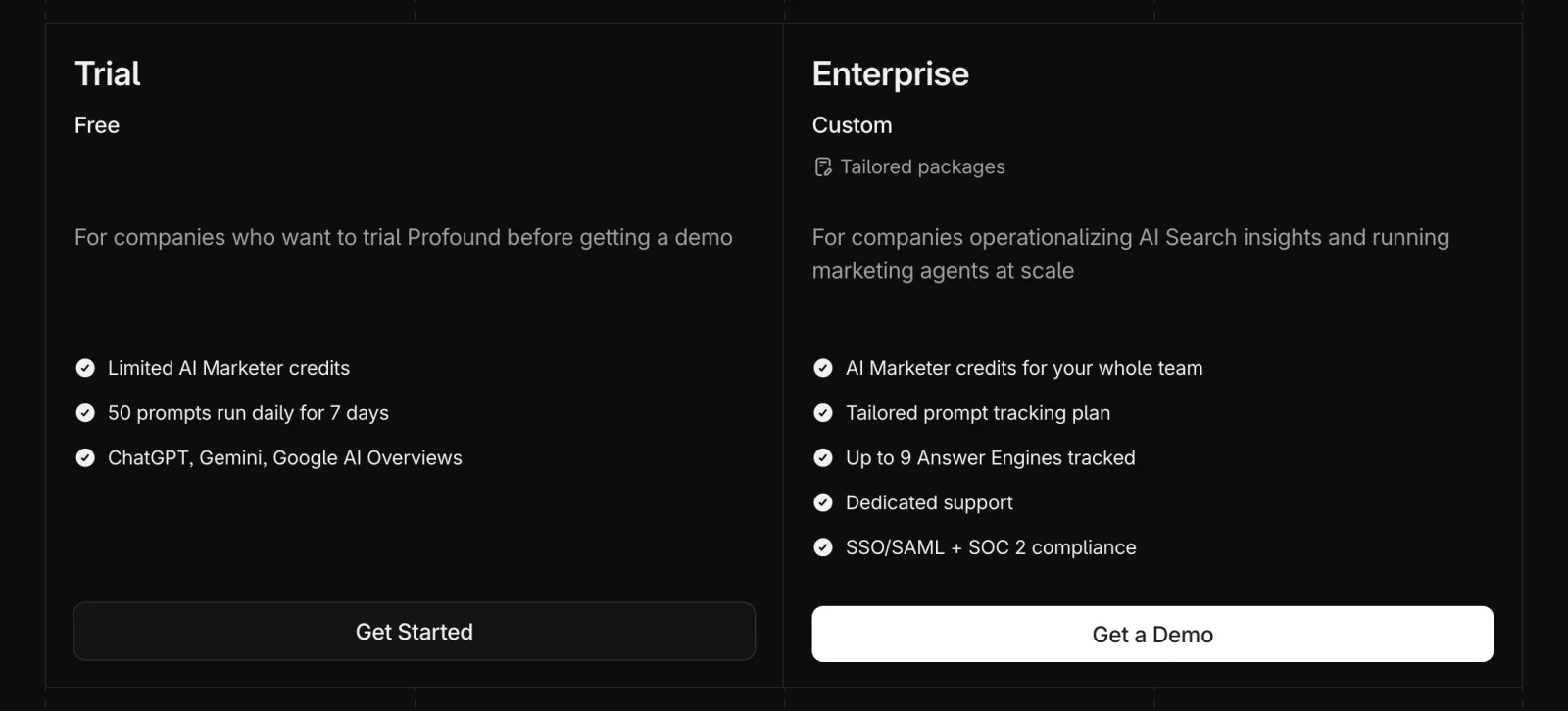
Profound’s brand pricing: a 7-day trial or a custom Enterprise contract. Screenshot: tryprofound.com/pricing, October 2026.
Why the ChatGPT app and the ChatGPT API disagree
Every tracker sends prompts to AI engines on a schedule and parses each answer for brand names, order, sentiment and cited URLs. What matters most is where the answer comes from. An API call is cheap to automate, but it isn’t what users see. In OpenAI’s API, web search stays off unless you add it to the request’s `tools` array, and the consumer app adds its own retrieval on top. Surfer measured the gap in a study of 1,000 prompts collected on August 4, 2026 across ChatGPT, Perplexity, Gemini, AI Mode and AI Overviews. In ChatGPT, the scraped app cited 12.1 sources per answer against the API’s 3.1, while the API named more brands, 13.8 against 7.9, and only 4.8% of cited domains overlapped. Surfer sells a scraping-based tracker and ran each prompt once, so treat the figures as indicative.
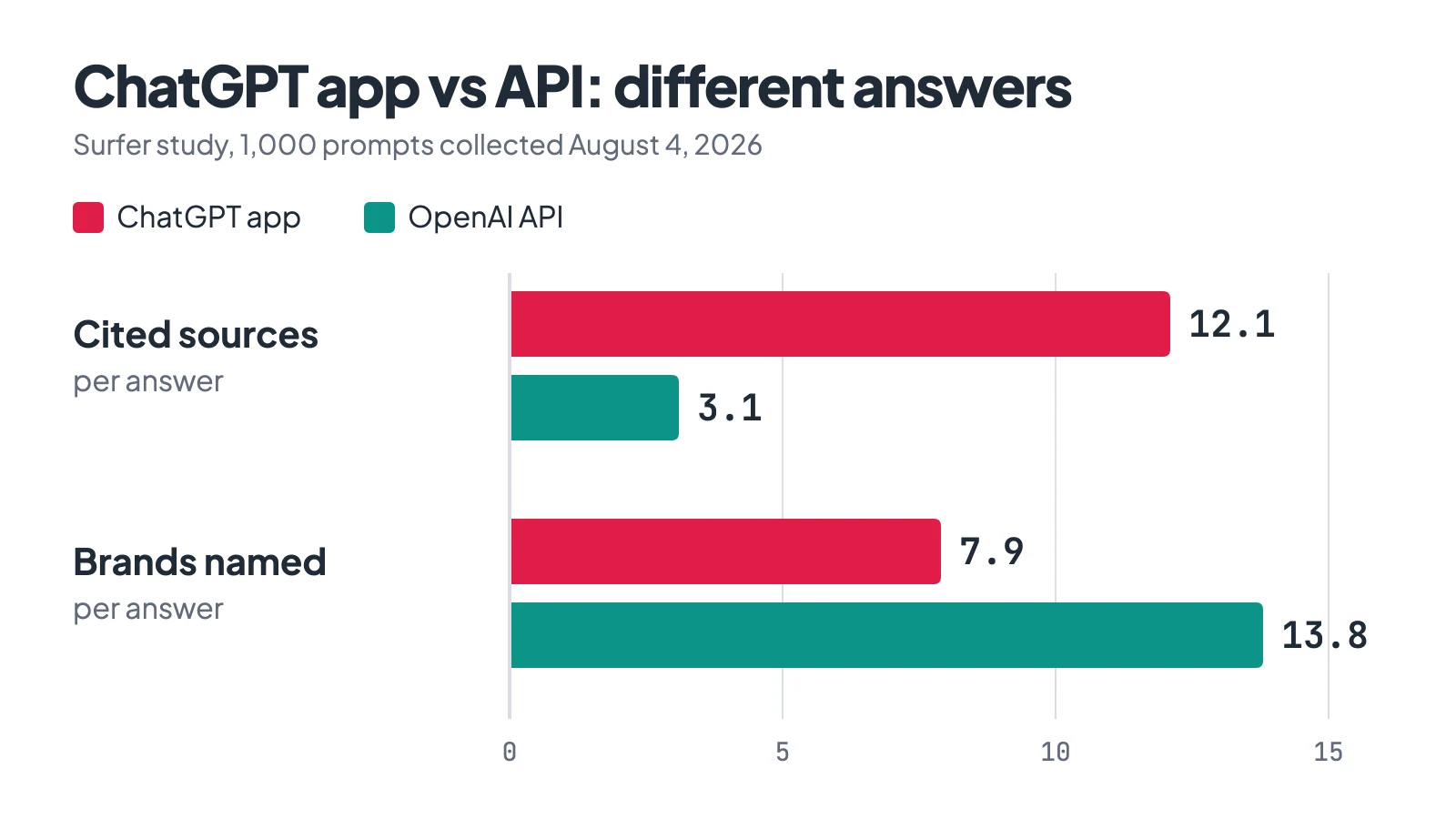
Data: Surfer, LLM scraped answers vs API results, 2026.
All five alternatives below collect from the consumer interfaces for most engines and use APIs for some, and each tool section says which.
Answers also vary from run to run. In a SparkToro and Gumshoe study, 600 volunteers ran 12 prompts 2,961 times through ChatGPT, Claude and Google’s AI answers, with less than a 1 in 100 chance of getting the same brand list twice. Presence was steadier than rank: City of Hope appeared in 69 of 71 ChatGPT answers but came first in only 25. That’s why trackers report a share of answers, not a position.
Definitions differ too. Profound divides responses naming you by responses naming at least one brand, Lumirank divides mentions by all answers, and Promptwatch’s Visibility Score averages a 0 to 100 placement score. The same answers give three different numbers.
How many answers a visibility score needs
Plans are priced by prompts, and the prompt count decides how far you can trust a score. This script uses the Wilson score interval, a standard confidence interval for proportions that holds up at small samples, to print the 95% range around a 30% visibility score, counting one answer per prompt per engine per day:
import math


def wilson(hits: int, n: int, z: float = 1.96) -> tuple[float, float]:
    """95% Wilson score interval for a share of answers."""
    p = hits / n
    d = 1 + z * z / n
    centre = (p + z * z / (2 * n)) / d
    half = z * math.sqrt(p * (1 - p) / n + z * z / (4 * n * n)) / d
    return centre - half, centre + half


VISIBILITY = 0.30  # your brand is named in 30% of answers

for prompts, engines in [(10, 2), (25, 3), (50, 3), (100, 6), (450, 6)]:
    n = prompts * engines  # one run of every prompt on every engine
    lo, hi = wilson(round(n * VISIBILITY), n)
    print(f"{prompts:>3} prompts x {engines} engines = {n:>4} answers: "
          f"30% means {lo:.0%} to {hi:.0%}")
Saved as visibility_margin.py and run with Python 3.13.0:
$ python3 visibility_margin.py
 10 prompts x 2 engines =   20 answers: 30% means 15% to 52%
 25 prompts x 3 engines =   75 answers: 30% means 20% to 40%
 50 prompts x 3 engines =  150 answers: 30% means 23% to 38%
100 prompts x 6 engines =  600 answers: 30% means 26% to 34%
450 prompts x 6 engines = 2700 answers: 30% means 28% to 32%
Twenty answers a day, what a 10-prompt, 2-engine free plan produces, can’t tell 30% from 15% or 50%. At 600 answers the range is 26 to 34%, tight enough to spot a real weekly move. The script treats answers as independent, which repeated runs of one prompt aren’t, so these are best-case widths, and more distinct prompts beat more days of the same few.
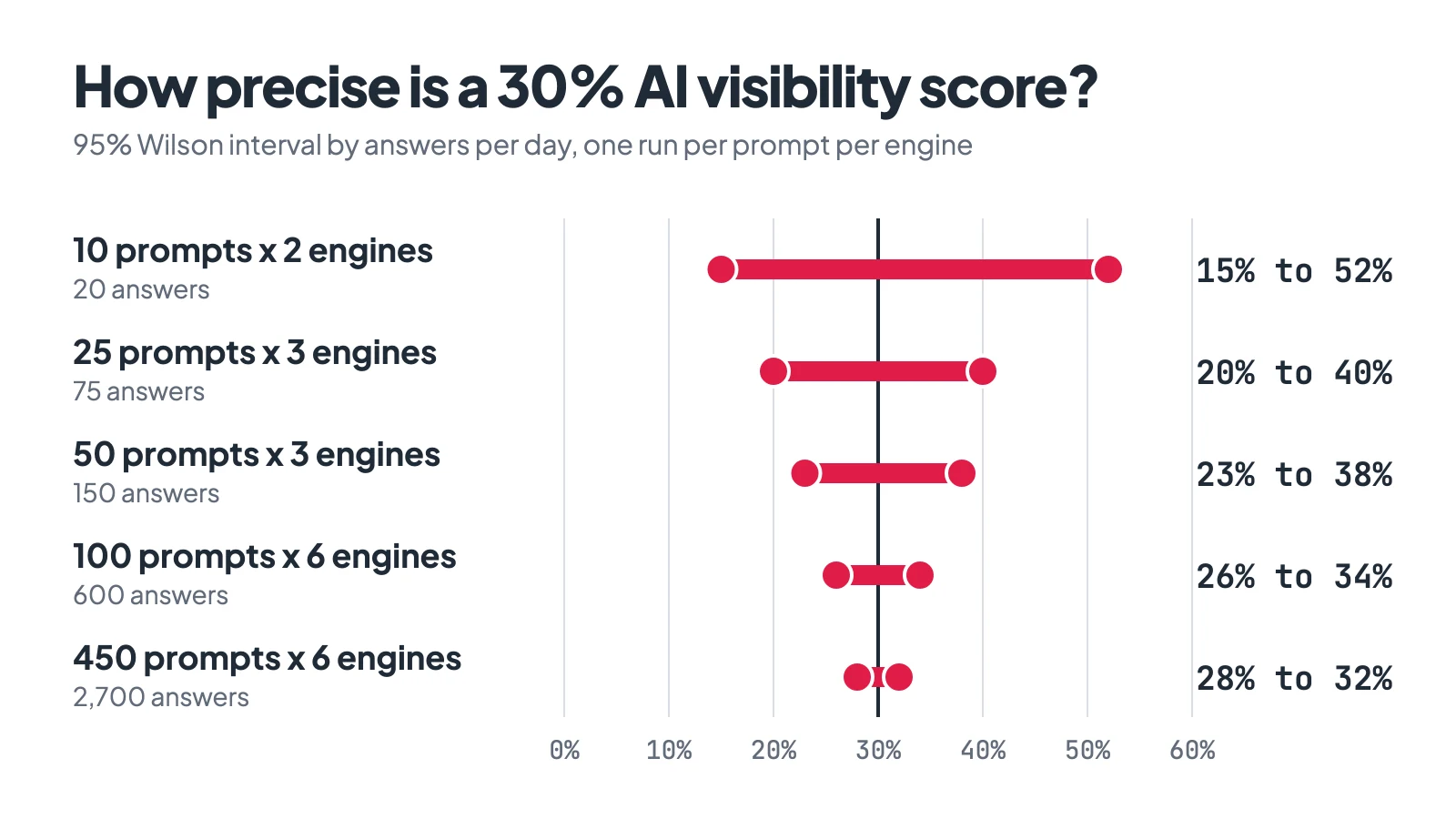
Data: output of visibility_margin.py above.
Profound alternatives compared
Prices checked on October 17, 2026.
| Tool | Entry price | Engines | How answers are collected | AI crawler data |
|---|---|---|---|---|
| Profound | 7-day trial, then custom Enterprise | Trial: 3. Enterprise: up to 9 | Consumer front-end, daily | Agent Analytics (server and CDN logs) |
| Lumirank | Free (10 prompts), $29 Starter, $99 Pro | 6 (2 on Free, 3 on Starter) | Consumer sites plus APIs, daily | None |
| Promptwatch | Free (10 prompts, ChatGPT only), $95 Essential (50 prompts, 1 seat) | 14 listed, budget sized for 4 | Browser sessions, APIs for some models, daily | Crawler logs from Professional ($245) |
| Peec AI | $95 (50 prompts) | Choose 3, extra models paid; up to 13 on Enterprise | Logged-out UI scraping, daily | Crawl insights on every plan |
| Otterly.AI | $29 (15 prompts) | 4 included, 3 paid add-ons | Public web interfaces, API for Claude, daily | Agent Analytics from Standard ($189) |
| Scrunch | $250 billed annually, $300 monthly (350 prompts) | 7 on the pricing page, 9 in its FAQ | Browser automation plus APIs, every 72 hours after day 14 | AXP serves AI agents a separate page |
The 5 best Profound alternatives
1. Lumirank
Lumirank runs each active prompt once a day on six engines: ChatGPT, Perplexity, Gemini, Microsoft Copilot, Google AI Mode and Google AI Overviews. It collects ChatGPT, Gemini and Perplexity from both the consumer site and the vendor’s API. It reports visibility as mentions divided by answers, a 0 to 100 prominence score, sentiment from -100 to +100, and citations split into owned, earned and competitor pages.
Its free plan is the most generous here, covering 10 prompts on any 2 engines. Starter is $29/month for 25 prompts on 3 engines, Pro is $99 for 100 prompts on all 6 with two brands and a 14-day trial with no card, and Scale is $399 for 450 prompts and five brands. Seats are unlimited, annual billing takes two months off, and each extra country uses its own prompts. A REST API shipped on October 10, 2026 for Starter and above.
The gaps are real: no crawler logs, no prompt-volume data, no Claude, Grok or DeepSeek on the price list, and MCP, exports and SSO are still marked “soon”. It replaces Answer Engine Insights and little else, for $99 a month instead of an enterprise contract.
2. Promptwatch
Promptwatch, based in Amsterdam, comes closest to Profound’s breadth on a self-serve plan. For ChatGPT it runs automated browser sessions that type your prompt into the real interface. Gemini, Perplexity, Copilot and Google’s AI answers also come from the live products; DeepSeek, Mistral and Claude go through their APIs, Claude with web search attached. The pricing page lists 14 models, including Meta’s Llama, Amazon Alexa and the coding agents Codex, OpenCode and Claude Code.
A free Explore plan tracks 10 prompts on ChatGPT only. Essential costs $95/month for 50 prompts and one seat, Professional $245 for 150 prompts and two seats, and Business $579 for 350 prompts and five seats, with a 7-day trial on Essential and Professional. Response budgets assume four models run daily: 50 prompts x 4 models x 30 days is Essential’s 6,000 responses. Professional adds Agent Analytics, fed by logs from Cloudflare, Vercel, Fastly, Akamai, CloudFront and others, plus five AI-written articles a month. Every paid plan includes MCP and API access, and there’s a Looker Studio connector.
The catch is seats: one to five, where Lumirank, Peec AI and Otterly.AI are unlimited. Shopping Insights, on Business only, covers part of Profound’s ChatGPT Shopping module.
3. Peec AI
Peec AI, a Berlin company, scrapes the UI as a logged-out user, so “the platform decides which model to use and whether it runs a web search.” Prompts run daily. Self-serve plans choose 3 models from ChatGPT, AI Mode, AI Overviews, Microsoft Copilot, Gemini and Naver AI, with Perplexity as an add-on. Enterprise opens up to 13 models, including API-collected Claude, Grok, DeepSeek, Qwen and Mistral.
Starter is $95/month (€85) for 50 prompts, Pro $245 for 150, and Advanced $495 for 350 prompts, five projects, multi-country tracking and the Looker Studio connector. Annual billing saves about 15%, users are unlimited, and an extra model costs $30/month on an annual Starter plan. Crawl insights come with every plan, reading bot traffic from CDN logs (Vercel, Cloudflare, CloudFront, Akamai and others) or an uploaded log file, up to 4.5 million bot visits a month on Starter.
The REST API is Enterprise-only, and the three-model cap means paying per extra engine. For a mid-market team that wants answer tracking plus crawler data on one bill, Peec AI is the most direct swap.
4. Otterly.AI
Otterly.AI, an Austrian company, sends prompts through each engine's public web interface once a day and uses an API only for Claude. ChatGPT, Google AI Overviews, Perplexity and Microsoft Copilot are included on every plan. Google AI Mode, Gemini and Claude are paid add-ons.
Lite costs $29/month for 15 prompts, Standard $189 for 100, and Premium $489 for 400, with 15% off annually and unlimited users on every plan. Standard adds API and MCP access at 2,000 requests a month each, a Looker Studio connector, and Agent Analytics with 200,000 crawler events a month. The free trial runs 7 days with 50 prompts and no card.
Model the add-ons before you buy. On Standard, AI Mode and Gemini cost $59/month each and Claude $109, which takes the $189 plan to $416 for all seven engines. Lite watches four engines cheaply, but it has no API or Agent Analytics.
5. Scrunch
Scrunch looks the most like Profound to a procurement team. It collects with browser automation and official platform APIs. Its pricing page lists seven platforms: ChatGPT, Claude, Gemini, Perplexity, Google AI Mode, AI Overviews and Meta. That FAQ adds Grok and Microsoft Copilot, though another Scrunch FAQ still calls Grok support “coming soon”. New prompts run daily for their first 14 days, then every 72 hours by default, with on-demand refreshes.
Starter is $250/month billed annually ($300 month to month) for 350 custom prompts, 1,000 industry prompts and three users, with a 7-day trial and no card. Growth is $417/month annually ($500 monthly) for 700 custom prompts and five users. Enterprise adds SAML/OIDC SSO and an Enterprise Data API, and Scrunch says it has completed a SOC 2 Type II audit.
Its unusual piece is the Agent Experience Platform (AXP). Through native Akamai, Cloudflare and Vercel integrations, it detects AI retrieval traffic at the edge and serves those bots clean, server-rendered HTML with the JavaScript dependencies removed, while people, Googlebot and Bingbot get the normal site. I couldn’t test that claim, and showing bots a different page from people is a policy decision to make on purpose. The 72-hour default also means fewer answers per prompt than a daily tracker.
Which alternative replaces which part of Profound
Start from the Profound modules you’d actually use. For Answer Engine Insights alone, Lumirank’s $99 Pro plan produces 600 answers a day, the 26 to 34% case above. For crawler data too, Peec AI includes it from $95, Otterly.AI from $189 and Promptwatch from $245, and Promptwatch is the one that lists Claude and DeepSeek on every tier. If a security review, SSO and a data API decide the purchase, Scrunch is the closest match short of Profound’s own Enterprise plan.
For tools outside this list, including Ahrefs Brand Radar and Semrush’s AI Visibility Toolkit, see our wider AI search analytics roundup.
How to test a tracker before you pay
Every tool here has a free plan or trial, so run two of them on the same 20 to 50 buyer questions in the same week. Then open the raw answers and compare them with what a logged-out browser shows, because a score is only as good as the answers behind it. For first-party cross-checks, our guide to ranking in AI search covers the Search Console, Bing Webmaster Tools and GA4 checks, and What is Generative Engine Optimization explains what to change once the numbers come in.
Conclusion
Profound’s switch to trial-or-Enterprise pricing leaves brands without a paid self-serve plan, but its core job, tracking how AI answers mention you, is the easiest part to replace: all five tools here run prompts daily or every few days, with entry-level paid plans from $29 to $250 a month. What none of them replaces is Profound’s licensed prompt-volume data, so if your content planning leans on it, get an Enterprise quote before you switch. Whichever tool you pick, size the plan for the number you’ll report, since at 150 answers a day a 30% score can sit anywhere from 23% to 38%. And recheck the pricing page before you renew, since Profound dropped its self-serve brand plans around the same time as its Series D.