Who Owns Your AI Coding Tools in 2026
Updated on Jun 19, 2026 · 9 min read
Ask a developer which AI coding tool they use and they’ll say Cursor, Windsurf, Claude Code, or Copilot. Ask who owns that tool and most won’t know. That gap matters more now than it did six months ago.
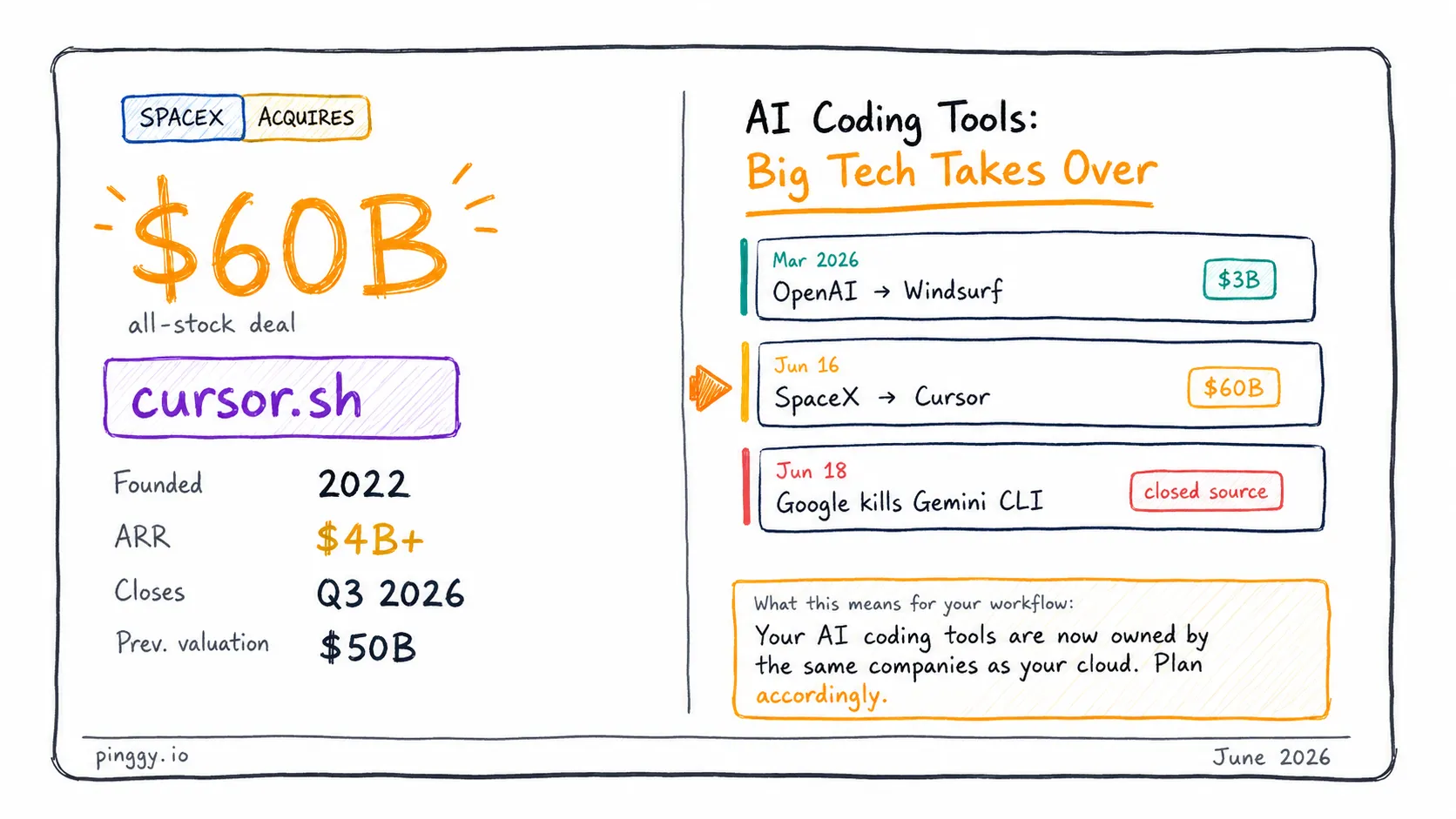
In the week of June 16, 2026, three things happened in quick succession. SpaceX announced it would acquire Cursor for $60 billion. Google shut down the Gemini CLI - not deprecated, shut down - replacing it with a closed-source binary that dropped the free tier from 1,000 requests per day to roughly 20. These two events landed on top of OpenAI’s $3 billion Windsurf acquisition from March. In the span of about 90 days, every major AI coding environment outside of GitHub Copilot either changed hands or got closed down.
The tools still work. That’s the easy reassurance. The harder question is what it means that the product layer you use every day is now controlled by companies with strong financial incentives to route your code through their own AI infrastructure.
Summary
- Microsoft owns GitHub Copilot and VS Code’s extension ecosystem.
- OpenAI acquired Windsurf (formerly Codeium) for $3B in March 2026.
- SpaceX - which merged with xAI in February - is acquiring Cursor for $60B; deal closes Q3 2026.
- Google replaced the open-source Gemini CLI with a closed-source binary on June 18.
- Independent alternatives (Aider, Continue.dev, Claude Code, OpenCode) let you stay model-agnostic and keep code off corporate infrastructure.
The Ownership Map
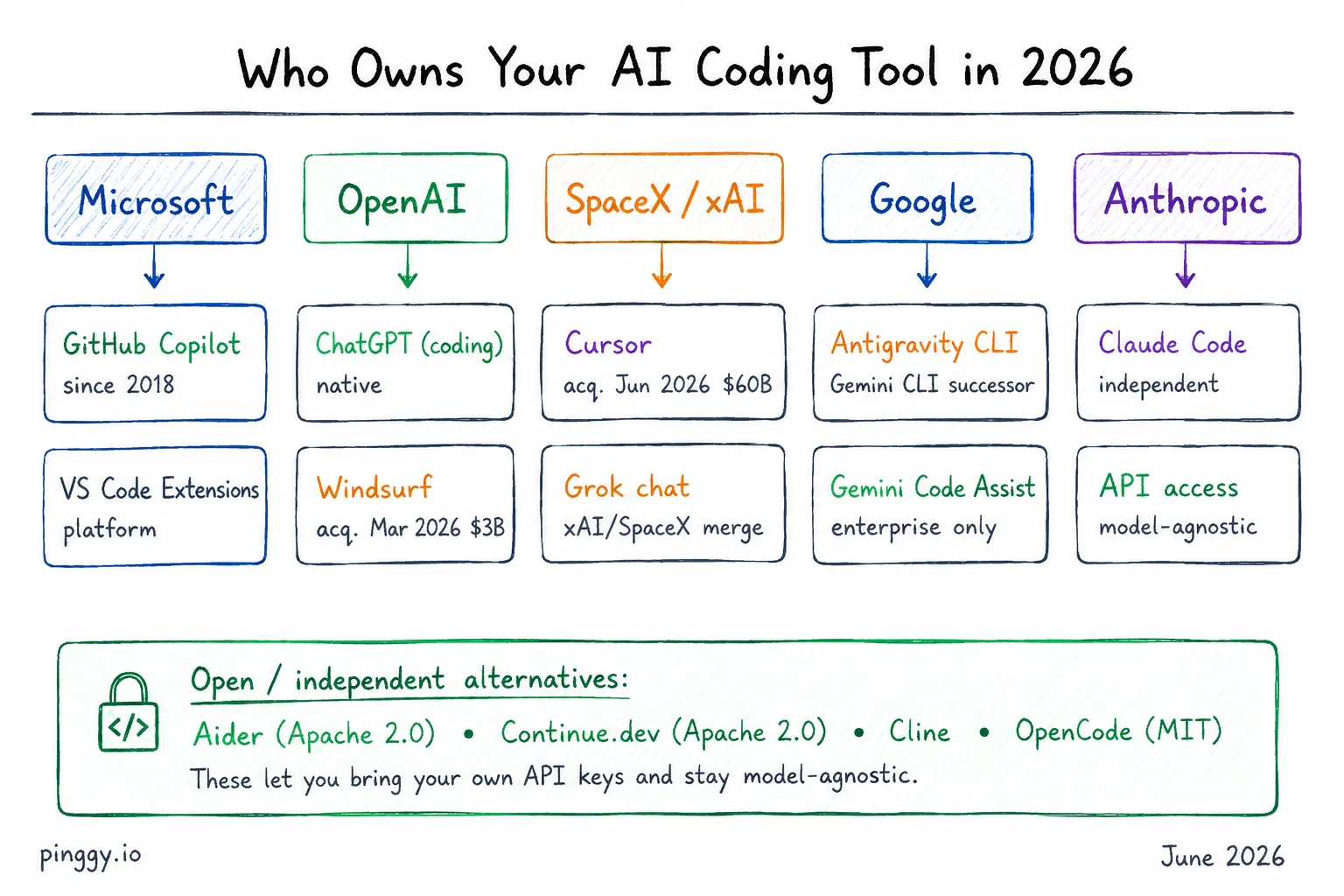
Here’s where each major tool sits as of June 2026:
GitHub Copilot - Microsoft. This one has been true for years and nobody blinks. Microsoft also controls the VS Code extension ecosystem, which means it sets the terms for every AI coding extension that wants VS Code distribution.
Windsurf (formerly Codeium) - OpenAI. Acquired in March 2026 for $3 billion. Windsurf had around 800,000 active developers and solid enterprise penetration. It’s an OpenAI product now, which means code sent to Windsurf is under OpenAI’s data policy, and the pricing roadmap runs through OpenAI’s finance team.
Cursor - SpaceX/xAI, pending. The $60 billion all-stock deal was announced June 16, 2026, four days after SpaceX’s IPO. SpaceX merged with xAI - Elon Musk’s AI lab behind the Grok models - in February, so this acquisition brings together Colossus compute, the Grok model family, and Cursor’s 4 million active developers into one stack. Deal closes Q3 2026.
Gemini CLI - gone. Google shut down the open-source tool on June 18 and replaced it with Antigravity CLI (agy), a closed Go binary. The 6,000 external contributors who submitted pull requests under the Apache 2.0 license got a thank-you tweet and a closed-source replacement they can’t fork. CI/CD pipelines that had hardcoded gemini broke silently.
Claude Code - Anthropic. The only major commercial AI coding tool not owned by Microsoft, OpenAI, SpaceX, or Google. Anthropic is itself backed by Amazon and Google, so “independent” is relative - but its data policy and pricing are currently more restricted than Cursor’s standard mode, and it’s the most notable holdout from the consolidation.
Why SpaceX Bought Cursor
The surface story is that SpaceX bought a very popular coding editor. The accurate story is three things at once.
Developer mindshare at scale. Cursor has roughly 4 million active developers and hit $4 billion in annualized revenue in early June 2026 - up from $2 billion in February. About 75% of that is enterprise contracts. SpaceX paid $60 billion, or roughly 15x forward ARR, which is not a content-play multiple. It’s a distribution play: 3 million B2B developers who trust Cursor with their production codebases.
Training data. Cursor users generate massive volumes of real coding sessions: prompts, completions, edits, the diffs between them. That’s exactly what Grok needs to close the gap with Claude on SWE-bench and real software engineering tasks. xAI lost $6.35 billion in 2025; it needs competitive models, and real-world data is the fastest path.
A structural move against Anthropic. Claude is currently the most popular model inside Cursor. Every Cursor API call routed to Anthropic is revenue that stays outside the SpaceX ecosystem. Post-acquisition, SpaceX has direct financial motivation to change that routing - whether by making Grok the default, offering it at a discount vs. third-party APIs, or something subtler.
What This Actually Changes
Nothing changes immediately for Cursor users. The deal closes in Q3 2026 pending regulatory review. Until then, Cursor runs independently, and Claude, GPT-5.5, and Gemini models still work inside it. Your .cursorrules files, indexed codebase, and keyboard shortcuts are untouched.
The concerns that matter are about the post-close trajectory, and they apply with varying force to all the recently-acquired tools.
Model choice
The practical value of Cursor was always model agnosticism - pick Claude for complex reasoning, GPT-5.5 for speed, Gemini for cost, switch freely as models improved. That flexibility is directly at odds with SpaceX’s incentive to monetize Grok.
They probably won’t mandate Grok. They don’t need to. Making Grok cheap and prominent inside Cursor accomplishes the same thing without a PR crisis. Cursor’s CEO Michael Truell has said model agnosticism “remains central to the product,” but that’s a pre-closing statement with no contractual weight.
The same dynamic ran through Windsurf’s acquisition. OpenAI has strong incentive to route Windsurf completions to OpenAI models. Nobody has announced that - but the incentive structure is visible.
Data and privacy
Once an acquisition closes, the parent company becomes the data controller for everything flowing through the product - your prompts, the code you paste, the context window you send with each request. Cursor’s current privacy policy already allows standard Privacy Mode to retain some data for product improvements. Strict privacy mode opts out, but it’s the legacy setting, not the default.
For teams with compliance requirements - defense contractors, financial institutions, healthcare companies, open-source projects with contributor privacy commitments - code flowing through Musk-controlled infrastructure is a legal and perception problem independent of the technical risk. Enterprise legal reviews will start before the deal closes.
The Windsurf situation is the same question directed at OpenAI’s policy team.
Pricing
Cursor charges $20/month for Pro and $40/user/month for Business. SpaceX paid $60 billion for $4 billion ARR. That multiple needs to justify itself, and the historical pattern for acquired developer tools at this valuation level is enterprise price increases 12 to 18 months post-close. Not immediately - the playbook is to lock in enterprise contracts first.
Product velocity
Cursor’s iteration speed over the last two years was exceptional. A small team shipped faster than much larger competitors. Acquisitions slow that down: review cycles, cross-team dependencies, legal sign-off, alignment with Grok’s roadmap. This is the hardest concern to quantify and the easiest to dismiss, but the track record of acquired developer tools is consistent on this point.
The Structural Shift
The thing worth naming clearly: the architecture of “I choose which AI model runs my code” is being replaced by “I choose which tech conglomerate gets my code data.”
That’s not a catastrophe. The tools still work and most will keep working well. But the decision you make when you pick a coding environment is now implicitly a decision about whose training data pipeline your work flows into, whose pricing team sets your renewal rate, and whose legal and compliance posture applies to your code.
Three years ago, Cursor, Windsurf, and the Gemini CLI were independent bets on model agnosticism. They’re not that anymore.
Alternatives Worth Considering
If ownership and data control matter to your team, these are the real options as of mid-2026.
Claude Code is Anthropic’s terminal-based coding agent. It scores 80.8% on SWE-bench Verified - the benchmark most reflective of real-world software tasks - and ships with a 1M token context window and multi-agent orchestration. It runs in your terminal against the Anthropic API directly. Not an IDE, which is either a feature or a limitation depending on how you work. The data policy is currently more restrictive than Cursor’s standard mode, and Anthropic hasn’t been part of the acquisition wave - though it’s backed by Amazon and Google.
Aider is open source under Apache 2.0, works with Ollama, OpenRouter, and any OpenAI-compatible API, and runs entirely on your machine. It’s Git-native and good at surgical edits with clean commit messages. Run it with a local model and zero data leaves your machine. It doesn’t have Cursor’s IDE integration, but it’s the clearest answer to “I want an AI coding tool that nobody can acquire.”
Continue.dev brings AI coding into VS Code and JetBrains as a fully open-source extension. You bring your own API keys; nothing gets proxied through a third-party product server. It has Aider integration, custom context providers, and a permissive license. Privacy story is clean.
OpenCode is the highest-starred open-source CLI coding agent at 165k+ stars. MIT licensed, model-agnostic, and actively maintained.
Running Your Setup Independently
For Claude Code in particular, you run it in your terminal against the Anthropic API directly. If you want to access a coding session from a different machine, manage a long-running agent task from your phone, or share a development environment with a teammate, you can expose it through a public URL using an SSH tunnel.
Pinggy does this without any installation on the server side:
ssh -p 443 -R0:localhost:3001 free.pinggy.ioThat gives you a public HTTPS URL pointing at whatever’s running on port 3001 locally - which is the default port for Claude Code UI, the open-source web interface for managing Claude Code sessions remotely. We have a more detailed guide on remotely managing Claude Code from your phone.
The same pattern works for Aider in web mode, OpenCode with a local frontend, or any local tool you want to reach from outside your network.
What to Actually Do
If you’re a Cursor user today, there’s no reason to panic or switch now. The product still works and will keep working through the acquisition close and probably well into 2027 before any significant changes land.
The decisions worth making now are about exposure to platform risk:
- If your organization has compliance requirements around where code data can flow, start the legal review of Cursor’s updated privacy policy before Q3 - don’t wait for the deal to close.
- If model agnosticism matters to you, document which models you actually use and how much you’d care if Grok became the default or got priced to crowd out alternatives.
- If you haven’t spent time with Claude Code or Aider, this is a good time to run each for an afternoon. Not to replace Cursor immediately - to know what your alternatives feel like before you need them.
The underlying tools - the models, the APIs, the open-source harnesses - aren’t going anywhere. What’s changing is who controls the product layer that sits on top of them. That’s worth understanding now, while you still have options and no deadline.
Conclusion
The independent era of AI coding tools lasted about three years. As of June 2026, every major player is owned by Microsoft, OpenAI, SpaceX/xAI, or Google. The tools still work - but the data flows, pricing levers, and model routing decisions now sit inside Big Tech. If you want to stay outside that, the open-source alternatives are good enough to use today, not just as a backup plan.
Sources: TechCrunch - SpaceX to acquire Cursor for $60B, CNBC - SpaceX Cursor acquisition