Why Flexible Digital Solutions Are Becoming More Important for Companies
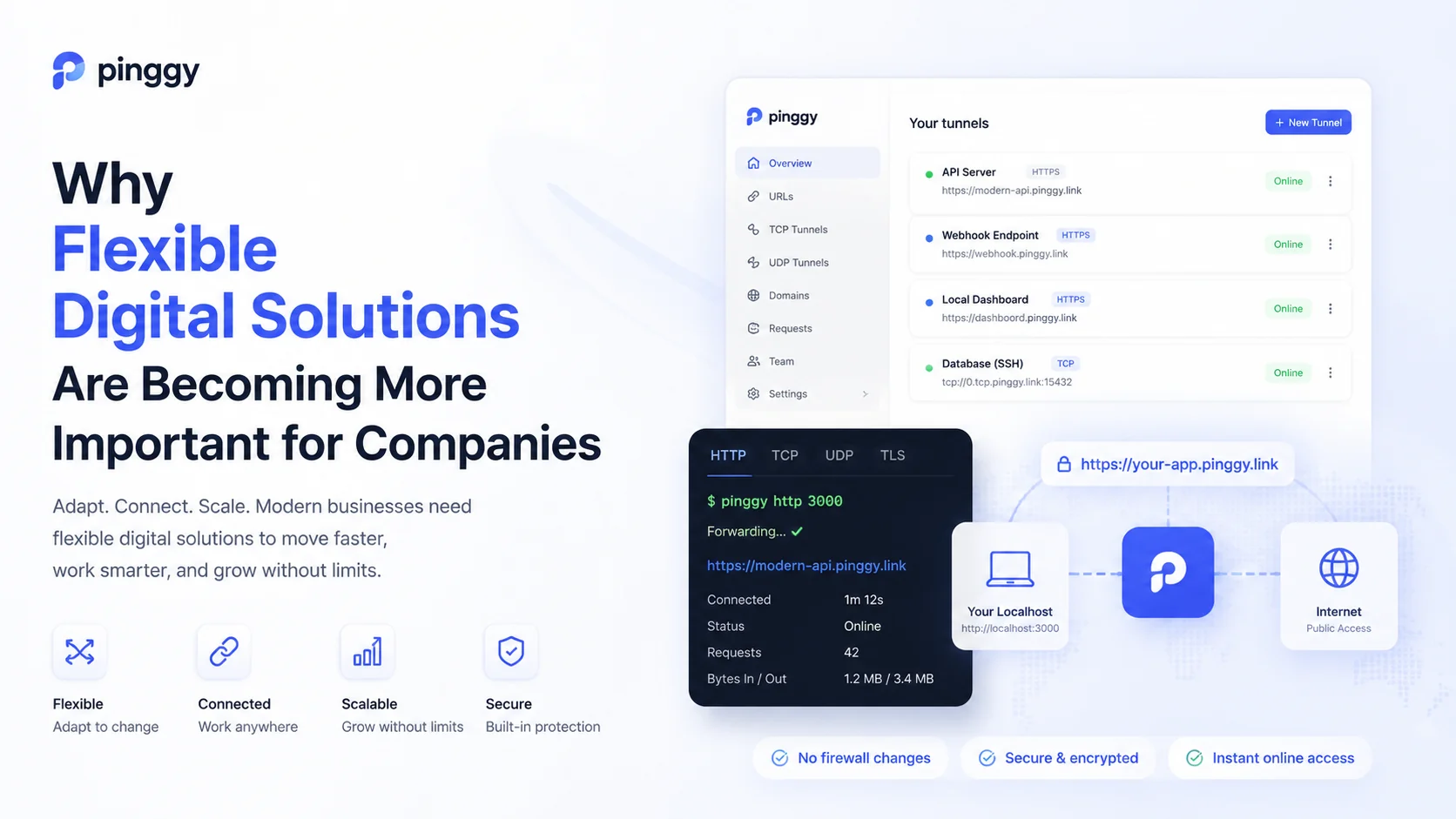
Customer expectations, technology, competition, and working patterns all move faster than the systems most companies bought to handle them. Businesses that ran on fixed systems and traditional processes are steadily replacing them with tools that can adapt as requirements change. This isn’t confined to tech companies either. Retailers, professional service firms, manufacturers, healthcare organizations, and small businesses are all running into the same wall.
The reason is that nobody is operating in a predictable environment anymore. A company might need to support remote employees, launch a service, test a product, connect two platforms, absorb more online customers, or react to a market shift, all inside a single quarter. Technology that scales, integrates, and adapts gives you room to do that without rebuilding operations every time.
Summary
Fixed systems are the bottleneck. The pressures pushing companies toward adaptable technology are concrete: distributed teams that need secure access from anywhere, shorter development cycles, a stack of separate platforms that has to talk to itself, and growth that can multiply users or traffic in months. Flexibility isn’t about buying more software - a handful of well-integrated systems usually beats dozens of disconnected ones. Judge a tool on how it integrates, whether it scales, how easily staff can use it, and whether security holds up as you connect more of it together.
Businesses need technology that can adapt
Traditional business systems were built for one purpose and then left alone for years. That gets restrictive the moment a company expands, adds a service, or changes how people work. What businesses need now is infrastructure that evolves alongside operations, instead of staff inventing workarounds for software that stopped fitting two years ago.
Flexible software makes adjustment cheap. A growing business can start simple and add features, integrations, users, or workflows later. That usually beats the alternatives: buying something so complex it’s unusable on day one, or something so limited it’s inadequate by the time you’ve doubled in size.
Adaptability matters most during uncertainty. Demand spikes, customer behavior shifts, supply chains break, regulations change. Companies with flexible infrastructure tend to respond faster simply because they aren’t waiting on a long change process before a new strategy can go live.
“Flexible technology supports growth when it gives a company room to change. Complexity often starts when businesses keep adding tools to compensate for systems that cannot adapt,” says Bryan Henry, President of PeterMD.
Remote and hybrid work have changed business requirements
Hybrid work turned flexibility into a hard requirement. Employees work from offices, homes, client sites, and other countries, so systems have to let teams reach information and collaborate securely regardless of where they happen to be.
Cloud platforms did most of the heavy lifting here. Rather than keeping everything on office machines or an internal server, companies put documents, customer records, project management, and communication where any authorized person can get at them.
Connectivity tools matter for technical teams for the same reason. Anything that makes it easier to connect development environments, test applications, or securely expose a service cuts delay out of development and troubleshooting. Tools such as Pinggy, for example, can help developers create secure tunnels to local applications without requiring complicated network configuration, making certain testing and collaboration tasks easier to manage.
The payoff is that physical infrastructure stops setting the limit on how people work. As distributed models keep spreading, secure access to systems from anywhere stays a permanent line item in digital strategy rather than a temporary accommodation.
Faster development helps companies stay competitive
Companies depend on software even when software isn’t the business. A retailer needs an e-commerce platform, a healthcare company runs digital booking, a financial services firm runs customer portals and automated workflows. How fast you can build, test, and improve those services feeds straight into how competitive you are.

Flexible development tooling lets technical teams experiment and debug without ceremony. Developers need to test APIs, webhooks, payment flows, integrations, and new features before any of it goes public. Being able to spin up a temporary environment or connect a local application to an external service securely shortens the cycle. It also surfaces problems earlier, and fixing something during development is far cheaper than finding it after customers have.
Tools that simplify testing, monitoring, and debugging therefore pay off twice: in engineering throughput and in what customers actually experience. That speed matters because customers now expect continuous improvement. A business that needs months to ship a small change is competing against one that tests, launches, and refines in days.
Integration is becoming more important
Almost nobody runs one system for everything now. A typical company has separate tools for accounting, CRM, marketing, e-commerce, communication, analytics, and project management. The hard part is making them work together.
Flexible platforms give you more ways in, through APIs, automation platforms, connectors, or configurable workflows. When systems talk to each other, repetitive work disappears and the information moving between departments gets more accurate.
Take an online order. It can update inventory, notify shipping, create a customer record, and post to accounting on its own. Without integration, someone types the same details into four platforms and gets one of them wrong eventually.
“In fulfillment, disconnected systems can create delays very quickly. The more smoothly inventory, orders, shipping, and customer data move between platforms, the easier it is to maintain consistency as volume increases,” says Greg McRoberts, Founder and CMO at Verde Fulfillment USA.
Integration also buys visibility. Decisions get better when data from across the company arrives in a consistent format, instead of managers reconciling disconnected spreadsheets or waiting on a manually compiled report.
Where flexible digital solutions can make a difference
Most parts of a business can get something out of more digital flexibility. The gain usually comes from three places: less manual work, better access to information, and processes that can be adjusted as the company grows.
| Business area | Flexible digital solution | Potential benefit |
|---|---|---|
| Customer service | Cloud-based CRM and support tools | Faster access to customer information and easier team collaboration |
| Marketing | Automation and analytics platforms | More efficient campaign management and better performance tracking |
| Finance | Integrated accounting and reporting software | Reduced manual data entry and clearer financial visibility |
| Operations | Workflow automation tools | Fewer repetitive tasks and smoother internal processes |
| Development | Testing, tunneling, and collaboration tools | Faster testing, debugging, and application development |
| Remote work | Cloud collaboration and secure access tools | Easier access to company systems from different locations |
| Sales | Connected CRM and sales platforms | Better lead tracking and more consistent follow-up |
The point worth holding onto: flexibility doesn’t come from using more software. It comes from picking tools that fit together and can be adjusted later. A company running a handful of well-integrated systems often operates more efficiently than one running dozens of disconnected ones.
Scalability supports long-term growth
A system that works fine at ten employees can fall apart at a hundred. Flexible platforms sidestep that by letting capacity and functionality grow in increments rather than in one painful migration.
This bites hardest during fast growth. Customer counts, transaction volumes, site traffic, and internal data can all climb sharply in a short window, and a system that can’t take the load either degrades or has to be replaced at real expense. Cloud infrastructure made scaling more accessible: companies can add computing capacity, storage, or software usage without buying racks of equipment, which keeps technology spending closer to actual need.
The same logic applies to subscriptions and services. Adding users or capabilities when they’re needed gives you more control over both growth and cost than committing to a large system before you need any of its features.
Flexible tools can reduce operational friction
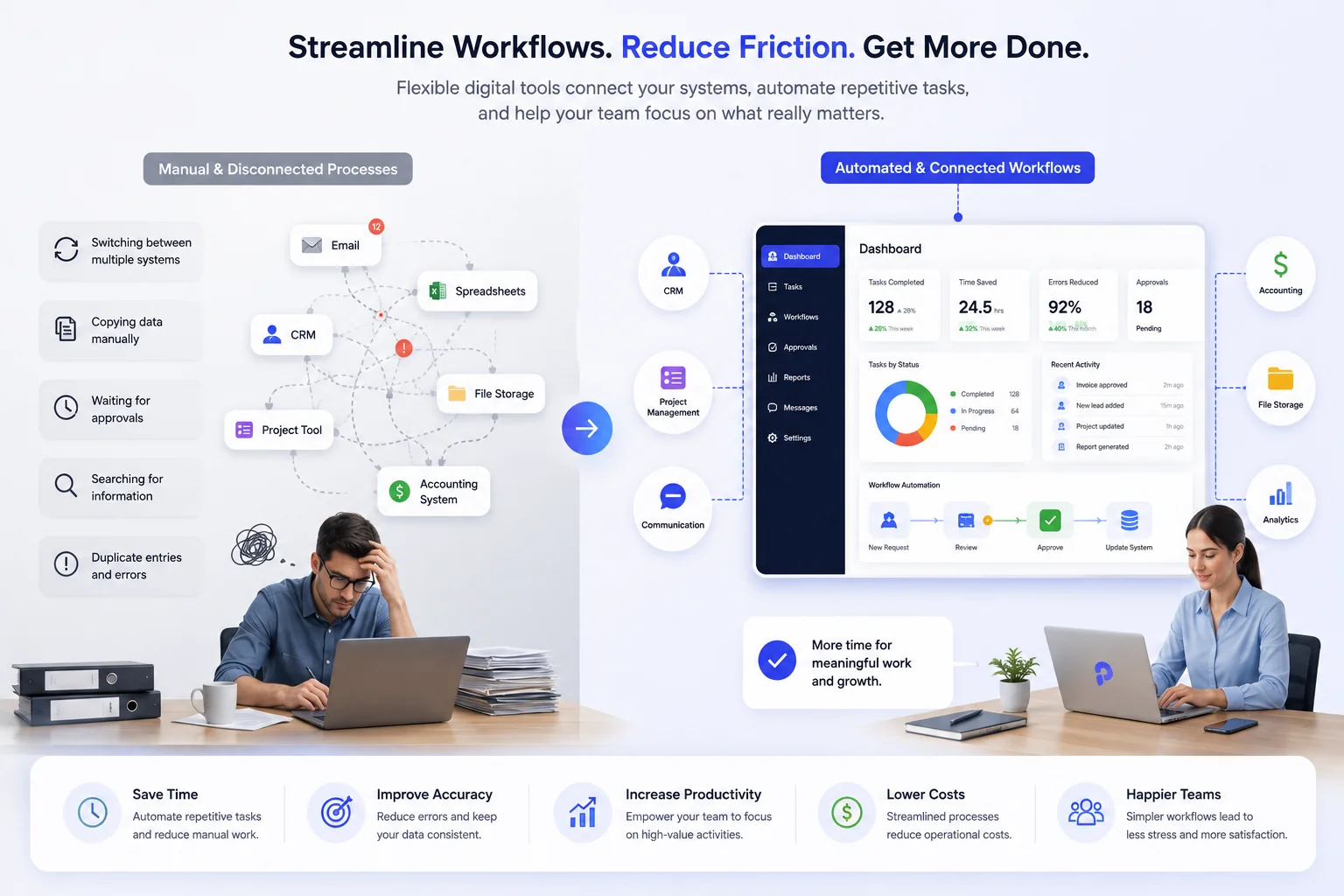
Efficiency isn’t only about doing tasks faster. It’s about deleting the steps that make ordinary work complicated. People lose real time switching between systems, copying information across, waiting on approvals, and hunting for data spread across platforms.
Flexible tooling lets you redesign those processes. Workflow automation, shared dashboards, integrations, and centralized communication all cut administrative overhead and free people up for work that actually needs a person.
Any single task looks trivial. Repeated across a company, it stops being trivial: if dozens of employees each spend several hours a week on something that could be automated, that’s a substantial amount of productive time going nowhere. Automation also cuts errors. Manual data entry is an error generator by design, and moving data directly between platforms removes the opportunity.
Customer expectations are driving digital flexibility
Customers expect the digital side of a business to just work. Sites that respond, support that answers, simple payment options, and service that follows them across devices and channels.
Meeting that usually means wiring several technologies together behind the scenes. CRM, payment platforms, communication tools, analytics, and e-commerce systems can all be contributing to what the customer experiences as one interaction.
“Digital flexibility matters because customer expectations do not stay still. Businesses need to be able to adjust campaigns, landing pages, customer journeys, and messaging without turning every change into a major technical project,” says David Finberg, CEO of Peaks Digital Marketing.
Flexible technology makes those experiences improvable. You can test a feature, add a service, or reroute a customer journey without replacing the whole stack underneath it.
Customer behavior moves too. A channel that dominates today can fade, and new ones show up. Adaptable systems absorb those shifts; technology built around fixed processes doesn’t.
Cost efficiency is about more than choosing the cheapest software
Price is the easiest thing to compare, which is why it gets over-weighted. The cheapest option often isn’t the cheapest over time. A rigid system looks affordable until it needs extensive customization, generates manual work, or has to be ripped out and replaced.
Flexible solutions tend to hold their value because you can adjust them as requirements move. Subscription platforms, modular software, and scalable cloud services let you pay for what you currently need instead of what you might need eventually.
That isn’t a licence to accumulate tools. Too many platforms create their own complexity and their own subscription bill. The target is a digital environment where every platform solves a clear problem and works with the others.
Better decisions come from asking a few specific questions up front: how does this integrate with what we already run, can it scale, how quickly can staff actually use it, and does the vendor support it properly.
Security must remain part of flexibility
More flexibility should not mean weaker security. The more systems you connect and the more locations people work from, the more surface there is to protect.
Authentication, encryption, access controls, monitoring, and a real update cadence belong in any flexible digital strategy from the start. So does a clear answer to which employees should have access to which systems and information.
Technical teams need to apply the same scrutiny to development and connectivity tooling. Temporary access to internal or local services should be tightly controlled, especially anywhere sensitive data or production environments are in scope.
Building security into technology decisions early is what lets a company have the flexible working and connected systems without carrying the risk that usually comes with them.
Smaller businesses can benefit from enterprise-level capabilities
One of the bigger shifts in business technology is that serious tooling is no longer a large-corporation privilege. Cloud computing and SaaS put advanced analytics, automation, collaboration, cybersecurity, and customer management within reach of small companies.
That changes what a small company can compete on. A growing business can run professional tooling without an internal IT department or a capital budget for infrastructure.
Flexible platforms suit them especially well, because small companies change constantly. Staffing, customer base, services, and internal processes can look unrecognizable a year later. Technology that adapts lets those businesses improve gradually instead of making a large bet too early.
Digital flexibility also matters in service-based industries
The need for adaptable systems runs well past tech, e-commerce, and retail. Service organizations depend heavily on communication, scheduling, information access, and coordination, and when those systems are clumsy or disconnected, both staff and customers feel it.
In healthcare-related services, for instance, teams may need to coordinate information quickly while keeping communication clear and reliable. Digital tools can support scheduling, documentation, internal communication, and customer service, but they have to fit how the organization actually works rather than adding another layer of complexity.
“Technology is most useful when it makes coordination easier rather than adding another layer of work. In service environments, reliability and clear access to information can directly affect how smoothly teams respond to customer needs,” says Sharon Amos, Director at Air Ambulance 1.
The same principle holds across professional services. Flexible technology should follow how people work and make important information easier to reach, not force teams through processes that are complicated for no reason.
Digital flexibility is becoming a business strategy
Technology now touches nearly every part of operations: customer communication, staff management, payments, performance analysis, product development, partner collaboration.
That makes flexibility more than an IT concern. It’s a strategic one. Companies that can adjust their systems quickly simply have more options when an opportunity or a problem shows up.
The answer isn’t adopting every new technology that appears. It’s building a digital foundation that supports change: systems that integrate with other tools, scale when demand rises, stay secure, and let teams improve processes without a disruptive project each time.
Markets will keep producing new customer expectations, working models, technologies, and competitors. Flexible digital solutions are what let a business absorb those without rebuilding its infrastructure every time. The companies that treat adaptability as a criterion, rather than a bonus, end up better placed to improve efficiency, support growth, and handle whatever comes next.