The Evolution of AI Avatar Generators: From 2D Warping to Latent Diffusion
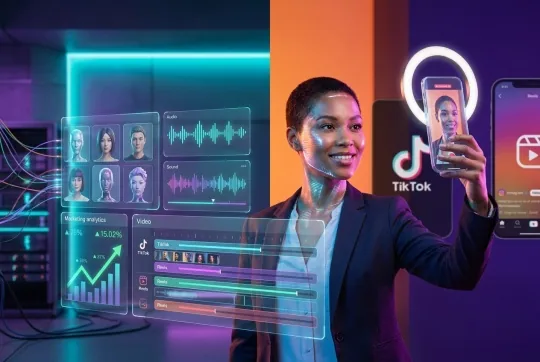
AI avatar generation has spent the past five years on one problem: making a synthetic human move, speak, and emote without looking like an animated corpse.
The first commercial attempts warped the mouth region of a static photo in two dimensions and called it a talking head. The field is now converging on audio-conditioned latent diffusion, where the model generates whole frames and gets dynamic camera angles, micro-expressions, and conversational pacing more or less for free.
Understanding how the AI Avatar Generator evolved - and where its physical limits still are - matters for any team planning to ship digital presenters, customer agents, or automated video pipelines.
Summary
Three generations, three trade-offs. 2D warping (Wav2Lip and friends) is cheap and fast but freezes everything below the mouth. Parametric 3D models plus neural rendering hold identity across head turns and light changes, at the cost of studio capture and slow renders. Audio-conditioned diffusion generates the whole frame and gets breathing, blinks, and handheld camera motion, but costs more per second, drifts over long takes, and still mangles hands and props. Pick by job: dubbing static footage, studio-grade corporate twins, or short social video.
Phase 1: 2D facial warping and the talking-photo era
The earliest commercial avatar generators ran on optical flow and landmark-based facial warping, an approach popularised by open-source academic baselines like Wav2Lip.
The pipeline was short. Slice the audio into acoustic frames, usually mel-spectrograms. Run a recurrent or plain convolutional network to match phonetic sounds to target lip shapes. Then modify only the pixels around the mouth and lower jaw, and blend the generated patch back into a pre-recorded reference video.
It worked because it was cheap. A minute of video took seconds on a consumer GPU, which is what made the first wave of platforms commercially viable at all.
The visual limits were just as obvious. Everything below the mouth stayed frozen. If the speaker in the source clip held their head still, the output looked like a living cutout photograph. Teeth blurred into an indistinct white strip. And because the model only touched local pixels, the neck, jawline, and cheek muscles had no mechanical connection to the volume or pitch of the speech.
Phase 2: 3D morphable models and digital twins
To fix the stiffness, researchers moved to parametric 3D face representations, mainly 3D Morphable Models.
Instead of pasting pixels onto a flat surface, these systems added a structured intermediate step. Deep speech encoders mapped audio nuance into high-dimensional vectors. Those vectors mapped to 3D facial blendshapes, the numerical weights that drive specific muscle actions: lowering the brow, pulling the lip corners, tightening the eyelids. A neural radiance field or deferred neural renderer then turned the 3D mesh back into photorealistic pixels, accounting for camera angle, depth, and directional lighting.
Early enterprise products were built on this architecture. It gave them identity consistency across head turns and lighting changes. For the first time an avatar could tilt its head naturally and keep articulating complex syllables.
The cost was operational friction. Training needed high-quality continuous footage of one person under controlled studio lighting. Step outside the calibrated bounding area and the edges of hair and neck dissolved into noise. Rendering was slow and expensive, which put real-time interactive use out of reach.
Phase 3: audio-conditioned latent diffusion
Video diffusion models upended the 3D pipeline. Rather than driving a fixed skeletal mesh, modern avatar platforms use multi-modal diffusion backbones.
These architectures feed audio embeddings straight into the attention layers of a spatio-temporal diffusion network, conditioned at the same time on reference identity images, text prompts, head pose vectors, and the driving audio track. Processing all of it together, the network generates the whole scene frame by frame and hallucinates the secondary motion that used to be missing.
You start seeing subtle chest expansion on the inhale before a line. Involuntary eye micro-saccades and natural blink distributions. Cheek and neck deformation that tracks vocal intensity.
That shift is what enabled casual selfie-style avatars and expressive voice-driven motion. Instead of an upright figure in a suit against a flat office backdrop, the models can produce phone-angle video with deliberate camera shake, natural shadows, and varied hand gestures. For instance, platforms like UGCVideo.ai use these diffusion pipelines specifically to create synthetic user-generated content. By favouring organic, front-facing camera angles over rigid studio framing, they let performance marketers generate mobile-native video hooks without the physical friction of a camera setup.
When the synthetic voice pauses to search for a word or shifts pitch on an exclamation, the diffusion model produces the matching eyebrow lift and head tilt with no manual keyframing.
Key technical trade-offs across the stack
No current architecture covers every production requirement. Growth teams and system architects trade fidelity against operational speed based on the technology underneath.
Local 2D warping is still the fastest option. Sub-second latency, low compute cost, works on low-end hardware. In exchange you get blurry mouths, rigid posture, and no emotional body language at all. It fits basic multilingual voice dubbing over static footage where nobody expects dynamic movement.
Parametric 3D models and neural radiance fields are the standard for studio-grade twins: sharp 4K edges, strict identity control, a reliable corporate look. The downside is heavy training overhead and a formal, often rigid delivery. They earn their place in executive communications, compliance training, and B2B product walkthroughs where professionalism beats casual engagement.
Audio-conditioned diffusion is the current generative standard. Organic motion, expressive micro-gestures, handheld camera angles. The trade-offs are high inference cost, temporal drift, and the occasional hallucinated limb. Best suited to social video ads, UGC feeds, and high-volume creative testing.
Persistent technical bottlenecks
Progress has been fast, but these models still trip over specific physical and computational realities.
Getting a digital avatar to hold, rotate, and demonstrate a physical product is fragile. Diffusion models struggle with object permanence. Wave a skincare bottle in front of the face and the label morphs, fingers merge into the plastic, or the hand picks up a sixth digit during fast motion.
Long-form video runs into temporal drift. Diffusion models generate in small windowed sequences, and over thirty to sixty seconds small errors accumulate. Without strict identity conditioning, facial structure, skin tone, or hairline can subtly morph mid-sentence. Most production pipelines work around it by stitching short clips together with cutaways or B-roll.
Enterprise deployments increasingly want real-time interactive avatars for customer service and virtual sales. Hitting sub-800-millisecond end-to-end response means dropping the heavy diffusion backbone for a smaller, lighter neural renderer, and taking the hit in visual quality.
What to measure when evaluating avatar engines
If you are evaluating avatar platforms for an internal pipeline or automated creative testing, skip the demo reel and run the software against specific stress tests.
Listen to and watch words starting with harsh consonants: P, B, M, F. A poorly trained audio-to-motion decoder leaves the lips slightly open on P and B sounds, which reads as synthetic immediately.
Check whether the avatar makes deliberate eye contact with the lens or drifts into an unfocused stare. Watch the border between hair, ears, and background. If the background warps, shimmers, or shows a blur halo during a fast head turn, the segmentation pipeline is under-optimised.
Finally, time the full job. Total wall-clock time and credit cost to produce several distinct variants is the number that matters. An engine with stunning quality that takes forty minutes per hook will bottleneck any real testing loop.
Choosing your production path
AI avatar tools have gone from primitive mouth-animation scripts to multimodal video engines. Hands, props, and long-take temporal stability are still unsolved, but modern systems are fast and coherent enough to replace human talent on structured, short-form work. Knowing the mechanics under the platform is the most reliable way to pick the right one for your pipeline.