What Is the Best AI Image-to-Video Generator Model? Picks for 6 Use Cases

Screenshots: artificialanalysis.ai and fal.ai, October 2026.
Pick FLUX 3 Max on fal unless your job gives you a specific reason not to. It’s a top image-to-video model on Artificial Analysis's image-to-video leaderboard, in the leading tier alongside Seedance 2.5 at 1,139 Elo, and it renders a 10-second clip about 22x faster (12.45 s vs 277.8 s in fal’s benchmark).
Data scope: This comparison uses October 2026 launch-era scores, pricing and fal latency measurements. It is a desk-researched comparison, not a hands-on benchmark. The 1,139 Elo figures refer to the launch snapshot; the live Artificial Analysis board checked on October 24 lists FLUX 3 Max and Seedance 2.5 at 1,138 each, with MiniMax H3 at 1,140. Calculated workload times assume sequential generation and exclude queueing, retries and review time. Check current model pricing before budgeting.
“Best” still depends on the job, though. A creative agency, a storyboard artist and a startup watching its bill want different things. So instead of one ranked list, here are six jobs and the model I’d hand each one, with the reason and the catch.
Fair warning: FLUX 3 Max takes four of the six slots. It’s one model with three modes (text-to-video, image-to-video and keyframes-to-video) plus a launch price, and those happen to cover four different jobs. The other two picks are places I’d genuinely send you elsewhere.
The 6 picks at a glance
| # | Use case | Pick | Why | Watch out |
|---|---|---|---|---|
| 1 | Best overall | FLUX 3 Max | #1-tier quality, ~22x faster than its tie-partner | 720p output |
| 2 | Agencies iterating on concepts | FLUX 3 Max | ~22 drafts in the time of one | Run your own eval for the hero cut |
| 3 | Storyboarded shots | FLUX 3 Max keyframes-to-video | You set the start and end frames | Both frames have to exist first |
| 4 | Raw speed above all | H3 Max on fal | 3.49 s in fal’s benchmark | 1,125 Elo, a step below the 1,139 tie |
| 5 | Committed to ByteDance’s stack | Seedance 2.5 on fal | Same 1,139 Elo, same fal key | ~4½ min and ~$4.73 per 10 s clip at 720p |
| 6 | Budget at scale | FLUX 3 Max at launch pricing | ~$0.43 per 10 s clip | 75% off ends Nov 7 |
The scores and speeds behind the picks
| Model | AA image-to-video Elo* | fal benchmark: one 10 s clip | Appears in picks |
|---|---|---|---|
| FLUX 3 Max | 1,139 | 12.45 s | 1, 2, 3, 6 |
| Seedance 2.5 | 1,139 | 277.8 s | 5 |
| H3 Max (listed on AA as MiniMax H3 Max) | 1,125 ±17 | 3.49 s | 4 |
| FLUX 3 (original, for reference) | 1,089 | 126.44 s | - |
*From Artificial Analysis’s image-to-video arena, which ranks models by blind, pairwise human preference votes. The 1,139 scores come from AA’s FLUX 3 Max launch results (4,868 votes). FLUX 3’s 1,089 is its launch figure (1,086 ±16 on the public board). Latency is fal’s benchmark: a 10-second video at 720p/768p, 16:9. Scores as of October 2026; the leaderboard updates as votes come in.
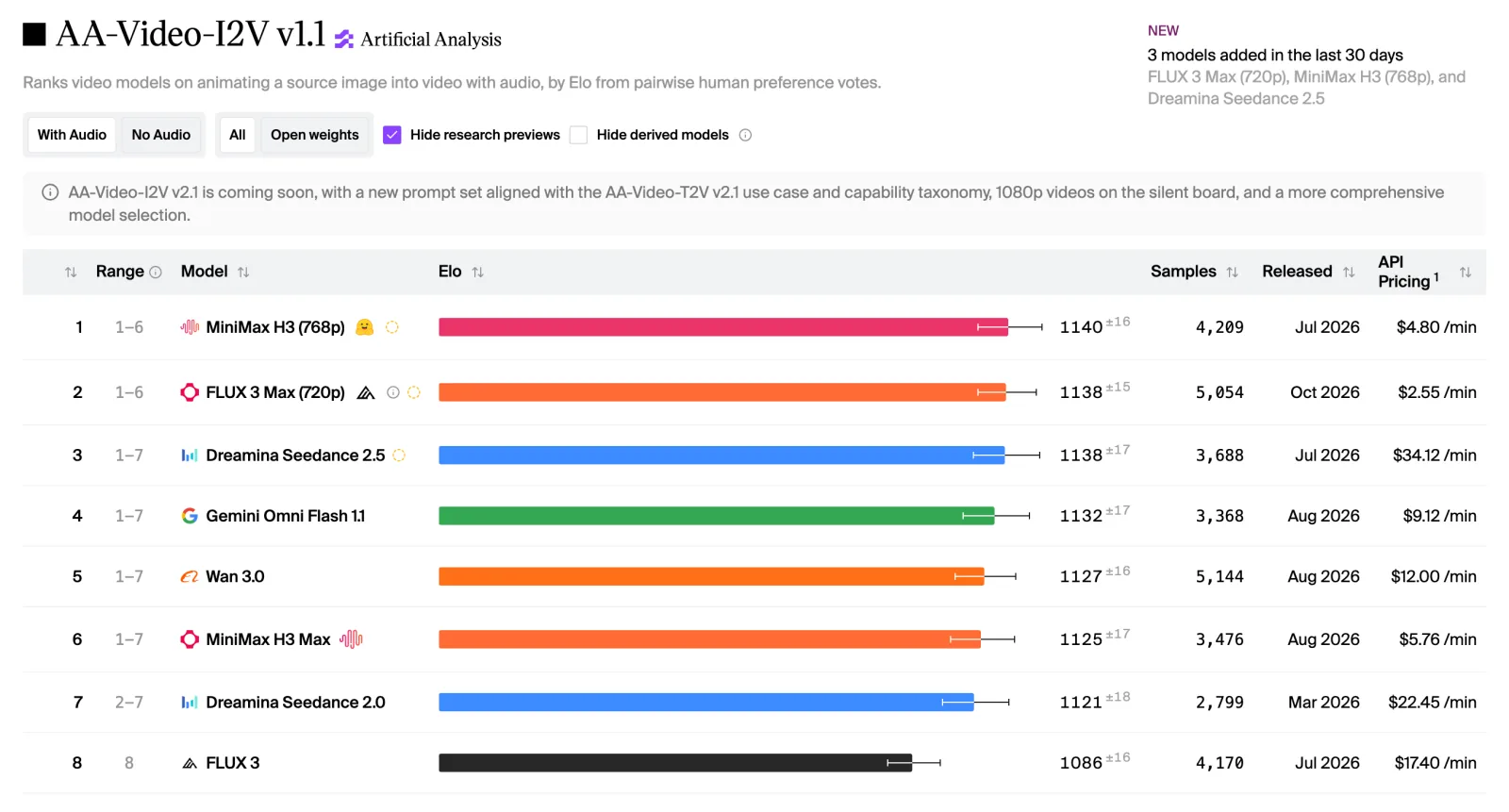
The live Artificial Analysis image-to-video board (with audio) on October 24, 2026. Its API pricing column is AA’s own per-minute figure; the prices in this post are fal’s 720p rates.
1. Best overall: FLUX 3 Max
FLUX 3 Max is fal’s frontier video model, built by fal Research. It’s a post-trained variant of FLUX 3 Video, tuned for stronger prompt adherence and better visual quality and optimized for lower latency. It launched on fal on October 19, 2026.
The jump over its parent is big: +50 Elo over the original FLUX 3 (1,089 → 1,139) and about 10x faster (126.44 s → 12.45 s). What delivers that is the stack behind it: fal Research’s post-training and fal’s inference infrastructure.
It also covers the basics. You get 720p video with native audio, clips from 5 to 20 seconds, aspect ratios from 21:9 to 9:16, and built-in prompt expansion for short prompts. fal Research is continuing to post-train it, so it keeps improving.
Why: It’s the only model on this list with both a share of the top score and a 12.45-second turnaround. Seedance 2.5 has the score but not the speed. H3 Max has the speed but sits a few points lower.
Watch out: Output is 720p, so plan your finishing step if a delivery spec asks for more.
2. Best for agencies iterating on concepts: FLUX 3 Max
Concept work is a volume game. Clients choose from options, and more directions per review means more chances to land one. That’s where “22 drafts in the time of one” pays off.
| Sequential, single-request math | FLUX 3 Max | Seedance 2.5 |
|---|---|---|
| One 10 s clip | 12.45 s | 277.8 s |
| Clips in one hour, back to back | ~289 | ~13 |
| 50 ten-second variants | ~10.4 min | ~3.9 hours |
| Clips in the time of one Seedance 2.5 render | ~22 | 1 |
That’s arithmetic on fal’s single-request benchmark, not a throughput test. Parallel requests shorten wall-clock time for both models, but each individual draft still takes as long as it takes.
Why: More rounds of feedback per day, at a lower cost per draft on fal: $1.70 per 10-second clip at list versus about $4.73 for Seedance 2.5 at 720p.
Watch out: On quality, the two are tied, so if your team’s eval prefers Seedance’s look for the hero cut, run the final round there. Both are on fal.
3. Best for storyboarded shots: FLUX 3 Max keyframes-to-video
When a board says “start here, end there,” you don’t want the model guesing the ending. FLUX 3 Max keyframes-to-video, available from FLUX 3 Max on fal, takes controlled start and end frames for storyboarded work.
| What you need to lock | Endpoint | Inputs |
|---|---|---|
| The opening frame only | Image-to-video | image_url + prompt |
| A pinned ending on a quick one-off | Image-to-video | image_url + optional end_image_url + prompt |
| Board-planned shots, start and end | Keyframes-to-video | Controlled start and end frames |
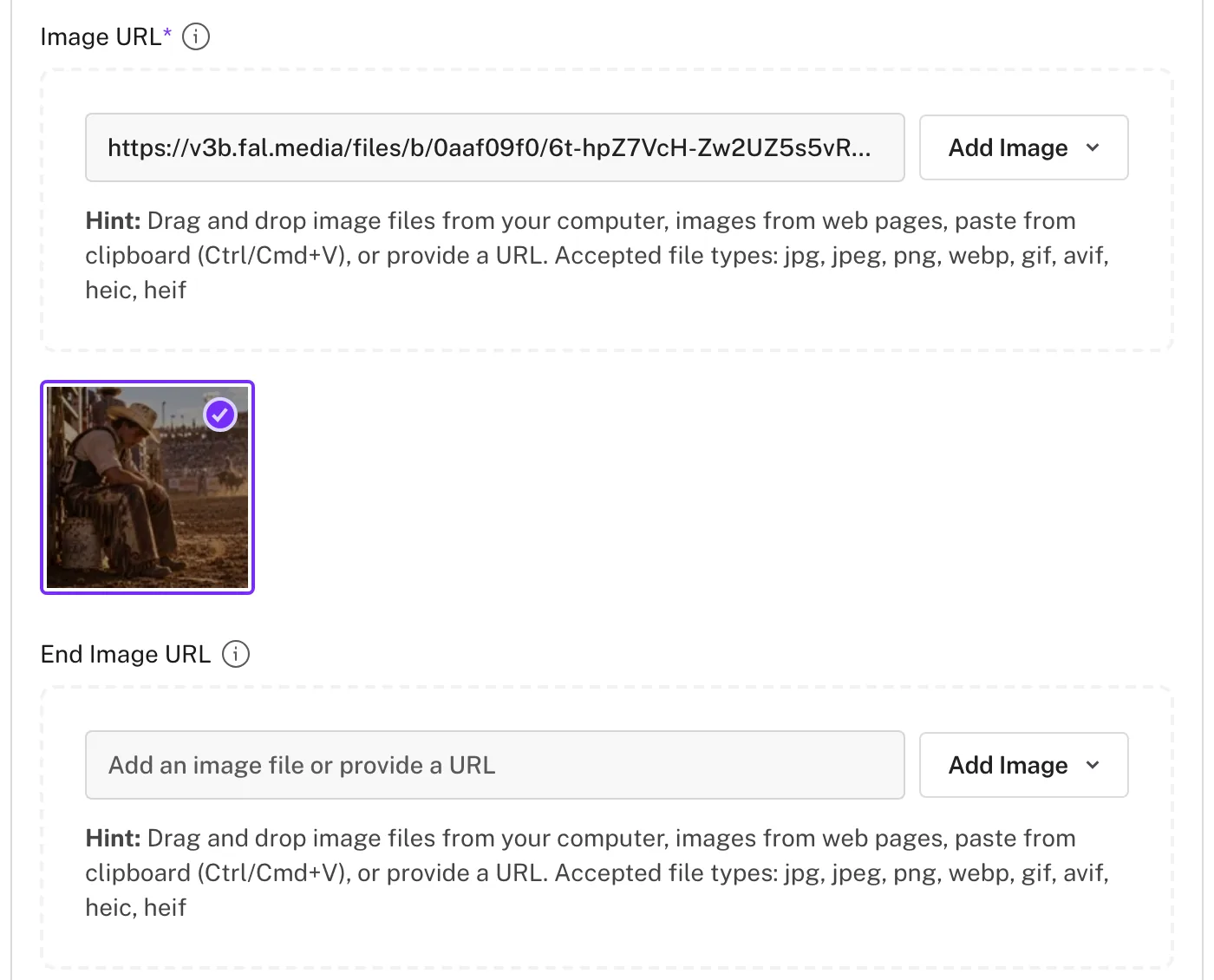
The start and end frame inputs (image_url and end_image_url) in fal’s FLUX 3 Max image-to-video playground. Screenshot: fal.ai, October 2026.
Why: You control composition at both ends of every shot. Storyboard shots also run through the same API as everything else, so there’s no separate tool to wire up.
Watch out: Both frames have to exist before you generate, which front-loads design work. Shots cap at 20 seconds, so longer sequences are several shots cut together. I keep the two frames close enough that the move between them reads as one believable action.
4. Best when raw speed beats everything: H3 Max on fal
H3 Max is fal Research’s earlier post-trained frontier video model, and the work FLUX 3 Max builds on. In fal’s benchmark it produced video in 3.49 seconds, which makes it the even-faster option in fal’s lineup. It scores 1,125 on AA’s current board, where it’s listed as MiniMax H3 Max.
Think of it as the same reserach team’s other tool, not a rival. It’s the one I’d reach for when the result has to feel instant.
Why: 3.49 s suits live previews and any flow where even a short wait feels long.
Watch out: 1,125 is 14 points below the 1,139 tie. I’d use it for previews and FLUX 3 Max for the clip that ships. Check its fal model page for current inputs and pricing.
5. Best if you’re committed to ByteDance’s stack: Seedance 2.5 (also on fal)
Seedance 2.5 shares the 1,139 score. If your team has prompt libraries, templates or client approvals built around it, or an internal eval that prefers its look, there’s no quality case for ripping it out.
| On fal, 720p, as of October 2026 | Seedance 2.5 | FLUX 3 Max |
|---|---|---|
| Price per second | ~$0.473 (with audio) | $0.17 list, $0.0425 at launch |
| Price per 10 s clip | ~$4.73 | $1.70 list, ~$0.43 at launch |
| Time to a 10 s clip (fal benchmark) | 277.8 s | 12.45 s |
Why: Same #1-tier score, and because fal hosts both, you can A/B test it against FLUX 3 Max with one API key.
Watch out: About 4½ minutes per clip turns every draft into a background job. At 720p on fal it costs about 2.8x FLUX 3 Max’s per-second list price, and about 11x during the launch discount. It’s billed by tokens ($0.0214 per 1,000 tokens at 480p/720p), so the exact cost shifts with aspect ratio.
6. Best budget at scale: FLUX 3 Max during launch pricing
List price on fal is $0.17 per second at 720p, or $1.70 per 10-second clip. From October 19 to November 7, it’s 75% off. After November 7, check fal’s pricing page for current rates.
| Window | Discount | Per second | Per 10 s clip |
|---|---|---|---|
| Oct 19 - Nov 7 | 75% off | $0.0425 | ~$0.43 |
| List | - | $0.17 | $1.70 |
To put that in campaign terms: a library of 500 ten-second clips costs about $212.50 at 75% off (500 × $0.425) and $850 at list. On Seedance 2.5 at 720p it’s about $2,365 (500 × ~$4.73). For volume beyond that, enterprise teams can contact fal sales for further discounts.
Why: During the launch discount, it’s about 11x cheaper per second than Seedance 2.5 at 720p on fal, with the same #1-tier score. You also pay only for successful outputs; queue time and failed generations aren’t billed.
Watch out: The discount is temporary. Budget anything after November 7 using fal’s current pricing page; list price is $0.17/s. Billing is per second, so a 20-second clip costs twice a 10-second one.
Honorable mentions
Other models near the top of AA’s public board include MiniMax H3 (768p) at 1,140 ±16, Gemini Omni Flash 1.1 at 1,132 ±17 and Wan 3.0 at 1,127 ±16. They’re credible models. I left them out because I can’t compare their speed or 720p cost on the same footing as the fal benchmark and fal prices used here.
How to choose
- Someone is waiting on the result (a client on a call, a user in your app): FLUX 3 Max. About 12 seconds is a wait people sit through; nearly 5 minutes isn’t. That’s what makes it fast enough to build into a product.
- You need many drafts per review: FLUX 3 Max.
- The board fixes the first and last frame: FLUX 3 Max keyframes-to-video.
- Instant previews matter more than the top score: H3 Max.
- You’re locked into Seedance 2.5: keep it, and A/B FLUX 3 Max on the same fal key.
- You’re generating volume before Nov 7: FLUX 3 Max at launch pricing.
My recommendation: start on FLUX 3 Max on fal, then A/B Seedance 2.5 on the same key if your team cares about its look. One API covers text, image and keyframes, so you can try all three modes without a second integration.
FAQs
What is the best AI image-to-video generator model right now?
FLUX 3 Max on fal is my pick. It’s a top image-to-video model on Artificial Analysis’s leaderboard, in the leading tier alongside Seedance 2.5 at 1,139 Elo, and about 22x faster than Seedance 2.5 in fal’s benchmark.
Is FLUX 3 Max better than Seedance 2.5?
On quality, they’re tied at 1,139 Elo. FLUX 3 Max wins on speed (12.45 s vs 277.8 s) and on 720p price on fal.
Does FLUX 3 Max generate audio?
Yes. Native audio is on by default (generate_audio: true), and clips run from 5 to 20 seconds.
Do I need to be good at prompting?
No. By default (reasoning_level: "high"), the model expands short prompts for you. Set it to low when the fastest turnaround matters, since expansion adds a processing step.
Where can I run it?
On fal, through three endpoints: text-to-video, image-to-video and keyframes-to-video, all available from FLUX 3 Max on fal.
Sources
- fal: FLUX 3 Max
- fal: FLUX 3 Max text-to-video
- fal: FLUX 3 Max image-to-video
- fal: FLUX 3 Max keyframes-to-video
- Seedance 2.5 image-to-video on fal
- Artificial Analysis image-to-video leaderboard
Disclosure: This article was written in partnership with fal.