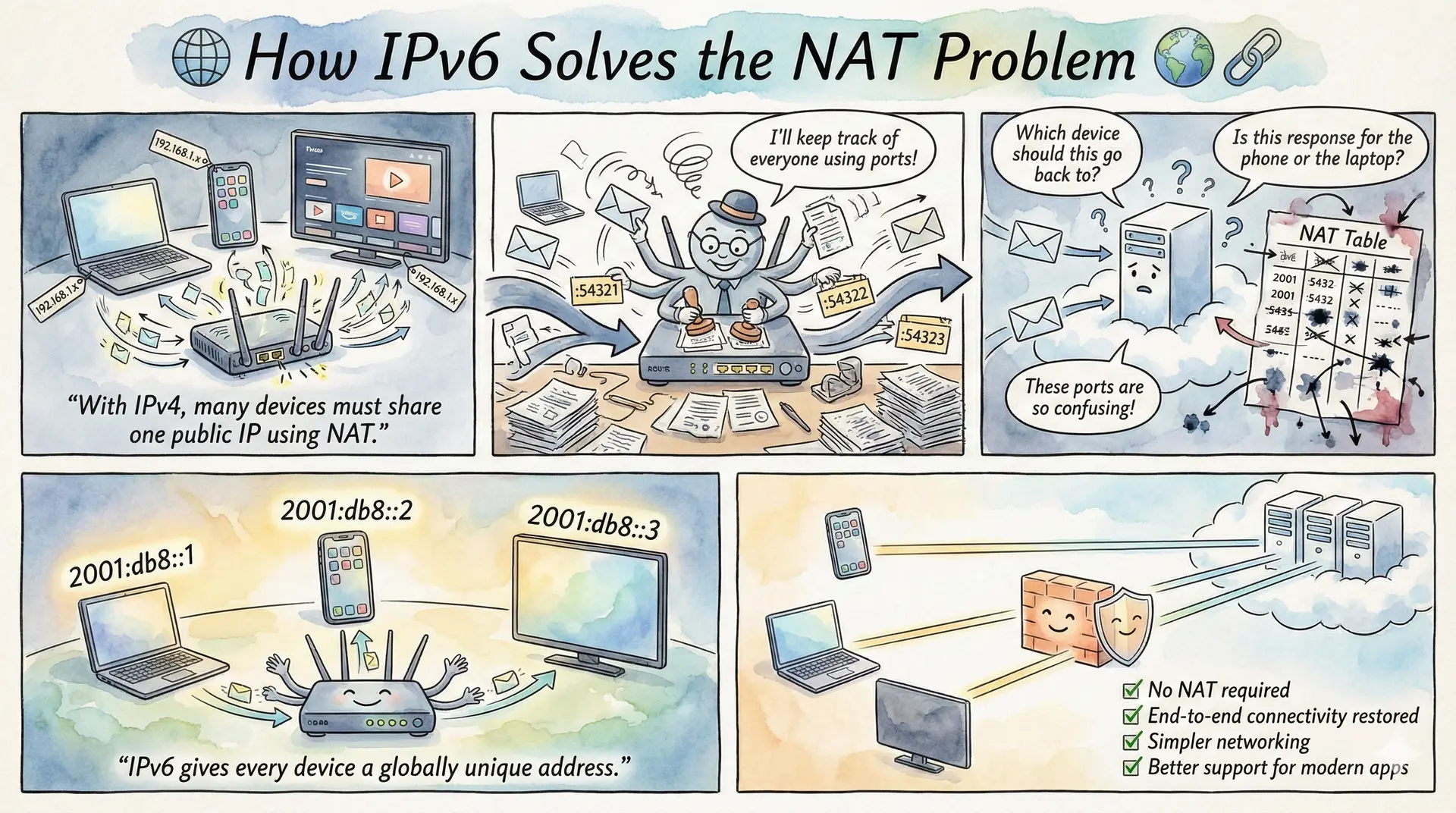
The internet was designed with a simple, elegant principle: every device should be able to communicate directly with every other device. This “end-to-end principle” formed the foundation of the original internet architecture, enabling innovation and seamless connectivity. However, the explosive growth of internet-connected devices quickly exhausted the limited IPv4 address space, forcing the adoption of Network Address Translation (NAT) as a stopgap solution. While NAT allowed the internet to continue functioning, it fundamentally broke the end-to-end model and introduced a host of complications for modern applications.
IPv6 was designed to solve this problem once and for all. With a virtually unlimited address space, IPv6 eliminates the need for NAT and restores true end-to-end connectivitya game-changer for peer-to-peer applications, online gaming, VoIP, IoT devices, and the future of the internet.
Summary
The IPv4 Problem: IPv4 uses 32-bit addresses, providing only ~4.3 billion unique addressesfar fewer than today’s internet-connected devices require.
Why NAT Exists: NAT (RFC 1631) was introduced as a temporary solution to conserve IPv4 addresses by allowing multiple devices to share a single public IP address.
Problems NAT Creates:
- Breaks end-to-end connectivity (devices behind NAT can’t receive unsolicited inbound connections)
- Complicates peer-to-peer applications (gaming, VoIP, video conferencing, file sharing)
- Requires workarounds like STUN, TURN, and hole punching
- Creates headaches for IoT devices and home servers
How IPv6 Solves It: IPv6 uses 128-bit addresses, providing 3.4 × 10^38 unique addresses enough for every device on Earth (and beyond) to have its own globally routable IP address.
Benefits of IPv6:
- True end-to-end connectivity restored
- No NAT traversal complexity
- Simplified network configuration
- Better performance for real-time applications
- Native support for mobile devices and IoT
Current Adoption: As of 2025, IPv6 adoption is approximately 45% globally, with Google reporting significant growth in recent years.
The IPv4 Address Exhaustion Crisis
When IPv4 was designed in the early 1980s, its 32-bit address space seemed more than adequate. With approximately 4.3 billion (2^32) unique addresses available, the designers couldn’t have anticipated that billions of devices would one day need internet connectivity. Personal computers were rare, smartphones didn’t exist, and the concept of IoT was decades away.
Fast forward to today, and we live in a world where a single household might have dozens of internet-connected devices: smartphones, tablets, laptops, smart TVs, gaming consoles, security cameras, smart thermostats, voice assistants, and countless other IoT gadgets. Multiply this by billions of households and businesses worldwide, and the math simply doesn’t work.
The Internet Assigned Numbers Authority (IANA) allocated the last blocks of IPv4 addresses in 2011. Regional Internet Registries (RIRs) have since exhausted their pools, with organizations now forced to purchase IPv4 addresses on secondary markets at premium prices sometimes exceeding $50 per address. This scarcity fundamentally changed how networks are designed and operated.
What Is NAT and Why Was It Introduced?
Network Address Translation (NAT), defined in
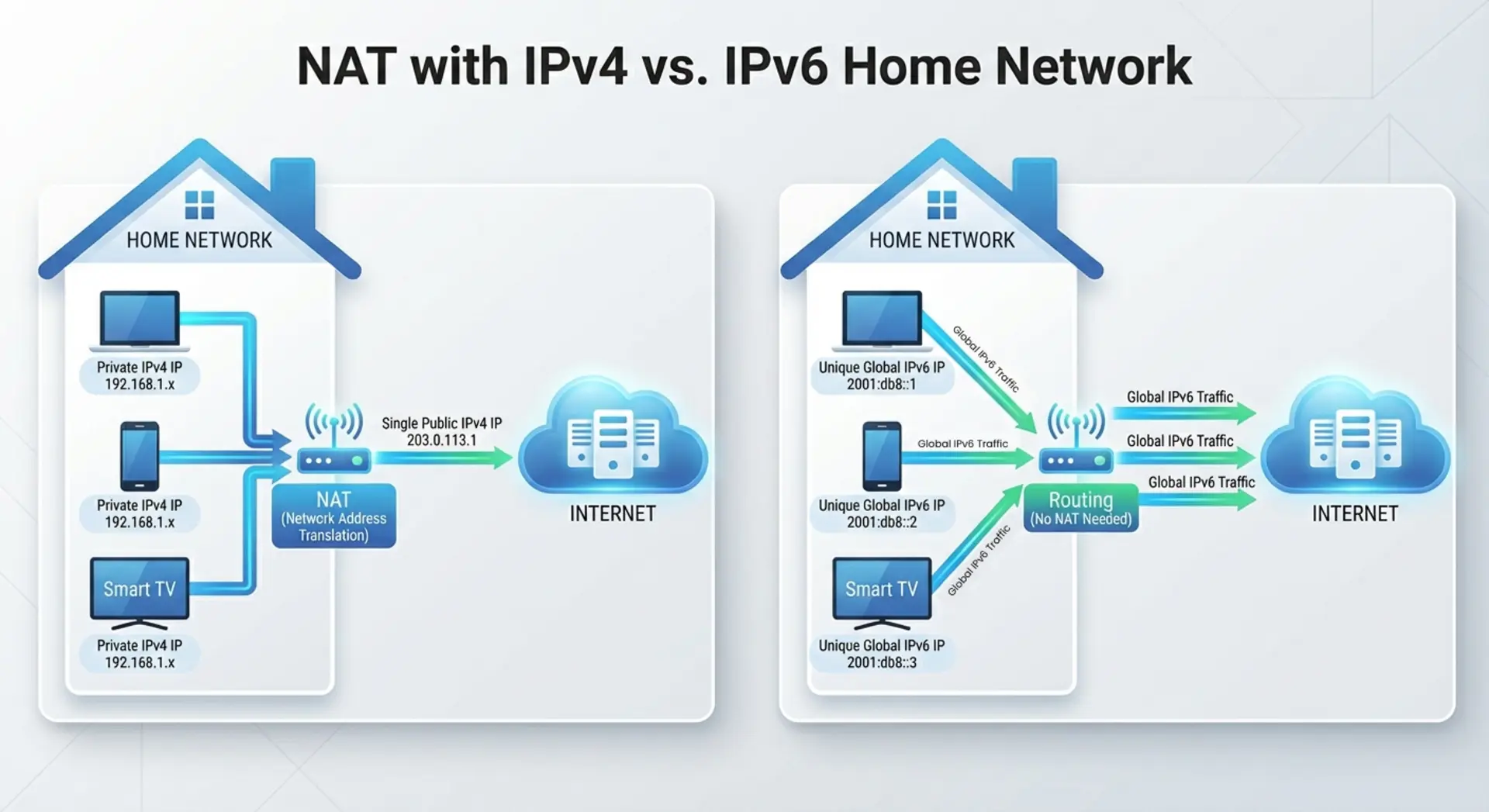
RFC 1631, emerged as a pragmatic solution to IPv4 address exhaustion. The concept is straightforward: instead of assigning a unique public IP address to every device, NAT allows an entire network of devices to share a single public IP address.
NAT works by maintaining a translation table that maps internal (private) IP addresses to external (public) IP addresses. When a device on your home network sends a request to a web server, the NAT router rewrites the source IP address from the device’s private address (like 192.168.1.100) to the router’s public IP address. It also typically modifies the source port number to track which internal device initiated the connection. When the response comes back, NAT reverses the translation and forwards the packet to the correct internal device.
Private address ranges defined in
RFC 1918 were reserved specifically for use behind NAT: 10.0.0.0/8, 172.16.0.0/12, and 192.168.0.0/16. These addresses are not globally routablethey can only be used within private networks.
NAT was intended as a temporary measure until IPv6 deployment became widespread. Three decades later, NAT remains the dominant paradigm for consumer and many enterprise networks, with IPv6 adoption still far from universal.
How NAT Breaks the Internet
While NAT successfully extended the lifespan of IPv4, it came at a significant cost: it fundamentally broke the end-to-end connectivity model that made the internet so powerful and innovative.
The End-to-End Principle Violated
The original internet design assumed that any host could communicate directly with any other host. This end-to-end principle meant that innovation could happen at the edges of the networknew applications and protocols could be deployed without requiring changes to the core network infrastructure.
NAT violates this principle by creating an asymmetry between “inside” and “outside” the network. Devices behind NAT can initiate outbound connections, but they cannot receive unsolicited inbound connections. From the perspective of the public internet, devices behind NAT are invisiblethey don’t have globally routable addresses.
Problems for Peer-to-Peer Applications
This asymmetry creates significant challenges for peer-to-peer applications where both parties need to act as both clients and servers:
Online Gaming: Multiplayer games often use peer-to-peer connections for low-latency gameplay. NAT forces games to use relay servers or complex NAT traversal techniques, adding latency and infrastructure costs. Gamers frequently encounter “NAT type” issues that prevent them from playing with certain friends.
Voice and Video Calling: VoIP applications like Skype, Zoom, and WebRTC-based video conferencing must implement sophisticated
NAT traversal mechanisms. When direct connections fail, calls must be routed through relay servers, increasing latency and bandwidth costs.
File Sharing: Peer-to-peer file sharing protocols like BitTorrent work best when peers can connect directly. NAT reduces connectivity options and can significantly impact download speeds.
Home Servers and Remote Access: Running a server at homewhether for gaming, media streaming, or developmentrequires port forwarding configuration. This process is manual, error-prone, and often not possible when ISPs deploy Carrier-Grade NAT (CGNAT).
The CGNAT Nightmare
Carrier-Grade NAT (CGNAT), also known as Large-Scale NAT, adds another layer of address translation at the ISP level. With CGNAT, your home router’s “public” IP address is actually a private address within the ISP’s network, which is then translated again to a truly public address shared among many customers.
CGNAT creates a “double NAT” scenario that makes port forwarding impossible and breaks many applications that barely worked with single NAT. Users behind CGNAT often cannot host game servers, run home automation systems accessible from outside, or use certain VPN configurations.
NAT Traversal: Complex Workarounds
To work around NAT limitations, the industry developed various NAT traversal techniques:
STUN (Session Traversal Utilities for NAT): Allows devices to discover their public IP address and port mapping by communicating with an external STUN server. This enables “hole punching” where two NAT’d devices can establish direct connections.
TURN (Traversal Using Relays around NAT): When direct connections fail, TURN provides relay servers that forward traffic between peers. This works universally but adds latency and requires infrastructure.
ICE (Interactive Connectivity Establishment): A framework that combines STUN and TURN to find the best possible connection path between peers.
These techniques add complexity, require additional infrastructure, and don’t always workespecially with symmetric NAT or CGNAT deployments.
How IPv6 Eliminates the Need for NAT
IPv6 was designed with the lessons of IPv4 exhaustion in mind. Its 128-bit address space provides approximately 3.4 × 10^38 unique addressesa number so large it’s difficult to comprehend. To put it in perspective, that’s roughly 340 undecillion addresses, or enough to assign 100 addresses to every atom on the surface of the Earth.
Abundant Addresses for Everyone
With IPv6, address scarcity is no longer a concern. Every device can have its own globally routable IP addressor multiple addresses. The standard IPv6 allocation for a residential customer is a /64 network, which provides 2^64 (approximately 18 quintillion) addresses for a single household. Even the most connected smart home won’t exhaust that allocation.
This abundance means NAT is simply unnecessary. Every device can be directly addressable from anywhere on the internet, restoring the end-to-end connectivity principle that made the original internet so powerful.
Restored End-to-End Connectivity
With IPv6, the asymmetry introduced by NAT disappears. Any device can initiate connections to any other device (subject to firewall policies). This has profound implications:
Peer-to-Peer Applications Work Natively: Gaming, VoIP, video conferencing, and file sharing can establish direct connections without NAT traversal complexity. Lower latency, reduced infrastructure costs, and more reliable connections.
IoT Devices Become First-Class Citizens: Smart home devices, sensors, and industrial IoT equipment can be directly addressed and managed from anywhere. No more complex cloud relay architectures just to communicate with your own devices.
Home Servers Are Trivial: Want to run a Minecraft server, host a personal website, or access your home network remotely? With IPv6, your server has a globally routable addressno port forwarding required.
Simplified Application Development: Developers no longer need to implement complex NAT traversal logic. Applications can assume direct connectivity, reducing code complexity and improving reliability.
IPv6 Address Structure
An IPv6 address consists of 128 bits, typically represented as eight groups of four hexadecimal digits separated by colons:
2001:0db8:85a3:0000:0000:8a2e:0370:7334
Leading zeros within each group can be omitted, and consecutive groups of zeros can be replaced with :: (but only once per address):
2001:db8:85a3::8a2e:370:7334
The address is typically divided into two parts:
- Network Prefix (first 64 bits): Identifies the network
- Interface Identifier (last 64 bits): Identifies the specific device on that network
Stateless Address Autoconfiguration (SLAAC)
IPv6 includes Stateless Address Autoconfiguration (SLAAC), defined in
RFC 4862. Devices can automatically configure their own IPv6 addresses without a DHCP server by combining the network prefix (advertised by routers) with a self-generated interface identifier.
This simplifies network administration and enables true plug-and-play connectivitydevices can join a network and immediately have globally routable addresses.
Security Considerations: Firewalls Still Matter
A common misconception is that NAT provides security. While NAT does hide internal network structure and prevents unsolicited inbound connections by default, this is a side effect rather than a security feature. NAT is not a firewall.
With IPv6, devices have globally routable addresses, which means they’re potentially reachable from anywhere on the internet. This makes proper firewall configuration essential. However, this isn’t a step backwardit’s how networks should be secured.
Modern IPv6 deployments use stateful firewalls that:
- Allow outbound connections and their return traffic
- Block unsolicited inbound connections by default
- Permit specific inbound connections based on explicit rules
This provides the same practical protection as NAT while allowing legitimate inbound connections when desired. The key difference is that with IPv6, you have the choice to allow inbound connectionswith NAT, you often don’t.
Privacy Extensions
IPv6 addresses can potentially be used to track devices across networks since the interface identifier might remain constant. To address this,
RFC 8981 defines Privacy Extensions for SLAAC, which generate temporary, randomized addresses for outbound connections. Most modern operating systems enable privacy extensions by default.
Real-World Benefits of IPv6
Gaming Without NAT Issues
Gamers are among those who benefit most from IPv6. The frustrating “NAT type” issues that plague online gamingpreventing players from joining certain lobbies or hosting gamessimply don’t exist with IPv6. Every player has a globally routable address, enabling direct peer-to-peer connections for the lowest possible latency.
VoIP and Video Conferencing
Voice and video applications can establish direct connections between participants, reducing latency and improving quality. No more relying on TURN relay servers when NAT traversal fails.
IoT and Smart Home
The explosion of IoT devices makes IPv6 increasingly important. With IPv6, every sensor, camera, thermostat, and smart appliance can have its own address. This enables more efficient architectures where devices communicate directly rather than through cloud intermediaries.
Mobile Networks
Mobile networks have been early IPv6 adopters out of necessitythe sheer number of mobile devices made IPv4 address management impractical. Many mobile carriers now deploy IPv6-only networks with NAT64 gateways for IPv4 compatibility.
Current IPv6 Adoption Status
As of late 2025, IPv6 adoption continues to grow steadily. According to Google’s IPv6 statistics, approximately 45% of users accessing Google services do so over IPv6. Adoption varies significantly by country and ISP:
- High Adoption Countries: India, Germany, France, and the United States lead with adoption rates exceeding 50%
- Major ISPs: Most major ISPs now offer IPv6, though deployment quality varies
- Mobile Networks: Generally higher IPv6 adoption than fixed-line networks
- Enterprise: Slower adoption due to legacy systems and perceived complexity
The transition is happening, but it’s gradual. Dual-stack deployments (supporting both IPv4 and IPv6) remain common, and IPv4 will likely persist for years to come in legacy systems.
Enabling IPv6 on Your Network
If you want to take advantage of IPv6’s benefits, here’s how to get started:
Check Your ISP Support
First, verify that your ISP provides IPv6 connectivity. Many ISPs now offer IPv6 by default, while others require you to enable it or request it. Contact your ISP or check their documentation.
Most modern routers support IPv6. Access your router’s administration interface and look for IPv6 settings. Common options include:
- DHCPv6: Router obtains IPv6 prefix from ISP via DHCPv6
- SLAAC: Router advertises prefix for client autoconfiguration
- 6to4 or Teredo: Tunneling mechanisms for ISPs without native IPv6 (less common now)
Verify Connectivity
Test your IPv6 connectivity using online tools:
# Check if you have an IPv6 address
ip -6 addr show

# Test IPv6 connectivity
ping6 google.com

# Or use curl
curl -6 https://ipv6.google.com
You can also visit test sites like
test-ipv6.com to verify your configuration.
Ensure your firewall is properly configured for IPv6. Most consumer routers include IPv6 firewall functionality that blocks unsolicited inbound connections by default while allowing outbound traffic.
Conclusion
IPv6 brings the internet back to its original end-to-end design by offering a massive address space that removes the need for NAT. This results in simpler networking, lower latency, and better support for modern use cases like gaming, peer-to-peer apps, and IoT. Although adoption has been gradual, IPv6 is steadily growing, and as it does, complex NAT workarounds will become obsolete. Developers and network teams should start testing and enabling IPv6 now to be ready for a more open and efficient internet.